

By Dr. Elinor Garely
A Region Seeking Recognition
Romagna, in northeastern Italy and part of the broader EmiliaRomagna region, remains undertheradar in global wine conversations. Positioned between the industrial heartland of Emilia and the star power of Tuscany, Romagna offers diverse terroirs, foodfriendly wines and an emerging narrative of quality and sustainability.
In 2024, Emilia-Romagna produced approximately 6.9 million hectoliters of wine, accounting for 14 percent of Italy’s total wine volume, according to Notizie Al Vino. Despite its quiet reputation, the region’s wine exports reached roughly US $500 million, in the twelve months ending December 2024. a modest 0.6 percent increase over the previous year, as reported by Emilia Romagna Vini.
These figures underscore a paradox: Romagna contributes meaningfully to Italy’s wine economy, yet its identity remains underrepresented in global wine discourse. For small producers like Chiara Condello, this disconnect is both challenge and opportunity. Her work in Predappio doesn’t just reflect regional output—it redefines it, proving that civic clarity and terroir precision can thrive even in the shadows of louder appellations.
Romagna holds an important milestone in Italian wine history: the white wine Romagna Albana DOCG (formerly Albana di Romagna) was awarded DOCG status in 1987, the first Italian white wine so classified. Key grape varieties include Sangiovese di Romagna, Trebbiano, Pagadebit and Cagnina.
Strengths
Romagna’s appeal lies in its combination of terroir, tradition and scale. Sangiovese di Romagna often offers more moderate extraction, balanced acidity and refined tannins compared with heavier styles elsewhere. The Albana DOCG shows both dry and passito styles, offering foodwine versatility and, in the best cases, ageing potential. Passito (airdried grapes) wines concentrate sugars, acids and aroma through appassimento, enhancing depth and complexity. Increasingly, producers adopt organic farming, native‐yeast fermentation and lowintervention techniques, positioning Romagna as relevant in the sustainabilityfocused segment of the global wine market.
Weaknesses
Despite its strengths, Romagna suffers from underawareness. Branding remains fragmented and the export share is modest compared with Italy’s top regions. Tourism infrastructure and viticulture–tourism linkages are less developed than in Tuscany or Piedmont, meaning much of the regional cultural asset (historic towns, ceramics, seaside resorts) remains underleveraged.
Opportunities
Romagna’s modest profile can be turned into a commercial advantage by targeting niche export markets that value terroirauthenticity over celebrity branding. Implementation of this strategy might focus on:
- Scandinavia: In countries such as Sweden and Denmark consumers show strong interest in organic, small‐lot wines with provenance. Romagna’s lowvolume, narrativerich wines match that profile.
- Japan: Japanese sommeliers and wine buyers look for wines with finesse, identity and a story. Romagna’s Sangiovese, expressive whites (including Albana) and artisanal ethos fit well with high‐end restaurant and specialty retailer placement.
- Boutique U.S. importers: On the East and West Coasts smaller importers specialize in terroirdriven wines with strong backstories. Romagna’s organic farming, indigenous yeasts and smallestate production provide an appealing narrative for specialist lists and sommeliers.
The region’s cities (Faenza known for ceramics; Cesena with agricultural heritage; and Ravenna – UNESCO mosaics), offer frameworks for immersive wine tourism experiences. These can reinforce the export narrative: wine + culture + place = differentiation.
In short, pairing Romagna’s craftsmanship with curated cultural experiences and select export markets enables the region to define itself beyond volume competition. It can build value through authenticity, story and niche relevance.
Threats
Climate variability (heat spikes, erratic rainfall) is already influencing production patterns. Market consolidation and global competition favor largescale brands and challenge smaller estates. Changing consumer preferences (lower alcohol, alternative formats) and generational transitions in vineyards can also pressure the region’s smaller producers. Romagna’s strength is resilience, but vigilance is required.
InMyPersonalOpinion
- 2023 Predappio – Chiara Condello. Variety: 100 percent Sangiovese, certified organic grapes.
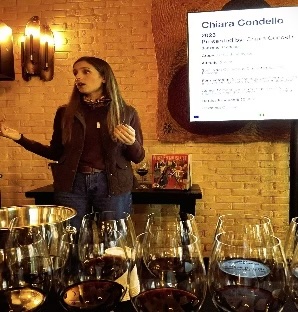
Chiara Condello is not simply a winemaker; she is making a statement. In a region often overlooked, she remembers: the soil, the quiet, the dignity of the Sangiovese grape. Her vineyard in Predappio covers just under five hectares but it speaks with clarity and purpose. Born in Forlì, raised on the family “Conde” estate, in 2015 (at age 24) she launched her own label in Predappio, determined to free Sangiovese from expectation and interference. Her approach: minimal intervention, organic viticulture, and deep respect for the calcareous‐clay hillside soils of her vineyard.
Vineyard
Chiara Condello’s vineyard lies in the foothills of the Apennines, where spungone soils, calcareous sandstone rich in marine fossils, form the foundation of her terroir. The vines, averaging 40 years in age, are planted across three distinct parcels situated between 450 and 1,050 feet in elevation, with a mix of red clay and limestone contributing to the wine’s mineral tension and structural depth.
Grapes are hand-harvested and destemmed before undergoing fermentation with indigenous yeasts in a combination of stainless steel and open-top wooden tanks, preserving varietal purity and site expression. The wine is then aged for 12 months in older 3.5-hectoliter Slavonian oak barrels, which impart subtle texture without overshadowing the character of the Sangiovese or the distinctiveness of the Predappio soils.
Notes
Nose: The bouquet opens with crisp, mineral-driven aromas of crushed limestone and river stones, immediately reflecting the spungone soils of the vineyard. Ripe red cherry and tart cranberry emerge, layered with subtle wild herb notes—thyme, sage, and a hint of rosemary—adding aromatic complexity. Undertones of musk, dried florals, and faint earthy humus lend depth, suggesting both freshness and terroir-driven elegance.
Palate: Medium-bodied and finely textured, the wine presents juicy red cherry and cranberry fruit as its core, bright and precise. Refined, silky tannins provide structure without dominance, while fresh, lively acidity lifts the flavors, giving energy and approachability. A delicate, mineral backbone supports the mid-palate, conveying tension and persistence. Subtle layers of wild herbs, hints of wet stone, and soft earthy notes emerge on the finish, leaving a long, clean, and savory impression.
2. 2020 Serra Riserva – Tenuta Masselina. 100 percent Sangiovese.
Located in the hills of Castel Bolognese (between Imola and Faenza), Tenuta Masselina sits on 22 hectares (16 under vine) and has been organically certified since 2019. Owned by Gruppo Cevico, the estate integrates traditional craftsmanship with solar/geothermal energy systems and lowintervention techniques under winemaker Stefano Chioccioli.
Vineyard
The vineyards, situated at 100–170 meters on red clay and calcareous Apennine soils, undergo extended maceration of over 30 days in stainless steel with délestage and gentle punch downs, followed by aging in neutral oak to preserve varietal purity and site expression.
Notes
Bouquet: ripe cherry, black plum, wild berries → evolving into black pepper, dried herbs, subtle leather, tertiary notes of tobacco & forestfloor.
Palate: silky yet structured; vibrant acidity lifts the fruit, finegrained tannins frame the midpalate; finish long, mineral and earthy.
Next
Romagna doesn’t need reinvention; it needs recognition. Its wines. rooted in tradition, terroir and sustainability. offer a subtle but compelling alternative to Italy’s highprofile regions. For sommeliers and wine trade professionals, Romagna offers authenticity, approachability and value. Its story is one of craft, patience and purpose, and its time on the global stage is approaching.
Copyright and International Rights Notice
All content, including articles, commentary, photographs, and research are the intellectual property of Dr. Elinor Garely and InMyPersonalOpinion.Life.
All rights are reserved under U.S. law (Title 17, U.S. Code) and international treaties, including the Berne Convention for the Protection of Literary and Artistic Works and the WIPO Copyright Treaty.
Unauthorized reproduction, distribution, or transmission of any content, in whole or in part, is strictly prohibited without prior written consent. This includes commercial use, digital republication, translation, or adaptation.
Exceptions are granted for brief quotations used in scholarly, journalistic, or critical contexts, provided that full credit and a direct link are given to Dr. Elinor Garely and InMyPersonalOpinion.Life.For permissions, syndication, or licensing inquiries, contact:
???? EG@InMyPersonalOpinion.Life