
Introduction:
The American wine industry has now crossed from warning signs into consequences. What began as legislative silence and structural distortion has become a full-scale unraveling, economic, ecological, and cultural. Part III confronts the collapse head-on: the labor losses, the climate shocks, the political paralysis, and the narrowing path that remains. This is where the system shows its true architecture, and where the cost of inaction becomes impossible to ignore.
Wine Industry Alert – Now is the Time to Wake Up
Dr. Elinor Garely
The American wine industry has entered the consequence phase, where decades of structural distortion have converged into economic, cultural, and ecological collapse. The Three-Tier System, originally framed as a post-Prohibition safeguard, now functions as a bottleneck that determines not only who sells wine but who survives. Analysts describe the current moment not as a cyclical downturn but as a predictable implosion of a system optimized for gatekeeping rather than growth (McMillan, 2026; National Association of Wine Retailers, 2026). The result is a market architecture that rewards consolidation, punishes transparency, and erases diversity across the supply chain.
Unraveled but Salvageable
Margins have collapsed across the industry. Small wineries operate below sustainability thresholds, distributors consolidate into fewer, more powerful entities, and retailers reduce shelf space for independent producers. Labor shortages compound the crisis, with vineyard workers displaced by automation and climate volatility while cellar staff are cut as production contracts. Federal data show that agricultural employment in wine regions is declining faster than in any other specialty crop sector, underscoring the severity of the structural breakdown (U.S. Department of Agriculture, 2026). Without systemic reform, economic recovery remains mathematically impossible.
The Climate is Aggressive
Climate volatility has become the silent accelerant of collapse. Heat spikes, wildfire smoke, shifting phenology, and rising insurance costs now intersect with distribution bottlenecks, amplifying losses across the value chain. Peer-reviewed research confirms that U.S. wine regions face accelerating yield instability and heightened climate-risk exposure (Alston et al., 2017; National Center for Atmospheric Research, 2026). In the absence of a national data infrastructure, adaptation remains fragmented with each winery forced to navigate climate risk alone while the system around them continues to fail.
Politics Impede Change
Legislative inertia remains one of the most powerful drivers of the crisis. Wholesalers continue to rank among the top political donors in multiple states, ensuring that reform bills stall in committee or die without hearings. California’s 2026 Senate hearings on the wine crisis produced no actionable legislation, while New York’s research grants avoided any examination of regulatory barriers. Federal agencies continue to treat the crisis as a market fluctuation rather than a structural failure (California Senate Select Committee on the Wine Industry, 2026). The silence is not accidental—it is profitable.
Hope Struggles to Bloom
Despite entrenched resistance, a small coalition of analysts and lawmakers has begun articulating the stakes. Rob McMillan of Silicon Valley Bank warned in his 2026 industry report that “the passive growth era is over. The only path forward is intentional change—transparency, consumer alignment, and political courage” (McMillan, 2026). California Senator Bill Dodd echoed this urgency during the 2026 hearings, stating, “We can’t keep calling this a market correction. It’s a structural failure. Reforming the Three-Tier System is not optional—it’s existential” (California Senate Select Committee on the Wine Industry, 2026). Industry analyst Jon Moramarco added in Wine-Searcher that “we’re bouncing along the bottom. The only way up is coordinated action—data transparency, interstate commerce reform, and political courage” (Moramarco, 2025). Wolf Richter framed the crisis even more bluntly in Wolf Street, arguing that “this isn’t a cyclical downturn. It’s an existential crisis created by structural bottlenecks and political inertia” (Richter, 2026). Decanter tied political instability directly to operational uncertainty, noting that “mercurial politics… translate into anxiety for staff and guests, and a heightened sense of risk for everyone” (Decanter, 2025). The emerging consensus is unmistakable: political will is the missing ingredient.
Role Models for Change
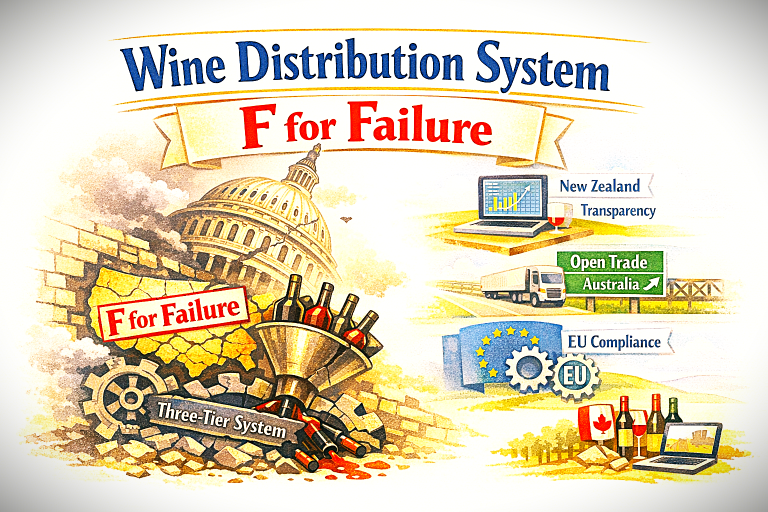
Other wine-producing nations have already solved the problems the United States continues to manufacture. New Zealand’s unified national compliance and data system enables real-time tracking of production, exports, and climate impacts, reducing friction and expanding market access. Australia’s Wine Australia Act provides a national export certification framework and cross-state commerce without bottlenecks, demonstrating that scale and mobility can coexist with oversight. The European Union’s harmonized labeling laws, cross-border trade, and shared climate-risk data illustrate the power of integrated compliance. Canada’s hybrid direct-to-consumer (DTC) model proves that consumer freedom and regulatory accountability can function together without collapsing the market. These systems share a common thread: transparency, mobility, and national coordination.
Drawing from these global successes, the U.S. pathway to reform is clear. First, the industry requires a national data infrastructure modeled on New Zealand and the EU. Second, interstate commerce reform must mirror the mobility frameworks of Australia and Canada. Third, climate-risk integration must be embedded into federal agricultural policy. Fourth, campaign finance transparency is essential to break the political chokehold of the Three-Tier System. Finally, a hybrid DTC-plus-compliance model must replace the current bottleneck architecture. As the National Grape Research Alliance stated in 2026, “without unified federal investment and a national data infrastructure, the U.S. wine sector cannot adapt to climate volatility or compete globally” (Wine Industry Insight, 2026).
Actions Have Consequences
The wine industry’s collapse is not accidental; it is the predictable outcome of a system optimized for failure. Every distortion documented in Parts I and II now converges into consequence. The gears still turn, the bottleneck still narrows, and the data vacuum still hums. The architecture remains intact because it was never designed to serve the market, it was designed to control it. The crisis engine runs on silence, and silence remains its most reliable fuel.
References
Alston, J. M., Anderson, K., & Sambucci, O. (2017). Introduction to the issue. Journal of Wine Economics, 12(2). https://wine-economics.org/wp-content/uploads/2017/10/Vol12-Issue02-Introduction-to-the-Issue.pdf
California Senate Select Committee on the Wine Industry. (2026). Hearing on the State of the Wine Industry. https://www.senate.ca.gov/
Colangelo & Partners. (2026). About us: Agency partners. https://www.colangelopr.com/about-us/
Decanter. (2025, December 16). Is America’s political instability hurting the wine industry? https://www.decanter.com/
McMillan, R. (2026). State of the U.S. wine industry. Silicon Valley Bank. https://www.svb.com/trends-insights/reports/wine-report
Moramarco, J. (2025, November 10). Are we there yet? Wine’s search for rock bottom. Wine-Searcher. https://www.wine-searcher.com/
National Association of Wine Retailers. (2026, February 18). Retailers urge Supreme Court to take up key case. https://nawr.org/news/
National Center for Atmospheric Research. (2026). Climate risk assessment for U.S. viticulture. https://ncar.ucar.edu/
U.S. Department of Agriculture. (2026). Agricultural labor statistics: Specialty crop employment trends. https://www.usda.gov/
Wine Industry Insight. (2026, March 31). National Grape Research Alliance launches 2026 national research and funding strategy. https://wineindustryinsight.com/
Richter, W. (2026, March 26). US winemakers and beer brewers face an existential crisis. Wolf Street. https://wolfstreet.com/
#WineCrisis #ThreeTierSystem #WineIndustryReform #DTCWine #ClimateRisk #PoliticalInertia #WineEconomics #USWine #PolicyReform #WineDistribution #TransparencyNow #WineFuture
© 2026 Dr. Elinor Garely / InMyPersonalOpinion.Life . This work is protected in full under U.S. and international copyright law, including the Digital Millennium Copyright Act (DMCA).
All rights strictly reserved. Any unauthorized reproduction, republication, redistribution, adaptation, extraction, or use in AI training datasets constitutes a violation of federal and international law and will be pursued accordingly. Only brief, non-substantive quotations are permitted, and only with full attribution and an active link to the original publication. For licensing or permissions, contact: EG@InMyPersonalOpinion.Life
000