
For maybe the first time in modern history, she brings the money, the status, and the prestige.
He brings himself. Both call it love.
Dr. Elinor Garely · InMyPersonalOpinion.Life
The male-provider fairy tale is bankrupt. The dating market already knows the secret. When will the rest of us catch up?
Women over 40 are now a financially powerful and increasingly autonomous cohort—independent earning power, property ownership, career stability, and accumulated social capital that previous generations were structurally denied (Spiegelman et al., 2026). Meanwhile, younger men face wage stagnation, job precarity, and the suffocating pressure of a breadwinner expectation that has become mathematically delusional. The old romantic script—older, richer man rescues dewy, economically inert woman—no longer matches the numbers. When the math stops working, culture, eventually and grudgingly, follows.
Key Numbers at a Glance
• 86% of men and 77% of women still define manhood as being a “provider”—even as sole provision has become a fantasy for many (Equimundo, 2025).
• Men facing financial strain are over 16 times more likely to report suicidal thoughts (Equimundo, 2025).
• Single women now account for roughly 21% of all U.S. homebuyers and 25% of first-time buyers—nearly double the share of single men (Fortune, 2026; National Association of Realtors data).
• On Feeld, the number of men (especially 18–25) actively seeking older women rose 64% over two years (Spiegelman et al., 2026).
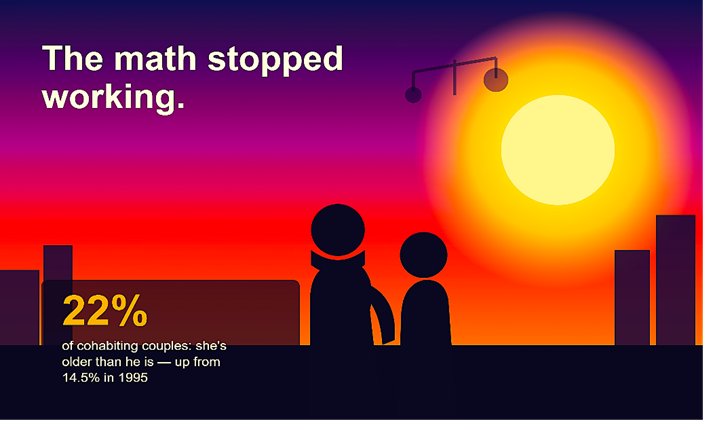
• In cohabiting heterosexual couples, women were older than their male partners in 22% of cases in 2023—up from 14.5% in 1995 (as reported in The Economist, 2026).
The Old Contract Is in Defaul
According to Equimundo’s State of American Men 2025 report, the overwhelming majority of Americans still equate manhood with being a provider. Yet income inequality, wage stagnation, and job insecurity have made that role increasingly unreachable for large numbers of men. The American Psychological Association has identified rigid masculinity ideology as a major driver of distress for men and boys (Andoh, 2025). We are asking men to perform a 1950s masculinity pageant in an economy that no longer supports the performance and then expressing surprise when many are depressed, anxious, or simply opting out.
When older women’s financial stability meets younger men’s economic insecurity, something interesting happens: they stop competing and start collaborating.
Insecure Dates Security
Ipsos found that 47% of Americans recognize financial freedom as a core benefit of dating someone significantly older, and 59% cite emotional maturity as the primary advantage (Newall, 2024). Not physical attractiveness. Not sexual stamina. Emotional maturity…the thing that costs nothing but remains in shorter supply than waterfront property.
A brief, anonymized snapshot: Maya, 44, a marketing director who bought her condo in 2023, matched with Jordan, 31, on a dating app. “He didn’t flinch when I mentioned the mortgage,” she said. “He asked about my renovation plans and whether the building had a good board. It was the first time a date felt like a conversation between equals instead of an audition for a provider role I no longer needed.” Stories like this are becoming less exceptional.
Cohabitation Is Telling the Truth Marriage Statistics Hide
If you look only at formal marriage data, you might conclude little has changed. Pew Research Center found that the share of American heterosexual marriages in which the woman is at least three years older has hovered around 10% since 2000 (Fry, 2024). Traditionalists can point to that number and declare victory.
But cohabitation tells a different story. Women were older than their male partners in 22% of unmarried, cohabiting heterosexual couples in 2023, up from 14.5% in 1995—a 51% relative increase (The Economist, 2026). Marriage is a lagging indicator; it is the institutional residue of the old contract. Cohabitation is where people actually live now, and it is moving faster. Similar directional signals appear in wealthy, urban, app-mediated markets across Western Europe, Australia, New Zealand, and even parts of East Asia, where younger men in cities such as Seoul and Tokyo are rejecting rigid “salaryman” masculinity.
Important caveat: formal marriage statistics remain largely flat, and some studies continue to associate larger age gaps with modestly higher dissolution risk. The trend is real and accelerating in cohabitation and on the apps; it has not yet rewritten the marriage tables.
The Apps Confirm What the Census Can’t
Bumble’s 2023 global survey of more than 26,000 users across 20-plus countries found that 63% of respondents consider age a non-factor in romance. Fifty-nine percent of women said they are more open to dating someone younger than before, and 35% reported becoming less judgmental toward age-gap relationships over the prior year (Bumble, 2023).
Tawkify, a matchmaking service with nearly 99,000 paying clients across all 50 states, found that 65.7% of men are open to dating older partners, accepting an average age gap of nearly nine years (High Intent Media, 2026). For context, 96.5% of men remain open to younger partners with a larger average acceptable gap—because of course they are. The directional change is the story: two-thirds of men in a large, high-intent dataset are willing to look upward in age.
Feeld’s internal data showed a 64% increase in the number of men, particularly those aged 18 to 25, actively seeking older women over a two-year period (Spiegelman et al., 2026). The New York Times called it “the rise of the sugar mama economy”—a reductive but directionally accurate label. Feeld’s own analysis also found that across all genders and sexualities, the most attractive age on the platform is 29, regardless of the sender’s own age (Feeld, 2025), a finding that quietly undermines the assumption that attraction rigidly tracks youth.
Younger Men Are Not Broken; Older Women Are Not Desperate
Older women (roughly 35 and up) often enter the dating market already equipped with emotional maturity, self-possession, clear boundary-setting, and a low tolerance for games. They are not looking for a project or a second chance at motherhood. Younger men (18–40) are, on average, proving remarkably emotionally open, adaptable, less status-anxious, and eager for genuine communication. As Holmes (2026) observed in The Atlantic, the culture is gradually retiring the derogatory vocabulary, “cougar,” “sugar mama,” “cradle robber”—that was designed to shame women for exercising the same romantic agency men have long taken for granted.
Spiegelman et al. (2026) found that younger men are not intimidated by older women; they are drawn to their directness and clarity. In a dating culture saturated with ghosting and breadcrumbing, someone who says what they mean is genuinely novel.
Follow the Money: The Financial Economics of the New Pairing
Single women now represent approximately 21% of all U.S. homebuyers and 25% of first-time buyers, far outpacing single men. More than 20 million single women are homeowners, a record high. In the most recent data, single women first-time buyers reported higher median incomes than their male counterparts for the first time in years (Fortune, 2026). Until 1974, an unmarried woman in the United States could not reliably secure a mortgage without a male co-signer. Fifty years later, she is the second-largest buyer demographic in the nation.
Homeownership remains the primary engine of wealth creation for most Americans. Women are not waiting for a wedding ring to start building equity. They are buying the house, accumulating the wealth, and then entering the dating market from a position of financial leverage the old script never contemplated.
Divorce economics reinforce the shift. Research shows women’s family income drops sharply after marital disruption, roughly double the decline men experience, yet women’s personal earned income often rises after separation (Smock et al., 2024). The loss was not in earning capacity; it was the loss of a second income. Women who have been through that meat grinder rarely re-enter the market looking for another provider to depend on. They want partners, not paychecks. Younger men facing their own economic precarity are not eager to be sole providers either. When complementary vulnerabilities meet, the old power dynamics do not merely shift—they can invert.
The Social Structure Is Cracking
In 2025 the U.S. Census Bureau confirmed that married-couple households had fallen to 47% of all American households, the first time on record they constituted less than half (U.S. Census Bureau, 2025). Only about 47% of U.S. adults are currently married. Parallel declines appear in England and Wales and, more dramatically, in China. This is a global demographic shift, not a Western curiosity.
The housing market is already reorganizing. The median age of a first-time homebuyer has reached 40. First-time buyers represent just 21% of the market—the lowest share since tracking began in 1981. Homebuyers with children under 18 have dropped to 24%, an all-time low. Developers are responding with smaller homes, more rental units, and flexible layouts. The four-bedroom family home is becoming a niche product.
When women own homes before marriage, enter relationships from positions of financial strength, and younger men are freed from the impossibility of sole provision, household power dynamics restructure. Decision-making becomes more egalitarian. The structural feature that once kept many women in unhappy marriages and many men in soul-crushing jobs begins to erode. Arizona State University research has identified the shadow side— “nurse with a purse” fears—but the directional trend is clear: economic parity tends to produce more equal partnerships (Arizona State University, 2024).
The Great Demographic Blind Spot: Where Are the Over-50s?
Mainstream relationship surveys still largely cut off around age 49, as if romantic and sexual agency expire at middle age. They do not. Arizona State University’s Romance and Dating in Later Life project interviewed adults aged 55–92 and found a wide range of experiences: many enjoyed being single; others sought everything from marriage to casual companionship. A common fear, especially among women, was being used for money—the “nurse with a purse” concern—yet success stories also emerged through shared-interest communities and dating apps (Arizona State University, 2024). Roughly 29% of Americans aged 50–64 and 33% of those 65 and older are currently single. The research establishment’s reluctance to study this financially powerful cohort is a choice, not an oversight.
A Quick Ethical Checklist Before You Swipe
Age-gap relationships work best when both parties enter as autonomous adults, not as rescue missions.
- Check life-stage compatibility: Do schedules, energy levels, and long-term visions actually align?
- Set financial boundaries early and explicitly.
- Watch for dependency dynamics: if one person’s resources become the relationship’s structural foundation, resentment often follows.
- Practice mutual public respect. If you can hold hands in daylight without flinching, you are already ahead of many couples in the studies.
What to Do with This Information
For younger men
Stop treating your attraction to older women as a phase, a guilty secret, or something that requires explanation over a martini. The data say roughly two-thirds of you are open to it. You are not an outlier; you are part of an emerging pattern. If you value emotional clarity and direct communication, own it. Update your age filters. Say what you want in your profile. Drop the archaic ego trip that pretends a woman who out-earns you is a problem. She does. Get over it.
For older women
Stop infantilizing younger partners. They are not looking for a mother, a caretaker, or a renovation project. They are looking for an equal adult partner, and the data show many actively desire you. If you catch yourself describing a 32-year-old man as “basically a child,” ask yourself why you need him to be one. The fear of being used financially is real and worth guarding against; it should not become a wall that keeps out genuine connection. Set boundaries early. Be clear about what you want. Then let the relationship be what it is.
For app designers and researchers
Your default age-range filters and your survey cutoffs at 49 are building products and knowledge for a market that no longer exists. Expand the age ranges. Include respondents over 50. Stop pretending people stop having romantic lives when they stop being demographically convenient to study.
For policymakers and urban planners
The household you are designing tax codes, pension systems, and housing policy around no longer dominates. Married-couple households are below 50%. First-time buyers average age 40. Single women are the second-largest homebuyer group. Plan for smaller households, later formation, and women who arrive at the negotiating table with their own mortgage.
For everyone else
Cut the cord to Cinderella. Ipsos found that 83% of people in a 10-plus-year age-gap relationship feel freer to be themselves in it (Newall, 2024). This is not Sleepless in Seattle. Nobody is waiting on a glass slipper. The risk was never the age gap. The risk is still running your love life on a script nobody is filming anymore.
References
Andoh, E. (2025, November 12). Rethinking masculinity to build healthier outcomes. Monitor on Psychology. https://www.apa.org/monitor/2025/11-12/rethinking-masculinity
Arizona State University. (2024, January 16). ASU research reveals challenges, joys of dating later in life. https://news.asu.edu/20240124-arts-humanities-and-education-asu-research-reveals-challenges-joys-dating-later-life
Bumble. (2023, November 16). What will dating look like in 2024? Here’s what Bumble’s data says. https://bumble.com/en-us/the-buzz/bumble-dating-trends-2024
Equimundo. (2025). State of American men 2025. https://www.equimundo.org/resources/state-of-american-men-2025/
Feeld. (2025, August 28). Forever 29: An age gap data analysis. https://feeld.co/uncharted-territory/forever-29
Fortune. (2026, March 10). The worst housing market in years couldn’t stop single women from owning a record-breaking number of homes. https://fortune.com/2026/03/10/housing-market-single-women-home-ownership/
Fry, R. (2024, August 15). A growing share of U.S. husbands and wives are roughly the same age. Pew Research Center. https://www.pewresearch.org/short-reads/2024/08/15/a-growing-share-of-us-husbands-and-wives-are-roughly-the-same-age/
High Intent Media. (2026, June 11). 100,000 matchmaking clients reveal the age-gap divide apps ignore. https://highintentmedia.com/news/women-men-open-to-older-dating
Holmes, A. (2026, April 2). Twilight of the “cougar.” The Atlantic. https://www.theatlantic.com/culture/2026/04/age-of-attraction-older-women-younger-men/686667/
Newall, M. (2024, February 23). Half of Americans say they have been in a 10+ year age-gap relationship. Ipsos. https://www.ipsos.com/en-us/half-americans-say-they-have-been-10-year-age-gap-relationship
Smock, P. J., Tzoc, K., & Carr, D. (2024). Gender and the economic consequences of divorce in the United States. Journal of Family and Economic Issues, 45(4), 800–818. https://doi.org/10.1007/s10834-024-099XX
Spiegelman, N. (Host). (2026, April 16). Older women are in demand by younger men [Audio podcast episode]. The Opinions. The New York Times. https://www.nytimes.com/2026/04/16/opinion/younger-men-dating-older-women.html
The Economist. (2026, August 6). Why Hollywood has gone wild for cougars in latest obsession. https://www.economist.com/culture/2026/08/06/hollywoods-latest-obsession-older-women-and-younger-men
U.S. Census Bureau. (2025, December 2). Census Bureau releases new estimates on America’s families and living arrangements. https://www.census.gov/newsroom/press-releases/2025/families-and-living-arrangements.html
USA Today. (2025, April 2). How single women are transforming the housing market: A first-time buyer’s story. https://www.usatoday.com/story/money/2025/04/02/single-women-housing-market/82783087007/
© 2026 Dr. Elinor Garely / InMyPersonalOpinion.Life
Protected by U.S. & international copyright + DMCA.
No reproduction, reposting, scraping, archiving, or AI training allowed.
Violations may result in takedowns + legal action.
Permissions: EG@InMyPersonalOpinion.Life