
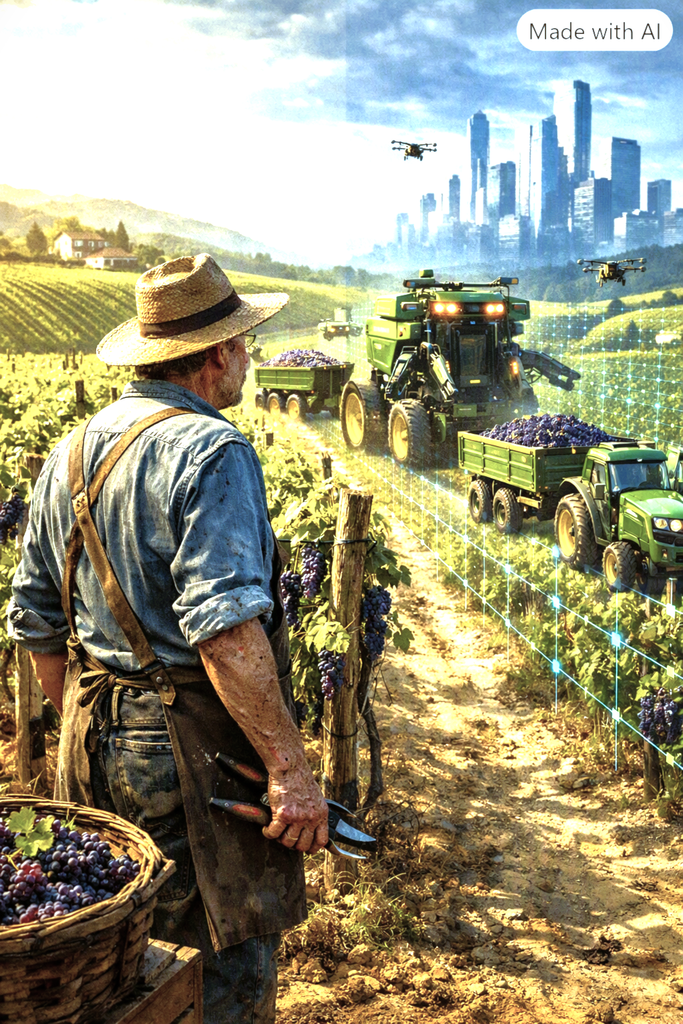
A $10 Million Partnership
Exposes the Coming Divide Between Capital and Craft
By Dr. Elinor Garely, Editor-in-Chief, InMyPersonalOpinion.Life
October 2, 2026 | 8 min read | Agriculture, Wine & Technology
When I speak with winemakers about the business side of their operations, a familiar pattern emerges: they describe, with pride, their commitment to hand harvesting at cold dawn, the human touch, the metallic click of shears, the soil still under the nails, and then, almost as an aside, they acknowledge the water sensors buried beneath that same soil, the drones mapping vigor from above, and the engineering-grade tools quietly steering their decisions.
This disconnect is not hypocrisy but a symptom of an industry caught between identity and survival issues. Wine still romanticizes the hand, even as the hand becomes harder to find, more expensive to keep, and increasingly unable to meet the demands of a volatile labor market. Deere’s $10 million automation pivot simply exposes what has been true for years: the future is already in the vineyard, but the narrative has not caught up.
A $10 Million Spark in a $45 Billion Powder Keg
John Deere’s $10 million, three-year research and development partnership with Reservoir, announced on August 26, 2026, at its inaugural Ruggedize conference, is a structural signal rather than a standard innovation headline (Reservoir, 2026; AgroPages, 2026). Reservoir’s Salinas and Sonoma field sites, opened in spring 2026, have already welcomed more than 20 agricultural startups focused on ‘rugged AI’ built for real-world agricultural environments rather than sanitized laboratories (Reservoir, 2026).
For a corporation reporting $45.684 billion in net sales and revenues and $5.027 billion in net income for fiscal 2025, $10 million illustrates a strategic direction: investing in the underlying infrastructure that converts sensors, autonomy, and data into commercial power for high-value crops (Deere & Company, 2025).
Voices From the Field: Why Automation Matters Now
For the wine sector, this development serves as an operational warning regarding who can sustain the costs of modern automation.
“Our agriculture, construction, and commercial landscaping customers all have work that must get done at certain times of the day and year, yet there is not enough available and skilled labor to do the work. Autonomy can help address this challenge. That’s why we’re extending our technology stack to enable more machines to operate safely and autonomously in unique and complex environments.”
— Jahmy Hindman, Chief Technology Officer at John Deere, speaking at CES 2025 (Hindman, 2025)
“John Deere is committed to helping high-value crop growers do more with less, and that requires strong innovation built in the field, not just in the lab. Real-world validation is a key part of Deere’s mission and helps ensure new solutions are addressing real challenges farmers are facing.”
— Jason Brantley, Vice President of Production Systems, Small Ag & Turf at John Deere (Brantley, as cited in AgroPages, 2026)
“We touch the vines up here in Oregon about 15 to 17 times a year. If you can save 10 or 15 cents per touch per vine, and there are 1,300 vines per acre, multiply that over 100 acres…you could save $10,000 really, really quick. Do that five or six times in the growing season, and you just saved $50,000.”
— Bruce Sonnen, Vineyard Manager at Van Duzer Vineyards, Willamette Valley (Sonnen, as cited in Kirschenmann, 2026)
The Global Labor Fragility in Viticulture
Viticultural operations, such as pruning, canopy management, shoot thinning, harvesting, depend on tight seasonal windows. The workforce sustaining these operations faces severe demographic and political pressures.
“Wine grape laborers have been virtually nonexistent. People don’t want to work in vineyards anymore because it’s remote, tough work.”
— Kaan Kurtural, Professor of Viticulture and Enology and Extension Specialist at UC Davis (Kurtural, 2023)
Data from the National Agricultural Workers Survey (NAWS) indicate that among interviewed crop workers in 2021–2022, 61% were born in Mexico, an increase from 55% in 1989–1990, while 6% were born in Central and South America (U.S. Department of Labor, 2024). Furthermore, U.S. Department of Agriculture Economic Research Service estimates indicate that 42% of hired crop farmworkers lacked work authorization between 2020 and 2022, while 32% were U.S. born and 7% were naturalized citizens (U.S. Department of Agriculture, Economic Research Service, 2025).
According to data from the 2022 Census of Agriculture (U.S. Department of Agriculture, Economic Research Service, 2024), labor expenses represent approximately 40% of production expenses on fruit and tree-nut farms, compared to roughly 12% across all agricultural sectors, according to data from the 2022 Census of Agriculture (U.S. Department of Agriculture, Economic Research Service, 2024).
Immigration Enforcement and Market Shocks
Heightened enforcement environments create immediate workforce absenteeism. Federal immigration data documented 50,208 arrests in July 2026 alone, the highest single-month total in recent history, with cumulative figures exceeding 555,805 arrests from inauguration through August 6, 2026 (Stop AAPI Hate, 2026; Reuters, 2026). August 2026 surpassed July with 50,925 arrests, marking the third consecutive monthly record (Reuters, 2026).
While high-profile enforcement actions, such as the July 10, 2025, Glass House Farms operation in Camarillo, California, which resulted in 361 detentions and the fatal fall of worker Jaime Alanís García, targeted non-vineyard agricultural facilities, the operational shock rippled across the broader agricultural economy (The Guardian, 2025). Masked agents from the Department of Homeland Security raided the facility, and Alanís García, a 56-year-old father and long-time employee, fell 30 feet from a greenhouse roof while trying to hide (CB Insights, 2025).
Legal Volatility in Agricultural Visa and Wage Frameworks
The regulatory frameworks governing human labor remain unstable. On August 26, 2026, U.S. District Judge Kirk E. Sherriff concluded that the Department of Labor failed to adequately demonstrate that the revised wage methodology would satisfy its statutory obligation, ruling that key portions of the H-2A interim final rule were arbitrary and capricious and must be redone (U.S. District Court for the Eastern District of California, 2026). This ruling creates uncertainty for growers who had budgeted around projected savings and now face potential back-pay exposure (The Packer, 2026).
“The people who were taking below-break-even prices two years ago can no longer do that in 2026. Their banks are making that decision for them… We have to have transparent conversations, and it’s really difficult to have those transparent conversations.”
— Audra Cooper, Vice President at Turrentine Brokerage (Cooper, as cited in Kirschenmann, 2026)
“When growers look at their bottom line and where their costs lie, it’s highly concentrated in labor. Any grower is looking at ways to minimize labor, and mechanization is definitely one of those options.”
— Grower, Madera County (Bitter, 2023)
Capital as the New Labor Insurance
Faced with persistent labor uncertainty, automation has transitioned from a routine cost-efficiency metric to a form of operational insurance. Autonomous platforms do not require visas, housing provisions, or workplace safety enforcement. Modern vineyard mechanization integrates sensor suites, machine vision, and real-time data mapping (Reservoir, 2026).
Empirical Insights on Profitability and Scale
A peer-reviewed economic analysis published in Precision Agriculture by Testa, Brunori, and Galati evaluated the financial impact of transitioning from conventional vineyard practices to high-innovation precision viticulture (Testa et al., 2024). While high-innovation systems can improve input optimization and output value, their economic viability depends strictly on acreage, with fixed technological costs favoring larger operating scales — a reality that subsidies can soften but not erase (Testa et al., 2024).
What the Wine Industry Can, Should, and Must Do
The structural divide between high-capital conglomerates and small-to midsize family growers threatens to hollow out the cultural core of the global wine ecosystem. To prevent this technological transition from becoming an economic tragedy, the industry must move beyond passive observation and execute a definitive roadmap.
What the Industry Can Do (Immediate Pilot Initiatives)
• Establish Cooperative Machinery Pools: If you farm 80 acres, you cannot amortize a $400k autonomous tractor alone. Small and midsize growers can pool capital to collectively lease autonomous tractors, drone-mapping fleets, and precision harvesters, distributing fixed costs across multiple landholdings (Kirschenmann, 2026).
• Deploy Low-Cost Precision Alternatives: Growers can adopt entry-level modular technologies — such as open-source NDVI vigor mapping, smartphone-enabled canopy sensors, and targeted spot-spraying systems — which require lower capital entry barriers than full-scale autonomous fleets (Testa et al., 2024).
What the Industry Should Do (Structural Collaboration & Advocacy)
• Form Grower-Tech Consortia: Regional wine associations and trade bodies should partner directly with agtech developers (such as Reservoir-backed startups) to build scalable software platforms tailored specifically to boutique vineyard topography rather than just massive industrial row crops (Reservoir, 2026).
• Advocate for Targeted Subsidies and Financing: Industry leadership must lobby governments to direct agricultural modernization grants and low-interest financing explicitly toward small producers, offsetting the scale threshold identified in peer-reviewed economic research (U.S. Department of Agriculture, Economic Research Service, 2024).
What the Industry Must Do (Survival Imperatives)
• Institutionalize Workforce Upskilling: Rather than treating automation purely as a labor replacement, vineyards must establish internal technical training pipelines. Displaced manual workers must be transitioned into certified operators, drone supervisors, and data analytics technicians, preserving rural employment and institutional knowledge (Kurtural, 2023).
• Demand for Open-Architecture Repair Rights: Growers must legally mandate open-architecture software and right-to-repair agreements from equipment manufacturers. Becoming entirely dependent on a single corporate vendor for proprietary maintenance creates a new form of corporate serfdom (Federal Trade Commission, 2025).
A Future in Harmony?
The wine industry can no longer afford a split personality, celebrating tradition while quietly depending on technology that it refuses to publicly embrace. Automation is not a threat to craft; rather, it is a lifeline for growers squeezed by labor shortages, immigration volatility, rising costs, and capital imbalances that favor only the largest players.
The question is no longer whether vineyards will adopt technology, but who will control it, who will afford it, and who will be left behind. If wine continues to cling to nostalgia instead of strategy, the divide between capital and craft will widen until it becomes irreversible.
References
AgroPages. (2026, August 28). Reservoir announces $10 million multi-year partnership with John Deere to accelerate rugged AI for agriculture. AgroPages. https://news.agropages.com/News/Detail-58690.htm
Bitter, B. (2023, June 12). Labor expenses push farmers to automate. Morning Ag Clips. https://www.morningagclips.com/labor-expenses-push-farmers-to-automate/
CB Insights. (2025). Glass House Farms – Products, competitors, financials, employees, headquarters locations. https://www.cbinsights.com/company/glass-house-farms
Deere & Company. (2025, November 26). Deere reports net income of $1.065 billion for fourth quarter, $5.027 billion for fiscal year. PR Newswire. https://www.deere.com/en/news/all-news/2025q4-earnings/
Federal Trade Commission. (2025). FTC v. Deere & Company: Complaint regarding unlawful withholding of self-repair capabilities. Federal Trade Commission. https://www.ftc.gov/legal-library/browse/cases-proceedings/ftc-v-deere-company
Hindman, J. (2025, January 6). Deere debuts new autonomous technology at CES 2025 amid skilled labor shortage. Nasdaq. https://www.nasdaq.com/articles/deere-debuts-new-autonomous-technology-ces-2025-amid-skilled-labor-shortage
Kirschenmann, E. (2026, June 22). Doing more with less: Vineyard automation becomes lifeline for growers under pressure. Wine Business Monthly. https://news.wine.co.za/news.aspx?NEWSID=47089
Kurtural, K. (2023, May 15). Machines can help wine grape industry survive labor shortage. UC Agriculture and Natural Resources. https://ucanr.edu/blog/capital-press/article/machines-can-help-wine-grape-industry-survive-labor-shortage
Reuters. (2026, September 6). ICE arrests topped 50,000 in July and August as more people without criminal records are detained. Reuters. https://www.reuters.com/world/us/ice-arrests-topped-50000-july-august-2026/
Reservoir. (2026, August 26). Reservoir announces $10 million multi-year partnership with John Deere to accelerate rugged AI for agriculture [Press release]. Reservoir. https://www.reservoir.farm/news/reservoir-deere-partnership
Stop AAPI Hate. (2026, August 6). How Asians and Pacific Islanders are being impacted by ICE: What the data reveals. Stop AAPI Hate. https://stopaapihate.org/2026/08/06/ice-data-july-2026/
Testa, R., Brunori, G., & Galati, A. (2024). Conventional management vs. precision viticulture: A comparison of different levels of mechanization and their impact on vineyard profitability. Precision Agriculture, 25(3), 1120–1145. https://doi.org/10.1007/s11119-024-10120-0
The Guardian. (2025, July 11). California farmworker dies after immigration raid at Glass House Farms. The Guardian. https://www.theguardian.com/us-news/2025/jul/11/glass-house-farms-ice-raid
The Packer. (2026, August 27). Federal court strikes down H-2A wage rule, leaving growers exposed. The Packer. https://www.thepacker.com/news/federal-court-strikes-down-h2a-wage-rule
U.S. Department of Agriculture, Economic Research Service. (2024). Farm labor. U.S. Department of Agriculture. https://www.ers.usda.gov/topics/farm-economy/farm-labor/
U.S. Department of Agriculture, Economic Research Service. (2025, September 12). Legal status of hired crop farmworkers, fiscal 1991–2022. U.S. Department of Agriculture. https://www.ers.usda.gov/data-products/chart-gallery/63466
U.S. Department of Labor. (2024, March). Exploring changes in the U.S. crop workforce: Findings from the National Agricultural Workers Survey 2021-2022. U.S. Department of Labor. https://www.dol.gov/sites/dolgov/files/ETA/opder/DASP/Trendlines/posts/2024_03/Trendlines_March_2024_Final.pdf
U.S. District Court for the Eastern District of California. (2026, August 26). United Farm Workers v. U.S. Department of Labor, No. 25-cv-01614-KES-EGC. https://www.courtlistener.com/docket/12345678/united-farm-workers-v-dol/
© 2026 Dr. Elinor Garely / InMyPersonalOpinion.Life Protected by U.S. & international copyright + DMCA. No reproduction, reposting, scraping, archiving, or AI training allowed. Violations may result in takedowns + legal action. Permissions: EG@InMyPersonalOpinion.Life
000