

By Dr. Elinor Garely
A Family Legacy Spanning Generations and Continents
The Flam family history is inextricably linked to the Israeli wine industry’s modern development. The Patriarch, Israel Flam, is regarded as one of Israel’s principal wine figures as he pioneered modern Israeli enology. In 1968, he became the first Israeli to graduate from UC Davis’s Viticulture and Enology program. Flam went on to serve as the chief winemaker at Carmel Winery for over 35 years, setting the foundation for quality that his children would later build upon. He now serves as a crucial consultant, advising and assisting the family endeavor.
Current Generation
The winery was established in 1998 by the second generation. Golan Flam (Winemaker) was born in South Africa. His passion for wine was cemented during a trip to Tuscany in 1996, leading him to study Oenology in Italy and apprentice in Tuscany and Australia, making him the master craftsman focusing on an elegant, balanced, European-style profile. Gilad Flam (Strategic Director/CEO) studied law and now manages the business development, marketing, and logistics. He is the pragmatist and strategist, responsible for the winery’s commercial success and global footprint. Camellia “Kami” Flam (Matriarch/Operations), a successful businesswoman, managed the financial and operational aspects, ensuring that passion is always balanced with business acumen. The family’s move to the Judean Hills in 2005, settling in the Forest of Eshtaol, cemented the winery’s identity, allowing the family to live and work surrounded by their own vineyards.
Vineyards, Soil, and Production Philosophy
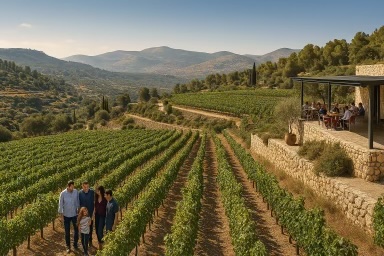
Flam’s wines are a direct expression of the Judean Hills terroir, combined with meticulous viticultural practice. Flam sources grapes from specific, meticulously chosen plots under long-term leases, primarily in the Judean Hills (Even Sapir, Givat Yeshayahu, and Eshtaol) and historically in the Upper Galilee (Dishon, Ben-Zimra). The primary focus is the Judean Hills, characterized by clay and terra rossa soils layered over limestone bedrock. The vineyards are often planted at high elevations, averaging 650 meters above sea level. This altitude, combined with cool Mediterranean breezes funneled through the valleys (or wadis), creates a significant diurnal temperature shift (cool nights, warm days). This is critical for slow, balanced ripening, which preserves the grapes’ acidity, structure, and aromatic complexity.
Production remains boutique, at approximately 100,000 bottles annually. The philosophy is minimal intervention after hand-harvesting and delicate handling. This small scale allows Golan Flam to personally supervise every stage, from pruning to bottling, upholding the belief that the basis for great wine is grown in the vineyard.
Changing Minds, One Glass at a Time
Flam has been a quiet leader in the revolution of Israeli winemaking. By focusing on terroir and critical acclaim over pure promotion, they have shifted the global perception of Israeli wines from merely “ceremonial” to truly “celebratory.” Their work as part of the Judean Hills Quartet (Flam, Castel, Tzora, and Sphera) further solidifies their commitment to elevating the region’s status. The appearance of the Flam White Label on Wine Spectator’s Top 100 Wines of 2024 is the latest validation, affirming their commitment to excellence and fueling an export market that comprises 30–40 percent of production.
Profile of the Flam Consumer
Flam’s wines are not mass-market; their pricing and style target a specific consumer base. The core consumer is:
The Discerning Wine Collector
An educated, high-end wine buyer who values elegance, balance, and Old-World structure over New-World fruit bombs. They are comfortable paying a premium for a wine that competes with top-tier Bordeaux or Napa estates.
The HORECA Enthusiast
Crucial consumer, as over half of all sales flow through the HORECA sector (hotels, restaurants, and catering). This reflects that Flam is highly valued by sommeliers and chefs who recognize its complexity and food-pairing versatility, particularly its famed balance.
The Celebration/Heritage Buyer
Those consumers who are celebrating Jewish holidays (Passover, Rosh Hashanah, Hanukkah) or special occasions like Thanksgiving, and seek a high-quality, Kosher wine with a profound story and reliable pedigree. They often prioritize wines that offer both heritage and excellence.
The Critical Lens: Navigating Turbulence and Price
While Flam’s technical credibility and dedication to quality are beyond dispute, a critical view must acknowledge the external challenges. Wines like the Flam Classico (generally priced in the $40–$50 USD range) and Flam Camellia hold a premium position, requiring continuous, flawless quality to justify the investment over comparable international offerings. The most pressing long-term critique is the impact of regional instability, which has caused severe labor shortages and a significant decline in domestic sales. Flam’s reliance on exports and digital storytelling, while effective, highlights the constant need to adapt to a climate of uncertainty—a challenge that requires deep financial and communal resilience.
InMyPersonalOpinion
A Tale of Two Classics
- Flam Classico 2023
The Flam Classico is the essential introduction to the winery’s Bordeaux-style focus. The 2023 vintage, a blend of Cabernet Sauvignon (61 percent), Cabernet Franc (16 percent), Merlot (12 percent), and Petit Verdot (7 percent), is aged for 10 months in French oak.
Profile: Deep, elegant ruby with aromas of ripe black cherry, plum, and spice, backed by subtle coffee and vanilla. Medium-to-full-bodied with firm yet inviting tannins and lively acidity. The Holiday Pairing Edge: The Classico is a beautifully balanced red that pairs effortlessly with rich, symbolic holiday meals, without overpowering them. It’s a wine that respects tradition while elevating the experience. Its acidity and structure make it the perfect wine for: Thanksgiving (November 27, 2025), pairing well with rich herb-roasted turkey, savory mushroom Wellington, and all the sides.
It is also ideal for Jewish holidays like
Hanukkah (Dec 14–22, 2025) and Purim (March 14–15, 2026), where its structure complements the festive lamb and robust celebratory fare.
The Classico continues to shine for Passover (Pesach, April 22–30, 2026) with brisket, Rosh Hashanah (September 22–24, 2026) with honey-glazed chicken, and Sukkot (September 25–October 2, 2026) with grilled vegetables, offering fruit-forward notes that balance sweetness with grounded elegance. - Flam Camellia 2023
Named for the matriarch, Camellia Flam, this white blend (90 percent Chardonnay, 10 percent Sauvignon Blanc) showcases Israel’s potential for sophisticated white wine.
Profile: Bright and aromatic with notes of citrus blossoms, white peach, and ripe pear, complemented by toasted brioche and vanilla from the oak. Full-bodied and textured on the palate, but kept fresh by vibrant acidity.
The Festive Appeal: The Camellia’s depth makes it excellent for holiday appetizers or a sophisticated alternative main-course pairing for poached salmon or creamy pasta dishes. Both of these wines are elegant, terroir-driven triumphs facing the twin challenges of premium market competition and regional instability.
What Wine is to Israel
Yair Haidu, Israeli sommelier, wine writer, and former head sommelier at El Al Airlines, has consistently praised Flam Winery, calling it “a benchmark for elegance and terroir expression in Israel.” Similarly, Daniel Rogov, the late Israeli food and wine critic widely regarded as the father of Israeli wine journalism, famously described their wines as “among the finest in the country.”
Copyright and International Rights Notice
All content, including articles, commentary, photographs, and research are the intellectual property of Dr. Elinor Garely and InMyPersonalOpinion.Life. All rights are reserved under U.S. law (Title 17, U.S. Code) and international treaties, including the Berne Convention for the Protection of Literary and Artistic Works and the WIPO Copyright Treaty. Unauthorized reproduction, distribution, or transmission of any content, in whole or in part, is strictly prohibited without prior written consent. This includes commercial use, digital republication, translation, or adaptation. Exceptions are granted for brief quotations used in scholarly, journalistic, or critical contexts, provided that full credit and a direct link are given to Dr. Elinor Garely and InMyPersonalOpinion.Life. For permissions, syndication, or licensing inquiries, contact:???? EG@InMyPersonalOpinion.Life