

By Dr. Elinor Garely
The Beauty and the Bargain
When I think of The Bahamas, I picture white-sand beaches, turquoise seas, and resorts that shimmer like jewels beneath a tropical sun. Yet every time I return, I feel the tension beneath the postcard. The country’s most valuable assets, its land, hotels, and infrastructure, are increasingly shaped by forces far from Nassau or Freeport. Decisions that once belonged to Bahamian planners, developers, and governments now often originate in Beijing, Hong Kong, Toronto, or Dubai. Two resorts encapsulate this shift more clearly than anything else: Baha Mar and Atlantis Paradise Island. They are very different projects with very different foreign powers behind them, and they reveal a great deal about how a small nation can lose control without even realizing it.
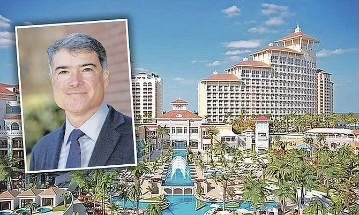
Baha Mar: China’s Billion-Dollar Bet and the Collapse That Followed
https://www.tribune242.com/photos/2022/nov/25/79411
The story of Baha Mar begins with Sarkis Izmirlian, a Bahamian-born businessman of Armenian descent who imagined a US$4.2 billion mega-resort that would redefine luxury tourism in the Caribbean. His vision was bold and global, but it required financing on a scale The Bahamas had never seen. Western banks would not commit. Major contractors declined the risk. Into this gap stepped China Export-Import Bank (EXIM Bank), which offered US$2.45 billion in loans, and China Construction America (CCA), which invested an additional US$150 million in equity. That dual involvement, financing from EXIM Bank and construction (plus partial ownership) through CCA, gave Chinese entities extraordinary leverage from the very start.
Construction delays mounted. Promises slipped. Behind the scenes, friction grew between Izmirlian’s development team and CCA, particularly over missed deadlines and questions about construction quality. Baha Mar was supposed to open in March 2015, but the deadline passed without the resort being ready. Izmirlian’s BML Properties filed for bankruptcy shortly thereafter, triggering one of the most dramatic transfers of control in Caribbean tourism history. With BML sidelined, EXIM Bank and CCA effectively seized the project, and ownership eventually passed to Hong Kong–based Chow Tai Fook Enterprises. Izmirlian, the man who conceived and championed Baha Mar, was left with nothing more than a protracted legal battle.
The legal reckoning arrived in October 2024, when the New York Supreme Court ruled that CCA had defrauded Izmirlian’s company, concealed construction delays, and breached its contractual obligations. The court found that CCA’s misrepresentations and actions directly triggered the project’s collapse and awarded Izmirlian US$1.6 billion in damages. CCA appealed the ruling, but in 2025 the judgment was upheld.
This is not speculation; it is part of the official legal record. Even beyond the courtroom, the broader pattern is striking. Chinese firms, capital, and contractors have become deeply embedded in Bahamian infrastructure including roads, ports, and civic developments, not only through financing but through strategic positioning. When financing becomes control and construction becomes influence, the sovereignty of a nation can be quietly compromised. In my personal opinion, Baha Mar has become a symbol of how easily national autonomy is traded away when the only available capital comes with strings attached.
Atlantis Paradise Island: A Quieter Empire of Private Equity and Gulf Sovereign Wealth
If Baha Mar reflects the muscle of Chinese state-backed financing, Atlantis Paradise Island embodies a far more discreet kind of foreign dominance; one driven by private equity and Middle Eastern sovereign wealth. The turning point came in 2012, when Brookfield Asset Management converted US$175 million of Kerzner International’s debt into equity. With a single transaction, Brookfield gained ownership of one of the Caribbean’s most iconic resorts, while Kerzner continued to operate it. The structure was clever, quiet, and unmistakably effective: Bahamians kept their jobs, Kerzner kept the brand, and Brookfield kept the real estate.
Layered atop Brookfield’s ownership were long-standing financial relationships with Middle Eastern entities, particularly Istithmar World PJSC and the Investment Corporation of Dubai (ICD). These groups had supported Kerzner long before Brookfield entered the picture, providing deep capital reserves tied to some of the world’s most powerful sovereign wealth funds. Their involvement was not dramatic, nor was it marred by legal judgments. Instead, it reflected the sophisticated, opaque, and often inscrutable world of global capital, where ownership structures span continents and jurisdictions. Atlantis has remained stable, successful, and popular, but the opacity surrounding its ownership means that Bahamians have little insight into who truly controls one of their country’s most important assets. In my personal opinion, Atlantis demonstrates that foreign dominance does not always require conflict or scandal—sometimes it simply requires money, timing, and the right financial instruments.
The National Pattern: Foreign Powers, Local Silence
Baha Mar and Atlantis tell two different stories, but they end in the same place: foreign control over the Bahamas’ most influential economic engines. Baha Mar was a battlefield, marked by publicly documented fraud, a bitter collapse, and a landmark court ruling. Atlantis was a boardroom maneuver, executed quietly through debt restructuring and sovereign wealth. One involved public scandal; the other relied on offshore entities and private financial engineering. Yet both exemplify the same national vulnerability. The Bahamas depends on foreign capital to sustain its tourism economy, and foreign capital rarely comes without influence.
And yet Bahamians continue to vote for the same political structures that allow these arrangements to continue. Perhaps it is stability they choose. Perhaps it is fear of change. Perhaps it is simply the belief that global investment is the price of progress. But dependence, no matter how beautiful the beaches, always comes with a cost.
Who Controls Paradise?
Baha Mar and Atlantis are more than resorts; they are warnings. One reveals how sovereignty can be undermined through deceit, mismanagement, and legally documented fraud. The other shows how a nation can relinquish control without a single headline, only a signature on a debt agreement. Together, they raise a question The Bahamas can no longer avoid: Who truly controls paradise?
If Bahamians do not reclaim the conversation about ownership, transparency, and national autonomy, someone else will—and they already have.
Copyright and International Rights Notice
All content, including articles, commentary, photographs, and research are the intellectual property of Dr. Elinor Garely and InMyPersonalOpinion.Life. All rights are reserved under U.S. law (Title 17, U.S. Code) and international treaties, including the Berne Convention for the Protection of Literary and Artistic Works and the WIPO Copyright Treaty. Unauthorized reproduction, distribution, or transmission of any content, in whole or in part, is strictly prohibited without prior written consent. This includes commercial use, digital republication, translation, or adaptation. Exceptions are granted for brief quotations used in scholarly, journalistic, or critical contexts, provided that full credit and a direct link are given to Dr. Elinor Garely and InMyPersonalOpinion.Life.For permissions, syndication, or licensing inquiries, contact:???? EG@InMyPersonalOpinion.Life
000