
Introduction:
For nearly a century, America has treated its wine economy as if it were governed, modern, and stable. It isn’t. What looks like a thriving $300 billion engine is, in reality, a system built on 1933 laws, political silence, and structural neglect. This three-part series exposes how the world’s largest wine market drifted into crisis not through scandal, but through design, an architecture of legislative inaction, distributor dominance, climate volatility, and economic distortion that now threatens every region from Napa to the Finger Lakes.
This is the moment the industry and politicians must stop whispering and become pro-active.
The Silence of the Legislators
By Dr. Elinor Garely
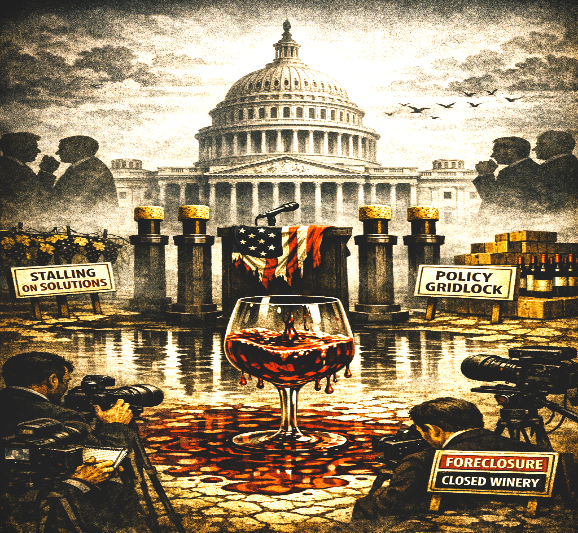
For nearly a century, America has pretended its wine industry is governed by coherent, modern regulation. It isn’t. The world’s largest alcohol market, an economic engine valued between $276 billion and $323 billion in national impact (WineAmerica, 2022), is operating on a regulatory framework built for 1933. Behind the tasting-room romance and tourism gloss lies a system defined by legislative paralysis, distributor concentration, and a legal framework so antiquated it cannot detect, let alone deter, the abuses it was created to prevent. What is unfolding now is not a scandal of individuals. It is a scandal of design. And the officials charged with protecting the public interest have responded with the one thing the system depends on most: silence.
The Architecture of Silence
The American wine industry did not drift into crisis; it was designed into one. The post-Prohibition distribution model, cemented by lobbying power and preserved by legislators unwilling to modernize alcohol law, has produced a marketplace where accountability is discretionary and opacity is structural. Producers face margin compression, consumers face misinformation, and regulators, chronically underfunded and politically unsupported, have been reduced to spectators. What remains is a $300 billion economy functioning without meaningful guardrails, where silence is not a bureaucratic failure but a governing strategy.
An Industry No One Wants to Touch
America’s wine sector supports 1.84 million jobs and more than $95.5 billion in wages (WineAmerica, 2022). Entire agricultural regions, from Napa to the Finger Lakes, from the Willamette Valley to the Texas High Plains, depend on its stability. Yet as the industry enters its most precarious decade in modern history, the response from federal leadership is not merely insufficient. It is strategically absent.
This is not a cyclical correction. It is a slow-motion structural collapse:
- More than 1,500 wineries reporting revenue declines in 2025–2026
- Oversupply crushing margins across California, Oregon, and Washington
- Climate volatility accelerating smoke taint, frost risk, and yield instability
- A generational consumption shift as younger drinkers abandon wine entirely
The alarms are blaring in every producing region. But in Washington? A whisper. A shrug. A fundraiser.
The question is no longer what is happening.
It is why the people with the power to intervene are choosing not to.
The Evidence of a System in Freefall
The crisis is now measurable across every axis:
- Demand: Younger cohorts are drinking less wine, a trend documented in industry analyses and consumer-behavior research (Silber et al., 2023).
- Supply: Chronic oversupply has destabilized pricing and inventory cycles, with growers reporting unsold fruit and wineries cutting production.
- Climate: Peer-reviewed research links climate-driven risks (heat spikes, wildfire smoke, shifting phenology) to long-term threats for U.S. wine regions (Alston et al., 2015; Alston et al., 2017).
- Labor: Persistent shortages in skilled agricultural labor have increased production costs and reduced operational resilience.
These are not abstract pressures. They are structural fractures. And they are accelerating.
The American Wine Industry Withers in Real Time
Vineyards that once produced reliable harvests now face unpicked grapes, idle cellars, and thinning tourism. Climate-driven smoke taint and labor shortages are immediate, measurable threats to yields, product quality, and revenues. UC Davis enology expert Anita Oberholster has stressed the scientific uncertainty surrounding smoke impacts: “There are so many variables… There’s so much we don’t know” (University of California, Davis, n.d.).
At the same time, the economic picture is unmistakably grim. There is an oversupply problem paired with weakening demand. Industry analyst Rob McMillan of Silicon Valley Bank has warned: “We have too much wine, too many wineries, and not enough consumers” (McMillan, 2026). The science remains under development; the economic signals are already clear.
Who Speaks Up—And Who Conveniently Stays Silent
Public records reveal a familiar pattern: city and state officials more often sound alarms, while federal lawmakers speak sporadically, usually on taxes, tariffs, or disaster relief. The Three-Tier System (producer → distributor → retailer) shapes much of the political behavior surrounding alcohol policy. Large wholesalers are significant campaign donors and stable tax remitters for states, which can make legislators reluctant to pursue reforms that threaten existing middlemen (Wark, n.d.).
The Silence Is Not Accidental
One reason the crisis has been allowed to deepen in public view is the quest of elected officials for campaign financing. The industry’s problems are broad, but the political response remains narrow.
- California Breaks Cover: Hearings, Warnings, and Political Reality
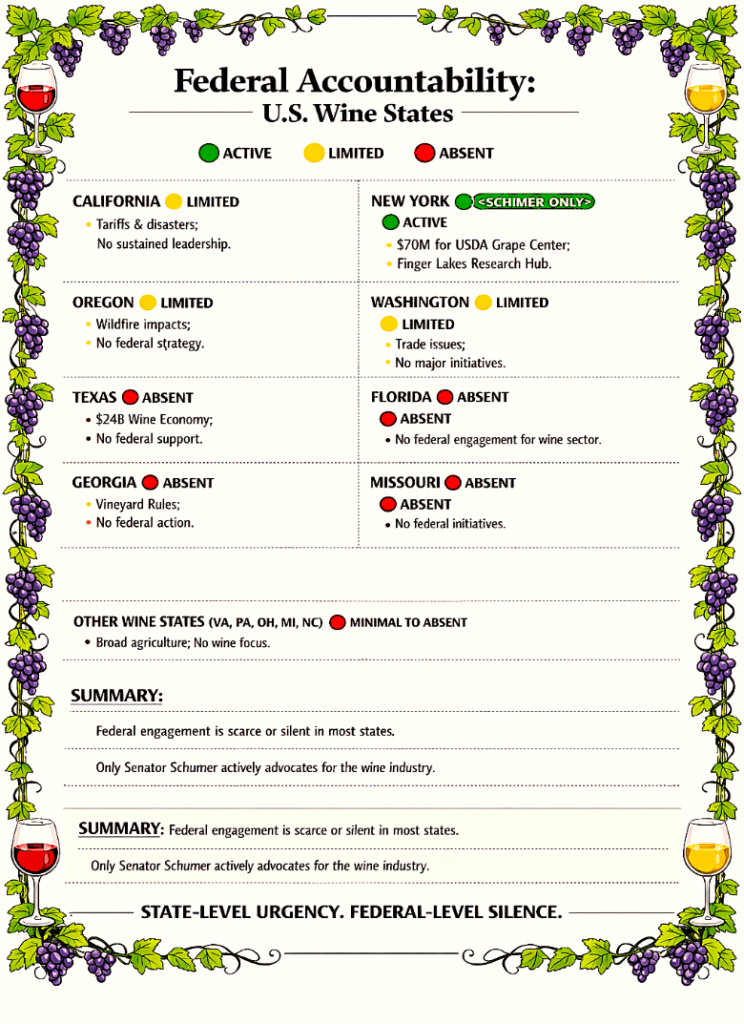
California, home to the single largest state wine economy, estimated at approximately $170.5 billion, has recently launched formal legislative scrutiny. Senator Christopher Cabaldon (D-CA), chairing the California Senate Select Committee on the Wine Industry, stated plainly on March 12, 2026: “When the wine industry thrives in California, California itself thrives… wine is our signature industry for California… a major contributor to our economy statewide” (California Senate Select Committee on the Wine Industry, 2026).
Senator Marie Alvarado-Gil (R-CA) has warned that widespread crop loss and collapsing revenue could erase vineyards and damage California’s global reputation in wine (Alvarado-Gil, 2025).
California’s response does not solve the crisis, but, at least, it acknowledges it openly, and that matters.
- New York’s Split Personality: Federal Advocacy, State-Level Quiet
New York’s wine industry contributes about $6.65 billion to the state economy. Senate Minority Leader Chuck Schumer has been an active federal advocate, championing research infrastructure such as the USDA National Grape Improvement Center in Geneva and positioning the Finger Lakes as a research and innovation hub for the grape and wine sector (Schumer, 2024).
Unfortunately, New York has not yet convened wine-specific legislative hearings comparable to California’s. That absence matters. Federal advocacy can support research and visibility, but it does not substitute for direct state-level policy attention on labor, taxation, infrastructure, tourism, or land use.
Regional Snapshots: Fifty States, One Slow-Motion Collapse
- Oregon — $7.21 Billion on the Line
Oregon’s wine economy, estimated at about $7.21 billion, has shifted from growth rhetoric to survival mode. Winemakers are pleading for relief from retaliatory tariffs and export disruptions that have reduced overseas demand (KGW, 2026). Industry leaders emphasize protecting Pinot Noir and adapting to climate risks, particularly as the region’s identity remains closely tied to quality, terroir, and export reputation. - Texas — A $24.39 Billion Giant Under Pressure
Texas’ wine economy is a major U.S. contributor, estimated at about $24.39 billion. The sector faces regulatory pressure that tends to advantage large industrial producers over small and mid-sized artisan wineries. The Texas Wine and Grape Growers Association continues to push state-level advocacy to protect the sector (Texas Wine and Grape Growers Association, 2026). - Washington — $9.51 Billion and a Shrinking Margin for Error
Washington accounts for roughly $9.51 billion in wine-related activity. While some optimism appears in industry reports, contraction continues, and stakeholders are calling for modernization in wine education, marketing, and production practices (SevenFifty Daily, 2026; American Vineyard Magazine, 2026). - Florida & Georgia — Emerging Sectors, Emerging Threats
Florida’s wine industry contributes to tourism-led economic strategies, and regulatory ease remains a focus for state advocates (Florida Politics, 2026).
Georgia, confronting new licensing requirements for commercial vineyards in 2026, has drawn criticism that regulatory tightening benefits major producers at the expense of small growers (Vinetur, 2026).
Missouri — $3.16 Billion and No Spotlight
Missouri’s $3.16 billion wine economy is threatened by aging infrastructure and a lack of sector-specific legislative attention. The Missouri Chamber urges broad competitiveness initiatives, but sector-targeted hearings remain limited (Missouri Chamber, 2026).
A Few Voices Willing to Fight Back
A small but active group of industry professionals is using litigation, advocacy, marketing, and research to push reform and public awareness.
Gino Colangelo (Colangelo & Partners) is helping transition wine communications from conventional public relations to movement-based marketing. His “Come Together — A Community for Wine” initiative seeks to expand consumer reach and counter anti-alcohol narratives while advocating for “agricultural honesty” and packaging innovation (Colangelo & Partners, 2026; Wine Business, 2026a; Wine Industry Advisor, 2026).
Tom Wark (National Association of Wine Retailers) continues to challenge protectionist barriers embedded in the three-tier system, arguing that current laws reduce interstate competition, stifle innovation, and harm consumers and smaller producers (Wark, n.d.; NAWR, 2026).
Rob McMillan (Silicon Valley Bank) has supplied the data driving many policy conversations. He supports efforts such as a national “Checkoff Program” to reintroduce wine to younger consumers and urges wineries to fundamentally alter consumer engagement strategies (McMillan, 2026).
Karen MacNeil (Come Together) is leading cultural outreach to counter anti-alcohol rhetoric, framing wine as a positive cultural and social good (Wine Business, 2026a).
Old Laws, New Crisis: How 1933 Still Strangles a Modern Industry
The U.S. regulatory framework governing alcohol distribution traces back to 1933 and the post-Prohibition era. The Three-Tier System, originally designed to prevent nefarious trade practices, now often discourages innovation, limits interstate commerce, and reinforces anti-competitive behavior among wholesalers and retailers.
Critics argue that the system reduces incentives for small producers to expand DTC sales and limits consumer choice (Wark, n.d.). In an industry already under pressure from oversupply, changing demand, and climate volatility, outdated regulation becomes more than a bureaucratic inconvenience. It becomes a drag on survival.
What the Industry Is Actually Asking for and Why It Matters
Industry professionals and advocates are coalescing around several concrete policy requests:
• Modernize the Three-Tier System
• Agricultural Parity
• Infrastructure Integration
• Research Funding and Innovation
Policy Implementation: Where Reform Lives or Dies
- DTC parity – Direct to Consumer
- Smoke-taint coverage
- H-2A and seasonal labor
- Infrastructure
Human Impact: The Collapse at Ground Level
Small Napa winery: A boutique producer reported two consecutive vintages impacted by smoke taint and a 35 percent revenue decline, forcing layoffs and reduced tourism operations (industry filings, 2025–2026).
Finger Lakes cooperative: Several growers in upstate New York faced unpredictable harvest windows as late-season heat and smoke altered ripening and increased processing costs (regional reports, 2026).
High Plains Texas artisan: A mid-sized winery shifted to farmer-direct sales and local tasting-room promotions after wholesale channels tightened and interstate distribution became cost-prohibitive (trade interviews, 2026).
These vignettes are illustrative, but they capture the human reality behind the numbers: fewer margins, fewer options, and more pressure on people who already operate on thin margins.
What Readers and Policymakers Must Do Now
Congress and state legislatures should hold hearings focused on wine’s regional economic role, modernize DTC rules to expand market access, and fund research and insurance mechanisms to address climate-driven risks.
Readers can also play a role. Contact state and federal representatives asking for hearings on wine-industry stabilization, support local wineries through DTC purchases when possible, and back research funding for climate adaptation.
The End—or the End of the Beginning
This is not a plea for another glossy economic report destined for a legislative inbox. This is a demand for hearings, legislation, research funding, and public leadership equal to the scale of the crisis. The decline of the American wine industry is not inevitable. It is a policy choice—one law-makers are making through inaction.
Congress and state legislatures can stabilize labor, modernize market access, ensure climate-driven losses, and rebuild the research infrastructure that once made American wine a global force. They can choose transparency over donor pressure, modernization over nostalgia, and economic stewardship over political convenience. Until they do, the vineyards will keep sending up smoke. And the people elected to protect a vital American industry will remain exactly where they have been—in the shadows, hoping no one notices the collapse happening on their watch.
REFERENCES
Alston, J. M., Anderson, K., & Sambucci, O. (2015). Drifting towards Bordeaux? Journal of Wine Economics, 10(3), 349–378. https://doi.org/10.1017/jwe.2015.25 (doi.org in Bing)
Alston, J. M., Anderson, K., & Sambucci, O. (2017). Introduction to the issue. Journal of Wine Economics, 12(2). https://wine-economics.org/wp-content/uploads/2017/10/Vol12-Issue02-Introduction-to-the-Issue.pdf (wine-economics.org in Bing)
Alvarado-Gil, M. (2025). California’s rural wine industry faces collapse amid legislative inaction. Office of Senator Marie Alvarado-Gil. https://sr04.senate.ca.gov/content/californias-rural-wine-industry-faces-collapse-amid-legislative-inaction (sr04.senate.ca.gov in Bing)
American Vineyard Magazine. (2026, February 25). Oregon wine industry awards announced. https://americanvineyardmagazine.com/oregon-wine-industry-awards-announced/ (americanvineyardmagazine.com in Bing)
California Senate Select Committee on the Wine Industry. (2026, March 12). Hearing [Video]. CalMatters. https://calmatters.digitaldemocracy.org/hearings/278965
Colangelo & Partners. (2026). About us: Agency partners. https://www.colangelopr.com/about-us/
Florida Politics. (2026, March 16). Florida maintains economic momentum after 2026 Session, Chamber says. https://floridapolitics.com/archives/785445-florida-maintains-economic-momentum-after-2026-session-chamber-says/ (floridapolitics.com in Bing)
KGW. (2026, January 5). Oregon wine industry looks to 2026 amid tariffs and declining demand. https://www.kgw.com/article/life/food/oregon-winemakers-2026-rebound-tariffs-slowing-sales/283-7599fa03-a0e5-440a-93fb-4d3f46250eb4 (kgw.com in Bing)
McMillan, R. (2026). State of the U.S. wine industry. Silicon Valley Bank. https://www.svb.com/trends-insights/reports/wine-report (svb.com in Bing)
Missouri Chamber of Commerce. (2026, January 7). Missouri Chamber urges legislators to focus on four critical issues. https://mochamber.com/news-archive/missouri-chamber-urges-legislators-to-focus-on-four-critical-issues-during-2026-session/ (mochamber.com in Bing)
National Association of Wine Retailers. (2026, February 18). Retailers urge Supreme Court to take up key case. https://nawr.org/news/
Schumer, C. (2024). Schumer, after years of advocacy, announces groundbreaking for new $70 million USDA National Grape Research Center. U.S. Senate Office. https://www.schumer.senate.gov/newsroom/press-releases/schumer-after-years-of-advocacy-announces-groundbreaking-for-new-70-milli (schumer.senate.gov in Bing)
SevenFifty Daily. (2026, January 15). “The worst is behind us”: Silicon Valley Bank’s 2026 wine industry report. https://daily.sevenfifty.com/the-worst-is-behind-us-svb-2026-wine-report-takeaways/ (daily.sevenfifty.com in Bing)
Texas Wine and Grape Growers Association. (2026, February 27). Advocacy: Economic impact of Texas wine. https://www.txwines.org/advocacy/
University of California, Davis. (n.d.). Wildfire smoke and wine grapes. Viticulture & Enology. https://viticulture.ucdavis.edu/ (viticulture.ucdavis.edu in Bing)
Vinetur. (2026, March 26). Georgia mandates state approval for new commercial vineyards starting in 2026. https://www.vinetur.com/en/2026032698205/georgia-mandates-state-approval-for-new-commercial-vineyards-starting-in-2026.html (vinetur.com in Bing)
Wark, T. (n.d.). The three-tier system and its consequences. National Association of Wine Retailers. https://nawr.org/
WineAmerica. (2022). Economic impact study of the American wine industry. https://wineamerica.org/impact/
Wine Business. (2026a, January 26). Come Together — A Community for Wine, Inc. announces 2025 results and plans for 2026. https://www.winebusiness.com/news/article/313135 (winebusiness.com in Bing)
Wine Business. (2026b, March 11). Wine innovation panel announced for 2026 Wine Market Council Research Conference. https://www.winebusiness.com/news/link/315083 (winebusiness.com in Bing)
Wine Industry Advisor. (2026, March 31). APCOR highlights cork’s unique technical and environmental credentials through new integrated communications efforts. https://wineindustryadvisor.com/2026/03/31/apcor-highlights-corks-unique-technical-and-environmental-credentials/ (wineindustryadvisor.com in Bing)
#WineIndustry #WineCrisis #AgriculturalPolicy #GinoColangelo #EconomicCollapse #WineLobby #ThreeTierSystem #ClimateChange #CaliforniaWine #NewYorkWine #Oenotourism #InMyPersonalOpinion
© 2026 Dr. Elinor Garely / InMyPersonalOpinion.Life . This work is protected in full under U.S. and international copyright law, including the Digital Millennium Copyright Act (DMCA).
All rights strictly reserved. Any unauthorized reproduction, republication, redistribution, adaptation, extraction, or use in AI training datasets constitutes a violation of federal and international law and will be pursued accordingly. Only brief, non-substantive quotations are permitted, and only with full attribution and an active link to the original publication. For licensing or permissions, contact: EG@InMyPersonalOpinion.Life
000