
Introduction:
The crisis facing American wine isn’t just unfolding in the vineyards or on distributor spreadsheets, it’s engineered into the system itself. Part II exposes how a regulatory framework built in 1933 has mutated into a modern distortion machine, determining which wineries survive, which consumers get access, and which regions are allowed to grow. This is where the collapse stops being accidental and becomes structural.
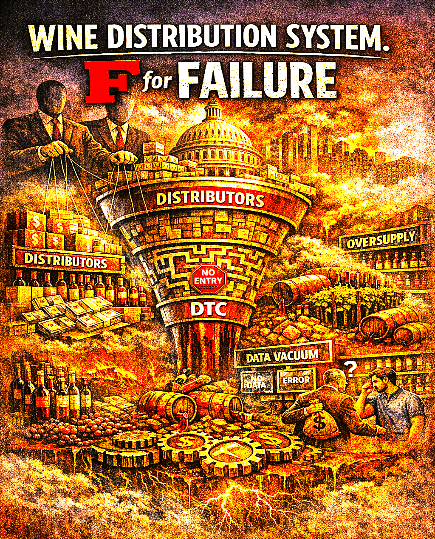
The System of Distortion
Dr. Elinor Garely
A 1933 Arrangement Turns Into a 2026 Crisis
The American wine industry is not simply suffering from market pressures; it is being actively distorted by a regulatory and commercial architecture that rewards consolidation, punishes transparency, and treats innovation as a threat. The Three-Tier System, originally designed in 1933 to prevent tied-house corruption, has evolved into a gatekeeping mechanism that determines which wines reach consumers, which wineries survive, and which regions are allowed to grow. This transformation is well documented in legal and economic analyses showing that the system now functions less as a safeguard and more as a structural barrier to competition (Wark, n.d.; National Association of Wine Retailers [NAWR], 2026). The crisis facing the industry is not merely economic; it is engineered through policy design, political incentives, and commercial leverage that shape the market long before a bottle reaches a shelf.
Channel(s) of Distribution. Designed to Limit Choice
A central distortion arises from the distributor bottleneck. The U.S. alcohol market is dominated by a shrinking number of wholesalers who control the majority of volume flowing through the system. Their incentives prioritize high-volume brands, minimize logistical complexity, and maximize margin through consolidation. As a result, small and mid-sized wineries, representing the majority of U.S. producers, are structurally disadvantaged because they cannot buy placement, attention, or leverage.
Trade analyses and industry litigation consistently show that distributor consolidation reduces competition, raises prices, and restricts interstate commerce (Wark, n.d.; NAWR, 2026). In practice, this means consumer choice is curated by middlemen rather than by demand, creating a marketplace where access is determined by portfolio priorities rather than product quality.
The DTC Irony. A Lifeline Turned into a Maze
Direct-to-consumer (DTC) sales were once heralded as the democratizing force that would allow wineries to bypass entrenched distribution barriers. Instead, DTC has become a patchwork of inconsistent state laws, protectionist restrictions, and compliance burdens that disproportionately harm smaller producers. States continue to block out-of-state shipments, wholesalers lobby aggressively to restrict DTC growth, and compliance costs often exceed the margins of small wineries. These constraints are especially damaging in an era of oversupply, where DTC should function as a pressure valve but instead operates as a maze designed to exhaust the very producers who need it most (Wark, n.d.). The result is a system where market access is theoretically available but practically unattainable for many wineries.
Excess
Oversupply itself is not the crisis; the way it interacts with the distribution system turns a market correction into a structural collapse. The distortion loop is predictable: growers produce fruit based on multi-year contracts; wineries overproduce to maintain distributor relationships; distributors push volume from large brands, sidelining smaller producers; retailers rely on distributor incentives rather than consumer demand; and consumers ultimately see fewer options, reinforcing consolidation. Industry analyst Rob McMillan captures this dynamic succinctly: “We have too much wine, too many wineries, and not enough consumers” (McMillan, 2026). His warning is not merely about demand; it is an indictment of a system that forces overproduction while restricting access to consumers.
Data Vacuum
Compounding these distortions is a profound data deficit. Unlike other major agricultural sectors, the wine industry lacks real-time production data, standardized climate-risk reporting, national inventory tracking, and coordinated research funding. This vacuum allows wholesalers to control market intelligence, legislators to claim ignorance, and regulators to avoid accountability. Peer-reviewed research demonstrates that climate-driven volatility, heat spikes, wildfire smoke, shifting phenology, is accelerating across U.S. wine regions (Alston et al., 2015; Alston et al., 2017). Yet federal investment in viticulture research remains fragmented and insufficient. The result is an industry navigating a twenty-first-century crisis with twentieth-century tools.
Political Dis-Incentive. Silence is Lucrative
Political incentives further entrench these distortions. Large wholesalers are major campaign donors, states rely on alcohol taxes as stable revenue streams, and legislators avoid reforms that threaten donor relationships. Federal lawmakers tend to focus on tariffs or disaster relief rather than structural modernization, leaving the core regulatory framework untouched. This dynamic explains why California stands nearly alone in holding formal hearings on the crisis (California Senate Select Committee on the Wine Industry, 2026), while other states remain silent. It also explains why New York champions research infrastructure but avoids regulatory scrutiny. Silence is not a failure of awareness; it is a political strategy.
Consumers Confused. The Appearance of Choice
Consumers operate within a misinformation loop. They believe they are choosing freely, but the choices are shaped by distributor portfolios, retailer incentives, limited shelf space, marketing budgets, and state shipping restrictions. Younger consumers, already drifting away from wine, encounter a marketplace that feels outdated, opaque, and unresponsive. Industry outreach initiatives such as Come Together — A Community for Wine attempt to counter this trend by reframing wine as a cultural and social good (Colangelo & Partners, 2026), but they are fighting against a system designed to limit visibility. The distortion is cultural as much as economic.
Spin Wins
Ultimately, every distortion reinforces the next. Oversupply worsens because producers cannot reach consumers. Climate risks worsen because research is underfunded. Labor shortages worsen because margins collapse. Political inaction worsens because donors benefit from the status quo. This is not a market failure; it is a policy-enabled distortion cycle. And it is accelerating.
REFERENCES
Alston, J. M., Anderson, K., & Sambucci, O. (2015). Drifting towards Bordeaux? Journal of Wine Economics, 10(3), 349–378. https://doi.org/10.1017/jwe.2015.25
Alston, J. M., Anderson, K., & Sambucci, O. (2017). Introduction to the issue. Journal of Wine Economics, 12(2). https://wine-economics.org/wp-content/uploads/2017/10/Vol12-Issue02-Introduction-to-the-Issue.pdf
Colangelo & Partners. (2026). About us: Agency partners. https://www.colangelopr.com/about-us/
McMillan, R. (2026). State of the U.S. wine industry. Silicon Valley Bank. https://www.svb.com/trends-insights/reports/wine-report
National Association of Wine Retailers. (2026, February 18). Retailers urge Supreme Court to take up key case. https://nawr.org/news/
Wark, T. (n.d.). The three-tier system and its consequences. National Association of Wine Retailers. https://nawr.org/
#WineIndustry #WineCrisis #ThreeTierSystem #RegulatoryFailure
#AgriculturalPolicy #WineEconomics
#DTCWine #DistributorConsolidation #ClimateRisk #WineReform #InMyPersonalOpinion
© 2026 Dr. Elinor Garely / InMyPersonalOpinion.Life . This work is protected in full under U.S. and international copyright law, including the Digital Millennium Copyright Act (DMCA).
All rights strictly reserved. Any unauthorized reproduction, republication, redistribution, adaptation, extraction, or use in AI training datasets constitutes a violation of federal and international law and will be pursued accordingly. Only brief, non-substantive quotations are permitted, and only with full attribution and an active link to the original publication. For licensing or permissions, contact: EG@InMyPersonalOpinion.Life
000