
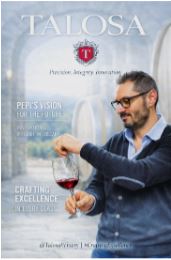
Inside Italy’s Talosa’s Quiet Revolution in Montepulciano
Dr. Elinor Garely, Editor in Chief
I met with Cristian Pepi in a Manhattan dining room humming with midday energy,
Cristian Pepi speaks with the rare clarity of someone who knows exactly what his winery stands
for, and what it refuses to become. In a world crowded with noise, Talosa is choosing precision,
identity, and a future built on authenticity rather than spectacle.
I spent a terrific afternoon with the Sales Manager of one of Italy’s most respected
estates, and what I learned was not only interesting, but instructive. Pepi offered something
increasingly rare in the wine world: a philosophy grounded in discipline, cultural coherence, and
long-term vision. His comments suggest a template not just for Talosa, but for any producer
seeking relevance without surrendering identity.
Pepi Was Waiting… Was I Late?
Cristian Pepi was already seated when I arrived, tucked into a corner table at the back of
a crowded westside Italian restaurant where the lunch rush surged like a tide. The room buzzed
with the kind of energy only Manhattan can produce; servers weaving between tables,
conversations rising and falling in a dozen accents, glasses clinking in the background.
Pepi sat with a calm, grounded presence, the kind of composure that comes from
someone who has learned to navigate both chaos and clarity. It fits him. He has spent his
professional life at the intersection of hospitality, agriculture, and global wine culture. Before
joining Talosa, he worked directly with sommeliers, importers, and on-premise buyers, building
relationships bottle by bottle, conversation by conversation.
He has poured wine in dining rooms, led tastings for skeptical buyers, walked vineyards
with agronomists, and sat in boardrooms where the language of wine becomes the language of
markets. His background is not theoretical. It is lived. And it shows in the way he speaks:
precise, unhurried, and anchored in experience rather than performance.
Talosa itself carries a weight of history that Pepi never uses as decoration. The estate is
one of Montepulciano’s most respected, with roots that stretch back to the 1500s and a cellar
carved deep into the tufa beneath the historic center. Its vineyards rise between 350 and 450
meters, giving the wines their characteristic tension…. altitude-driven freshness layered over
the natural depth of Prugnolo Gentile.
Over the past decade, Talosa has earned global recognition for producing Vino Nobile
that balances structure with elegance, precision with soul. Yet Pepi is refreshingly
unsentimental about success. “We are not competing on price,” he told me. “Price competition
destroys continuity. Continuity is what builds a market.”
Price and Continuity
That statement set the tone for the entire conversation. Talosa has deliberately reduced
fragmented, low-margin placements in the U.S. market and focused instead on fewer importers
and on-premise partners capable of building long-term consistency. The strategy is simple, but
not easy: eliminate noise, concentrate on quality placements, and invest in relationships that
outlast a single vintage or a single order.
The results, Pepi said, have been measurable. Reorder frequency has increased. Bottle
rotation in premium restaurants has improved. Sommeliers are more engaged. And in strategic
markets such as New York, the wine is selling through with greater stability.
- “We don’t want one-time placements,” he said. “We want relationships.”
That distinction matters. In an industry too often seduced by distribution for its own
sake, Pepi’s approach is a reminder that visibility without continuity is an expensive illusion.
Talosa is not trying to be everywhere. It is trying to be understood, respected, and remembered
where it matters most.
Clarity Over Complexity
When the conversation turned to the Pieve designation, Pepi leaned in slightly, not to
emphasize a point, but to correct a misconception.
- “People think it complicates things,” he said. “It actually clarifies them.”
Montepulciano has always been a mosaic of soils, altitudes, and microclimates, but for
decades the world flattened it into a single generic identity. The Pieve system, Pepi explained,
finally gives language to distinctions that have long existed but were not fully explained. It is
less about reinvention than about precision.
“Complexity only becomes a weakness when it lacks clarity,” he said. “Our responsibility
as producers is to make these distinctions understandable through consistency and
transparency, not marketing abstraction.”
That idea is central to Talosa’s philosophy. The estate is not chasing novelty for its own
sake; it is refining how identity is communicated. In Pepi’s view, territorial precision strengthens
Vino Nobile rather than diminishing it. It gives the region a more exact and credible voice.
Technology With Purpose
Pepi speaks about technology with equal discipline. His view is notably free of both hype
and fear. “Technology becomes a problem only when it replaces interpretation instead of
supporting it,” he said.
Talosa’s climate monitoring systems and vineyard sensors are not designed to
standardize wine. They are there to reduce avoidable mistakes and respond more precisely to
increasingly unstable vintages. The goal is not uniformity. It is the opposite: preserving vineyard
identity despite climate volatility.
“A historic vineyard planted in 1969 behaves differently from a younger site,” Pepi
noted. “Technology helps us respect those differences more accurately rather than flatten
them.”
That distinction is important. In a sector where innovation is often framed as a threat to
tradition, Pepi offers a more intelligent model. Technology, in his view, is not a replacement for
craftsmanship; it is a tool that allows craftsmanship to function better under contemporary
conditions.
Italy as Benchmark
Pepi’s perspective on the domestic Italian market is equally unsentimental. “We do not
see Italy as a vulnerability,” he said. “Italy remains our cultural foundation and an essential
testing ground for long-term credibility.”
Italian consumers, he explained, are highly informed, less easily swayed by trends, and
less impressed by score-chasing or marketing gloss. That makes the domestic market
demanding, but also invaluable. If a wine works in Italy, it works because it deserves to.
“At the same time, relying exclusively on domestic consumption would clearly limit
growth potential,” he added. “That is why Talosa continues to expand internationally while
maintaining a strong local presence.”
For Pepi, Italy is not a safety net. It is a benchmark. That is an elegant way of saying that
credibility at home matters as much as visibility abroad.
Luxury and Relevance
Pepi’s definition of luxury is grounded in realism. “Luxury positioning only works if the
product maintains relevance after the tariff impact reaches the final consumer,” he said. “There
is a threshold beyond which absorbing additional costs becomes unsustainable for both
producer and importer.”
In other words, luxury is not just about image. It is about whether the product still
makes sense once it reaches the table. That means operational efficiency, long-term
partnerships, and coherent market positioning matter more than short-term expansion.
He was equally candid about packaging. Heavy glass, once associated with prestige, no longer
automatically signals value. “If a significant reduction in bottle weight created a meaningful
environmental improvement without compromising wine protection, it would be a logical
decision for us.”
That is a modern definition of luxury: thoughtful, credible, and free of excess that no
longer serves the wine.
Wine at the Center
Pepi is clear that wine remains the center of Talosa’s identity. “Hospitality is not
replacing agriculture,” he said. “It is creating a more direct relationship between the territory
and the final consumer.”
The Talosa wine resort is not a real estate venture detached from the estate’s
agricultural roots. It is a way of making the world behind each bottle more accessible. The
credibility of the project, however, still depends on the vineyards.
- “If the wine is not strong, the hospitality project has no foundation.”
That statement captures the hierarchy beautifully. Experience matters, but it cannot
outshine the product that made the experience necessary in the first place. Talosa understands
that hospitality can amplify wine, but it cannot substitute for it.
Tradition and Change
Pepi also spoke with honesty about the tensions within family businesses. “Every family
business lives with a natural tension between continuity and change,” he said. “The most
difficult innovation is not introducing something new. It is having the clarity to remove what is
no longer necessary.”
That may be one of the most insightful lines in the interview.
It is this idea that gives the estate both discipline and flexibility. It also explains why
Talosa feels so coherent. The old cellar carries memory. The modern facilities provide
efficiency. Both are essential, and neither is enough on its own
- “Tradition is not repetition,” Pepi said. “Tradition is understanding what should continue.”
Montepulciano, Not Comparison
Pepi refuses to define Vino Nobile by comparison to other Tuscan benchmarks. “We are
not the alternative to anything,” he said. “We are Montepulciano.”
That may be one of the most effective brand statements in the interview.
Montepulciano, in his view, offers a rare combination of elegance, aging potential, and cultural
accessibility. It is not trying to mimic Chianti’s volume or Brunello’s financial positioning. It has
its own logic and its own value.
“Our responsibility is not to transform Vino Nobile,” he said. “It is to communicate it
better.” That is exactly right. Too often, regions weaken themselves by trying to sound like
someone else. Pepi’s thinking goes in the opposite direction: sharpen identity, explain it clearly,
and let the wine stand on its own merits.
The Changing Ritual
Pepi also sees a profound shift in how people drink wine today. “Wine is becoming less
formal and more personal,” he said. “Today, an important bottle is not necessarily opened
during a celebratory white-tablecloth dinner. More often, it is shared in spontaneous contexts:
at home, during informal conversations, in smaller gatherings, or through travel and territorial
experiences.”
That is a significant observation. It reflects a broader cultural move away from ceremony
as proof of value and toward intimacy as the new measure of significance. For Talosa, this shift
matters because it reframes luxury not as performance, but as connection.
“The modern ritual,” Pepi believes, “is creating authentic connections without requiring
formal settings.” Thia is a powerful idea, and a very contemporary one.
Precision and Drinkability
Climate change is also reshaping the conversation. Pepi was careful not to use
environmental pressure as an excuse for stylistic simplification. “We are not trying to produce
artificially lighter wines,” he said. “We are trying to make more precise wines.”
Freshness, in his view, should not be manufactured. It should emerge naturally from the
vineyard and harvest management. The structure of Vino Nobile remains essential, but
elegance and drinkability now matter even more.
“The risk exists,” he said, “but it largely comes from market oversimplification.”
That is a valuable insight. Regions do not usually lose relevance because they lack
quality. They lose relevance because they fail to explain themselves in ways modern consumers
can understand.
Scores and Loyalty
Pepi’s position on scores is pragmatic. “Scores still carry commercial weight, especially
in certain international markets,” he said. “It would be unrealistic to deny it;” however, he is
equally clear that scores are not the center of the strategy. Younger generations build trust
through direct experiences, recommendations, and fragmented digital communication. A high
score may create attention, but it does not create lasting loyalty if the wine lacks consistency.
- “Scores create attention,” he said. “Consistency creates loyalty.”
That is a statement every producer should take seriously. Ratings may open the door,
but only substance keeps people inside.
Authenticity and the Future
Pepi’s definition of authenticity was one of the strongest moments in our conversation.
“Authenticity is not a slogan,” he said. “It is the combination of factors that cannot be fully
replicated.”
He went on to describe the soils of Montepulciano, the altitude, the temperature
variation, and the behavior of Prugnolo Gentile as forces that create a specific balance of
acidity, tannic structure, and aromatic elegance that cannot be reproduced elsewhere.
“Authentic wine is not wine that tries to be recognizable through style,” he said. “It is
wine that could not be born anywhere else.” This is the essence of the story. Talosa is not trying
to become louder, broader, or more marketable by dilution. It is trying to become clearer.
As our conversation wound down, Pepi’s attention shifted toward the future. Talosa is
investing in energy independence, refining cellar practices, and preparing a new generation of
vineyards to carry the estate forward.
“The next chapter is precision,” he said. “We don’t want to grow for the sake of growth.
We want to evolve with purpose.”
This feels like the right ending for a winery that understands its own identity so well. In a
world that often mistakes volume for success, Talosa is making a more difficult and more
compelling choice: to refine, to clarify, and to remain itself.
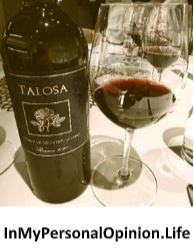
Talosa’s Vino Nobile di Montepulciano Riserva 2020 earns its luxury status not through
theatrics, but through quiet, disciplined craftsmanship. It opens with the composed confidence
of ripe cherry, plum, cocoa, and subtle spice, with each element integrated rather than
embellished.
The tannins are polished, the acidity lifts without cutting, and the finish lingers with the
ease that signals intention and investment. Luxury here is defined by restraint and lineage.
Talosa’s historic cellar and patient Riserva process reflect a commitment to precision over
trend.
The 2020 vintage gives the estate ripe fruit and natural freshness, allowing depth
without heaviness. This is a tailored wine, not a mass-market performance. It rewards attention
and reflects a standard rather than a style.
For InMyPersonalOpinion.Life, the larger story is about intentionality. Talosa’s Riserva
2020 is proof that true luxury is not advertised. It is earned.