
Why Italian Espresso Captivates America?
What Would Make It Unforgettable?
Dr. Elinor Garely
The Room Where Nothing Happened
The espresso was perfect. Not “good” — perfect. The gelato had texture, balance, and restraint. The pastries looked like they belonged behind glass in Milan, not on a folding table in a Manhattan event space. The branding was confident, and unmistakably Italian.
Yet — nothing. No sparkle. No excitement. No deals.
At a recent Italian coffee and specialty food showcase in Manhattan, buyers tasted. Media nodded. Conversations did not happen. There was no follow-up and no follow-through. This was not about quality. The products were extraordinary. This was about fit, or, more precisely, the absence of it.
If there is one uncomfortable truth Italian producers need to accept about the U.S. market, it is this: excellence is admired, but relevance is purchased. As Harvard Business School Professor Theodore Levitt observed, people do not buy products; they buy solutions to problems (Levitt, 1983). Decades of international marketing research confirm the same point: companies that adapt to local behavior consistently outperform those that export their model intact (Theodosiou & Leonidou, 2003; Zou & Cavusgil, 2002). Italian brands are not failing because they are bad. They are failing because they are proud of the wrong things.
America Does Not Drink Coffee the Italian Way
Start with scale. According to the National Coffee Association’s 2024 National Coffee Data Trends Report, roughly two-thirds of Americans drink coffee every single day (National Coffee Association, 2024). That is not a niche market. It is the default behavior of a nation.
But the composition of that cup has shifted dramatically. The Specialty Coffee Association’s 2024 Consumer Trends Report tracks where actual growth is occurring: cold brew, ready-to-drink formats, and highly customized beverages engineered for mobility, not contemplation (Specialty Coffee Association, 2024). Statista’s 2025 analysis of the U.S. coffee market reinforces the pattern, the ready-to-drink segment keeps expanding because it fits American life (Statista, 2025). By 2026, the U.S. cold brew market alone surpassed $4.7 billion, driven by a 22 percent surge in on-the-go formats, according to Fortune Business Insights’ Cold Brew Coffee Market report (Fortune Business Insights, 2026).
James Hoffmann, 2007 World Barista Champion, co-founder of Square Mile Coffee Roasters in London, and author of The World Atlas of Coffee, frames the structural problem with precision: “Coffee culture adapts to the people who drink it, not the other way around” (Hoffmann, 2018, p. 14). That single observation explains why the Italian espresso model — short, hot, fast, and fixed — struggles in a culture that treats a 24-ounce vacuum-insulated tumbler as a daily essential.
The Real Mistake: Treating America as a Destination
Too many Italian brands approach the United States as a destination, as if the job is to ship product, tell a story, and let heritage close the sale. The Organization for Economic Co-operation and Development has documented for years that companies underperform internationally not because their products are weak, but because their localization strategy is insufficient (OECD, 2024).
In the U.S. market, that failure materializes as friction. NielsenIQ’s 2024 Global Consumer Behavior research found that purchase decisions happen almost instantly, and any ambiguity acts as a barrier to sale (NielsenIQ, 2024). That friction takes three specific forms:
- Heritage versus utility. Italian brands lead with provenance and legacy. American consumers scan for utility. McKinsey & Company’s 2023 research on consumer personalization found that shoppers now expect products to offer a seamless fit into their existing routines; if the packaging does not explain how the product fits, it is ignored (McKinsey & Company, 2023).
- Physical format mismatch. Italian formats frequently fail to account for the physical realities of a mobile society, products that do not fit cup holders, gym bags, or American refrigerator shelving. Zou and Cavusgil identified format localization as a persistent failure point in international market entry nearly a quarter century ago, and it remains unresolved (Zou & Cavusgil, 2002).
- The clarity gap. NielsenIQ research identifies “clarity of use” as a top-three driver of first-time grocery purchases (NielsenIQ, 2024). When a label tells the story of Tuscan hills but fails to answer the shopper’s immediate question…is this for my Keurig or my cold brew pitcher, the sale is lost to a competitor who answers that question in two seconds.
Adapting the Guardian: What the illycaffè Pivot Actually Involved
Even illycaffè, the most disciplined guardian of Italian coffee identity, the brand that spent decades insisting on a single, perfect blend, has been forced to reckon with this reality. Watching how that reckoning has unfolded is instructive for any Italian producer considering the U.S. market.
Cristina Scocchia became CEO of illycaffè in January 2022, bringing a background that included senior roles at L’Oréal and the transformation of Kiko Milano. Since her appointment, she has consistently emphasized that being operationally closer to the U.S. market is no longer optional. The explosive American demand for cold-brew bases, a format that barely exists in traditional Italian coffee culture, has required illycaffè to develop products and positioning that would have been unthinkable under the brand’s previous strategic framework (Comunicaffè, 2025).
The lesson is not that illycaffè abandoned its identity. It did not. The single-blend standard is intact. What changed was format, channel communication, and operational proximity to the market. That is the model Theodosiou and Leonidou describe as effective localization… targeted adaptation of specific variables while holding the core proposition fixed (Theodosiou & Leonidou, 2003). It is surgical, not wholesale.
Most Italian brands never reach that conclusion. They attend the trade show, bring the beautiful product, shake the hands, and return home to wait for the market to come to them. The market does not come.
Who Is Winning. The Pattern Shared
Not every Italian-origin brand is failing in the U.S. market. The brands that are succeeding share a recognizable pattern.
Lavazza has made meaningful gains by deploying Italian heritage as a targeted quality signal rather than a general story. Mintel’s 2024 research on the U.S. espresso segment found that espresso consumers are less likely to view affordability as an ideal brand descriptor, and more likely to seek luxury and provenance (Mintel, 2024). Lavazza’s “Torino, Italia, 1895” origin claim on front-of-pack communicates directly to that segment, rather than attempting to win the mass market with messaging calibrated for a different culture (Mintel, 2024).
De’Longhi has won differently, by becoming the infrastructure of the American home espresso moment rather than a purveyor of a specific coffee philosophy. The De’Longhi La Specialista Opera with Cold Brew was named among the best espresso machines of 2026 by CNN Underscored precisely because it meets American coffee behavior rather than attempting to redirect it (CNN Underscored, 2026). Cold-brew preset, built-in grinder, intuitive interface: it answers the question the buyer is actually asking. The brands still losing are the ones waiting for Americans to start standing at a coffee bar.
Coffee’s Biggest Opportunity: Inheriting Wine’s Cultural Moment
The most underreported story in the American beverage market in 2026 is not about coffee at all. It is about what is happening to wine, and what that creates for coffee.
In January 2023, the World Health Organization issued guidance stating that no level of alcohol consumption is safe for health (World Health Organization, 2023). That statement arrived in a consumer culture already trending toward health consciousness. Wine and beverage author Karen MacNeil has documented that younger consumers are drinking less wine and doing so less frequently, with social wine rituals being displaced by health-aligned alternatives (MacNeil, 2023).
Coffee is the primary beneficiary of that displacement, and its health narrative is actively positive. Research published in Circulation by Ding et al. (2014) linked long-term coffee consumption to lower cardiovascular risk. More recently, research highlighted by the Harvard Gazette in 2026 associated two to three daily cups with an 18 percent reduction in dementia risk (Harvard Gazette, 2026).
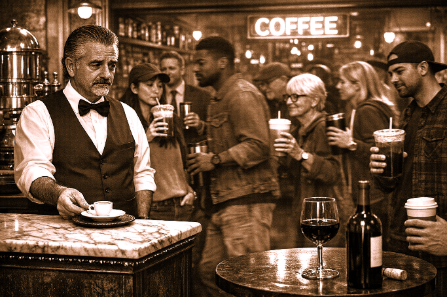
The result is a cultural opening that Italian producers are sitting directly on top of, and largely failing to exploit. The third-wave coffee bar is becoming what the wine bar was a generation ago, a place of social ritual, connoisseurship, and identity. The consumer who would have spent a Thursday evening at a natural wine bar is increasingly spending it at a specialty coffee shop.
Italian coffee carries exactly the cultural cachet that American consumers are seeking in this new social ritual: provenance, craft, heritage, and the insistence that a small thing done perfectly is worth slowing down for. The playbook that built Italian wine’s reputation in America over four decades — education, experience, aspiration — is sitting open and available for Italian coffee right now. Almost no one is running it.
Three Changes That Would Actually Move the Needle
- Lead with utility, close with heritage. Reverse the information order on every piece of packaging and every trade presentation. The first question a U.S. buyer asks is: what is this for, and how does it fit into my customer’s life? Answer that question first — in plain language, on the front panel, in the first slide. Then, and only then, tell the story of the hillside in Trieste. The heritage is the reason to trust the product. It is not, by itself, the reason to buy it.
- Engineer one American format before the next trade show. Choose one product and adapt it specifically for American consumption patterns: cold-brew compatible, RTD-ready, or single-serve-format. Bring that product to market, generate data, and use that data to inform the broader line. Theodosiou and Leonidou found that targeted local adaptation, not wholesale reinvention, is what separates brands that succeed internationally from brands that do not (Theodosiou & Leonidou, 2003). One adapted product is a beachhead, not a compromise.
- Market coffee as the new wine, not as the old espresso. The Thursday-evening social occasion is open and uncontested. Position premium Italian coffee explicitly as a health-conscious alternative to wine for social gatherings. Build the experience, the tasting, the education, the provenance conversation, that the wine industry spent forty years constructing. The consumer is already moving in this direction. The Italian coffee producer who meets them there first will own the category.
InMyPersonalOpinion
Quality creates the story. Adaptation determines whether the story sells. In the United States, heritage may open the door, buyers will taste the espresso, and they will be impressed. But relevance, which means removing every ounce of friction between the product and the shelf, is what closes the sale and keeps the brand there. As Howard Schultz, former CEO of Starbucks, put the principle plainly: “Success is not in the coffee, but in how you connect with the customer” (Schultz, 2011, p. 48).
The brands that will win the American market in the next decade are the ones that stop waiting for America to become Italy and start figuring out what Italy can become in America. That is a very different brief. And it starts the morning after the trade show.
References
CNN Underscored. (2026). The best espresso machines in 2026, tried and tested. CNN. https://www.cnn.com/cnn-underscored/reviews/best-espresso-machines
Comunicaffè. (2025). Illy U.S. production strategy. https://www.comunicaffe.com/illy-us-production-strategy/
Ding, M., Satija, A., Bhupathiraju, S. N., Hu, Y., Sun, Q., Han, J., Lopez-Garcia, E., Willett, W., van Dam, R. M., & Hu, F. B. (2014). Long-term coffee consumption and risk of cardiovascular disease. Circulation, 129(6), 643–659. https://doi.org/10.1161/CIRCULATIONAHA.113.005925
Fortune Business Insights. (2026). Cold brew coffee market size, share & industry analysis. https://www.fortunebusinessinsights.com/cold-brew-coffee-market-102647
Harvard Gazette. (2026). Coffee consumption and cognitive health: 2026 updates. Harvard University. https://news.harvard.edu/gazette/2026/coffee-dementia-study
Hoffmann, J. (2018). The world atlas of coffee (2nd ed.). Octopus Publishing.
Levitt, T. (1983). The marketing imagination. Free Press.
MacNeil, K. (2023). Wine consumer trends. https://www.karenmacneil.com
McKinsey & Company. (2023). The future of personalization. https://www.mckinsey.com/capabilities/growth-marketing-and-sales/our-insights/the-future-of-personalization
Mintel. (2024). Three key takeaways for brands in the espresso market. Mintel Group. https://www.mintel.com/insights/food-and-drink/three-takeaways-brands-espresso-market-from-sabrina-carpenter/
National Coffee Association. (2024). National coffee data trends report. https://www.ncausa.org/Newsroom/NCDT-2024-release
NielsenIQ. (2024). Global consumer behavior insights. https://nielseniq.com
OECD. (2024). SME and entrepreneurship outlook. Organization for Economic Co-operation and Development. https://www.oecd.org/industry/smes/
Schultz, H. (2011). Onward: How Starbucks fought for its life without losing its soul. Rodale Books.
Specialty Coffee Association. (2024). Coffee consumer trends report. https://sca.coffee/research
Statista. (2025). Coffee market in the United States. https://www.statista.com/topics/1249/coffee-market/
Theodosiou, M., & Leonidou, L. C. (2003). Standardization versus adaptation of international marketing strategy: An integrative assessment of the empirical research. International Business Review, 12(2), 141–171. https://doi.org/10.1016/S0969-5931(02)00094-X
World Health Organization. (2023). No level of alcohol consumption is safe for our health. https://www.who.int/europe/news/item/04-01-2023-no-level-of-alcohol-consumption-is-safe-for-our-health
Zou, S., & Cavusgil, S. T. (2002). The GMS: A broad conceptualization of global marketing strategy and its effect on firm performance. Journal of Marketing, 66(4), 40–56. https://doi.org/10.1509/jmkg.66.4.40.18519
#InMyPersonalOpinion #CoffeeIndustry #ItalianBrands #MarketReality #ConsumerBehavior #GlobalMarketing #SpecialtyCoffee #RetailStrategy #BrandStrategy #WineIndustry #USMarket #InnovationVsTradition
© 2026 Dr. Elinor Garely / InMyPersonalOpinion.Life Protected by U.S. & international copyright + DMCA. No reproduction, reposting, scraping, archiving, or AI training allowed. Violations may result in takedowns + legal action. Permissions: EG@InMyPersonalOpinion.Life