

And What It Actually Costs to Eat It
Dr. Elinor Garely
Every once in a while, you stumble across a topic so fascinating, so controversial, and so futuristic that you immediately want to text the link to five friends. This is one of those stories.
Welcome to the mind-bending world of cultivated meat, also known as cellular agriculture. If you think this is just another veggie burger or some fancy tofu trying its best to mimic beef, buckle up. This is a multibillion-dollar geopolitical chess game that is actively rewriting the economics, regulation, and politics of food production.
Picture the First Date
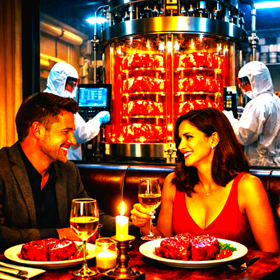
Imagine trying to impress a new dinner date with a cutting-edge menu. You slide into a sleek booth, order a crisp Goose Bay Sauvignon Blanc from New Zealand, and casually point to the special of the night: bioreactor flank steak.
Your date glances at the kitchen, expecting to see a frantic line cook tossing garlic into a smoking pan. Instead, through a giant observation window, there stands a team of scientists in white protective gear, precisely calibrating digital control panels and monitoring a towering stainless-steel tank.
“Don’t worry,” you whisper reassuringly, “the technicians say the liquid amino broth achieved optimal fluid dynamics this morning. It’s perfectly sterile.”
Cultivated Meat Production. Is It Food?
This is not science fiction; it is the working model of cultivated meat production. Scientists begin with a small tissue sample from an animal such as a cow, chicken, or quail. They place those cells in a bioreactor and feed them a nutrient-rich medium containing amino acids, sugars, vitamins, and other growth factors. Under controlled conditions, the cells proliferate, attach to a scaffold or structure when needed, and develop into animal tissue that can be harvested for food.
It is not yet accurate to call cultivated meat fully identical to conventional meat in every structural, sensory, and economic respect, especially at commercial scale, but it is biologically derived animal tissue rather than a plant substitute. As Josh Tetrick, CEO of Eat Just, has argued, “growing meat instead of raising animals for food” changes the basic logic of how protein is produced and distributed.
The Money Trail
This is where the story gets even more interesting. For a while, Silicon Valley treated cultivated meat like the next massive tech gold rush. Venture capital poured into the sector, and industry interest accelerated rapidly as investors and founders imagined a future in which bioreactor steaks would eventually sit next to conventional meat in grocery stores.
That dream has run into a brutal financial wall. Rising capital costs, expensive facilities, and the ongoing challenge of scaling production have made it much harder for startups to attract patient private money. As a result, many companies have narrowed their ambitions, reduced headcount, or pivoted toward partnerships rather than direct-to-consumer retail models.
The money did not disappear. It shifted. And who is funding the industry now tells you where the future may be heading.
The B2B Pivot
Cultivated meat companies are increasingly positioning themselves as ingredient suppliers for industrial food manufacturers rather than standalone consumer brands. That means their cells may show up first in nuggets, sausages, blended products, and processed foods rather than expensive restaurant-only steaks.
The geopolitical power play. With private capital becoming more cautious, governments have stepped in. Nations that rely heavily on food imports, including Singapore, have viewed cellular agriculture as a strategic tool for food security and supply-chain resilience.
The big meat hedge. In a twist of corporate irony, some of the largest financial backers of cultivated meat are major conventional meat companies. This is not necessarily about environmental idealism. It is also a hedge against a future in which alternative protein takes a meaningful share of the market.
What it Really Costs
If you want to sit down and actually eat cultivated meat, your options remain limited, and public availability is still concentrated in a very small number of markets, with Singapore serving as the clearest example of restaurant-level access. In other words, this is still an early-stage food system, not a mainstream supermarket category.
Because cultivated meat is still expensive to produce, the real-world pricing is eye-opening.
1. The luxury status symbol: the US$214 quail parfait
The Australian biotech firm Vow launched its commercial Forged Parfait, made from cultured Japanese quail cells, through elite dining venues in Singapore. It appeared as part of an exclusive tasting menu designed less as a mass-market product and more as a proof of concept for high-end hospitality.
The bill: US$214 for the dining experience.
The math: analysts who broke down the portion size estimated that the small 8-gram serving cost roughly US$15, which implies an extraordinary wholesale cost per kilogram. That kind of price helps explain why cultivated meat is still, for now, a luxury novelty rather than a routine grocery item.
2. The loss leader: the US$16 chicken pasta
For a more casual example, Huber’s Bistro in Singapore partnered with Eat Just’s GOOD Meat division to offer a cultivated chicken entrée.
The bill: about US$16 for the plate.
The catch: the restaurant has used cultivated chicken as a highly controlled limited-run item, which means the economics are still unusual and, in many cases, supported by company strategy rather than traditional restaurant margins. In practice, this type of offering serves as a public introduction to the technology rather than a fully scalable menu category.
3. The grocery store illusion: the US$5.30 frozen pack
GOOD Meat also introduced packaged shredded “chicken” in Singapore for about US$5.30.
The reality check: the product is not pure cultivated meat. It is a hybrid blend in which cultivated chicken cells make up only a small portion of the product, while the rest is made from plant-based ingredients such as soy and wheat. That does not make it fake, but it does mean consumers are paying premium prices for a blended product that is still far from a fully cultivated meat case in the freezer aisle.
Global Reaction
The global response to this technology has created a sharp political and cultural divide. Singapore and Israel have emerged as proactive test markets and innovation hubs for cultivated food development, with Singapore especially notable for regulatory openness and consumer access.
The United States has approved cultivated meat through federal regulatory pathways, but the sector has also faced a strong backlash in some states. Florida and Alabama, among others, have enacted restrictions on the sale or production of cultivated meat to protect traditional livestock markets.
Italy has positioned itself as one of the most forceful opponents, passing restrictions on cultivated foods to defend agricultural tradition and culinary identity.
Can it Save the Planet?
Can this technology help feed a global population projected to reach 9.8 billion by 2050? The environmental promise is real, but it is more complicated than the sales pitch suggests.
Modeling studies and industry analyses often show that cultivated meat could reduce land and water use dramatically compared with conventional livestock production, in some cases by very large margins depending on the assumptions used. But a systematic review in ACS Food Science & Technology notes that energy use remains a major challenge because industrial production requires continuous heating, cooling, mixing, and aeration, all of which can raise the climate footprint if the electricity supply is carbon-intensive.
The review concludes that cultured meat may reduce land and water footprints, but its energy performance depends heavily on low-carbon electricity and on improvements across the culture-medium supply chain.
The reality of 2026 is clear: the dream of replacing the entire grocery store meat case with fully cultivated meat remains constrained by economics, scale, and energy demand. Until production can move beyond small-batch and hybrid offerings without prohibitive costs, 100 percent lab-grown meat is still a premium technology rather than an everyday staple.
The Human Question
Science is only part of the story. Food is emotional, cultural, and sensory. It is about taste, yes, but also memory, identity, ritual, and place. Legendary chef Thomas Keller captured that idea simply: “A recipe has no soul. You, as the cook, must bring soul to the recipe.” Heston Blumenthal has made a similar point, emphasizing that food is shaped by the moment, the occasion, the location, and the company as much as by the ingredients themselves.
The real question is not only whether cultivated meat can be made; it is whether people will truly embrace it. Who among us is ready to RSVP to a dinner date where the main course was grown in a bioreactor? Are you ready to cut into a precision-engineered steak, or does the future of food belong strictly in a test tube?
Share this story, drop your thoughts in the comments, and let us know: are you bringing the wine, or are we waiting for a venture-backed version of that too?
References
ACS Publications. (2025). Environmental impact of cultured meat: A systematic review. ACS Food Science & Technology, 11(2), 114–125.
Anees, A. (2025, May 9). What is lab-grown meat? A comprehensive scientific guide. American Halal Foundation. https://halalfoundation.org/what-is-lab-grown-meat/
Blumenthal, H. (2025, February 27). Great quotes for chefs to live by. Harvest America CUES Blog. https://harvestamericacues.com/2025/02/27/great-quotes-for-chefs-to-live-by/
Brennan, T., Katz, J., Quint, Y., & Spencer, B. (2021, June 16). Cultivated meat: Out of the lab, into the frying pan. McKinsey & Company.
Keller, T. (2025, February 27). Great quotes for chefs to live by. Harvest America CUES Blog. https://harvestamericacues.com/2025/02/27/great-quotes-for-chefs-to-live-by/
Kim, S., & Park, K. H. (2024). Cultivated meat and the future of food systems: Promise, progress, and challenges. Journal of Cellular Agriculture, 8(3), 202–215.
McKinsey & Company. (2021, September 14). Rethinking meat: A leader in the cultivated meat industry envisions the future. McKinsey Explainers.
Roth, A., & Laboutka, T. (2022, April 22). Growing meat instead of raising animals for food: A conversation with Eat Just’s Josh Tetrick. McKinsey & Company.
© 2026 Dr. Elinor Garely / InMyPersonalOpinion.Life . This work is protected in full under U.S. and international copyright law, including the Digital Millennium Copyright Act (DMCA). All rights strictly reserved. Any unauthorized reproduction, republication, redistribution, adaptation, extraction, or use in AI training datasets constitutes a violation of federal and international law and will be pursued accordingly. Only brief, non-substantive quotations are permitted, and only with full attribution and an active link to the original publication. For licensing or permissions, contact: EG@InMyPersonalOpinion.Life
000