
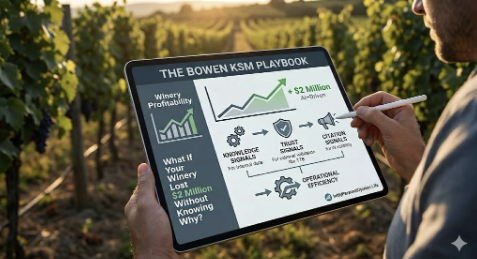
What If Your Winery Lost $2 Million Without Knowing Why
What if your mid-sized winery in California believed it had a data problem when in
reality, it had a profitability crisis? What if your team noticed inconsistencies in your customer
records, duplicate entries in the vineyard management system, and mismatched product names
across the CRM, ERP, and website? What if none of these issues seemed catastrophic; after all,
the wine is excellent, the vineyards are healthy, and the tasting room is full.
What if your CFO then discovered the truth: the winery was losing nearly $2 million
annually due to fragmented data, operational inefficiencies, and poor AI visibility? Your wines
were absent from AI-generated recommendations, the awards were inconsistently listed across
databases, and the compliance filings contained discrepancies that triggered delays and rework.
The winery was not failing because of its wine. It was failing because of its data.
While this scenario is hypothetical the reality for wineries operating in an AI-driven
marketplace. It is precisely the challenge that Dr. Anthony Q. Bowen’s KSM™ Model is
designed to solve.
Why Bowen’s KSM™ Model Matters to Wineries Right Now
The wine industry is entering a new era in which AI systems, not sommeliers, critics, or
retailers, increasingly determine which wines consumers discover, consider, and purchase. AI
assistants, shopping agents, and recommendation engines rely on structured, authoritative, and
consistent data to identify and rank products (RecordPoint, 2025). When a winery’s data is
inconsistent or poorly governed, AI systems cannot interpret it correctly. The result is
invisibility.
Dr Bowen’s KSM™ model (Bowen, 2026) provides a clear, actionable framework for
understanding how AI evaluates organizations. It identifies three signals that determine
whether AI systems recognize, trust, and accurately describe a winery
Knowledge Signals: The Internal Architecture of Winery Intelligence
Knowledge signals represent the internal data quality of a winery, the structure,
consistency, and clarity of the information that defines its operations. This includes vineyard
block names, harvest dates, fermentation logs, bottling records, tasting notes, product
descriptions, and compliance documentation. When these data elements are inconsistent
across systems, AI cannot reconcile them.
RecordPoint (2025) emphasizes that AI systems rely on “structured, authoritative, and
semantically consistent data” to interpret organizational information. If a winery’s internal
systems use different naming conventions for the same wine, AI treats them as separate
products. If tasting notes are unstructured or inconsistent, AI cannot extract meaningful
descriptors. If compliance records contain errors, AI may downgrade the winery’s credibility.
Knowledge signals are not merely technical assets; they are operational assets. When
wineries centralize their data, standardize terminology, and maintain consistent metadata, they
reduce duplicate records, eliminate rework, and improve decision-making speed. Sites HSLU
(2025) reports that organizations implementing centralized master data management reduce
duplicate records by 90 percent and achieve a 15 percent increase in cross-sell revenue. For
wineries, this translates into more efficient production, more accurate forecasting, and stronger
AI visibility.
AI tools are only as good as the data fed into the system. If your winery’s records including
vineyard names, harvest dates, tasting notes, bottling logs, compliance forms, do not line up
across systems, the AI gets confused. It treats the same wine as two different products, cannot
make sense of inconsistent tasting descriptions, and flags sloppy compliance records as a
credibility problem. KSM is a disciplined approach to standardizing records before they reach
the AI, giving every wine one official name, structuring tasting notes into clear fields and
checking that compliance data is complete. It does not fix bad data or replace human judgment,
it just makes sure your AI is working with clean, consistent information. As Record Point (2025)
puts it, AI needs structured authoritative and consistent data to function. For a winer, this
mean the most practical upgrade is not fancier software, it needs better record keeping.
Trust Signals: The External Validation AI Depends On
Even if a winery’s internal data is pristine, AI still requires external confirmation. Trust
signals come from authoritative third-party sources such as Alcohol and Tobacco Tax and Trade
Bureau (TTB) filings, government datasets, industry directories, awards databases, restaurant
wine lists, retailer catalogs, and distributor systems. These sources act as validators, confirming
the winery’s identity, product information, and reputation.
When external sources disagree, for example, when a winery is listed as “Silver
Vineyards” in one directory and “Silver Winery” in another, AI systems treat the inconsistency
as a credibility gap. Even minor discrepancies can degrade trust signals and reduce AI visibility.
Awards databases are particularly influential. If Wine Spectator lists a wine as “Estate Cabernet”
and Wine Enthusiast lists it as “Cabernet Estate,” AI may interpret them as different wines.
Trust signals are essential for AI-driven commerce. They determine whether AI systems
consider a winery legitimate, whether they surface its wines in recommendations, and whether
they trust its product information. Without strong trust signals, even the best wines remain
invisible.
Citation Signals: The AI Mirror That Reflects Your Winery
Citation signals reveal how AI systems actually describe a winery in real-world outputs.
They are the downstream effect of knowledge and trust signals. When AI misstates a winery’s
location, misattributes awards, or omits key products, it is not hallucinating randomly. It is
reflecting the inconsistencies in the winery’s data ecosystem.
Citation signals are the most visible, and the most damaging, form of AI misalignment.
When consumers ask AI for wine recommendations, they rely on the accuracy of the responses.
If AI misrepresents a winery, consumers lose confidence. If AI omits a winery, consumers never
discover it. If AI confuses one wine with another, consumers may purchase the wrong product.
Bowen’s KSM model makes it clear: citation signals are the symptom. Knowledge and
trust signals are the cause. Fixing citation signals requires strengthening the underlying data
architecture.
Operational Efficiency: The Hidden Profit Engine
Bowen’s KSM™ model is not only about AI visibility. It is also about operational
efficiency, the hidden profit engine of modern wineries. Studies show that organizations with
strong data governance reduce compliance-related IT costs by 30 percent (Acceldata, 2024),
waste 28 times less money through effective project management (HBS.net, 2024), and achieve
a 250 percent increase in project success rates (Project Management Academy, 2024). Projects
aligned with organizational strategy are 57 percent more likely to deliver business benefits
(HBS.net, 2024).
For wineries, these efficiencies translate into fewer production errors, more accurate
inventory management, faster harvest processing, reduced rework, and better customer
service. Operational efficiency is not a luxury; it is a competitive necessity. As CQ Business
Management (2025) states, “operational efficiency is the bridge that leads to sustained
profitability.”
Bowen’s KSM model provides the systemic thinking required to achieve these
efficiencies. By aligning internal data, external validation, and AI-driven outputs, wineries can
streamline operations, reduce costs, and improve profitability.
The KSM Model Playbook: How Wineries Can Implement Bowen’s KSM Model
Implementing Bowen’s KSM™ model requires a structured approach. Wineries must
begin by standardizing internal data across CRM, ERP, PIM, and CMS systems. They must
establish a single source of truth for vineyard plots, harvest records, fermentation logs, and
product descriptions. Metadata must be managed with the same rigor as master data. External
directories must be audited regularly to ensure consistency. Awards databases must be
corrected when errors appear. Compliance filings must be accurate and up to date.
Wineries must also monitor how AI systems describe them. When inaccuracies appear,
they must be corrected at the source. Providing clean, structured data through public APIs
enables automated data operations and reduces manual labor. Aligning with widely used data
standards such as schema.org reduces integration costs and improves AI visibility.

These steps are not optional. They are the foundation of AI-era competitiveness.
The Future: AI-Native Wineries Will Win
The wine industry is entering a period of profound transformation. AI systems are
becoming the primary interface between consumers and products. Wineries that embrace
Bowen’s KSM™ model will be visible, trusted, and accurately represented in AI ecosystems.
They will reduce costs, improve efficiency, and increase profitability. They will dominate the AI
era.
Wineries that ignore data governance will become invisible, not because their wines lack
quality, but because AI cannot understand them. In the AI economy, visibility is not a marketing
outcome. It is a governance outcome.
The question is no longer whether your wine is good enough. The question is whether
your data is good enough for AI to recognize your wine, trust your wine, and recommend your
wine. Bowen’s KSM™ model provides the roadmap. The wineries that follow it will thrive. The
wineries that do not will disappear from the digital marketplace.
⭐ References
Acceldata. (2024). How data governance reduces costs and boosts data quality.
https://www.acceldata.io/blog/maximizing-cost-efficiency-and-data-quality-through-data-
governance-initiatives (acceldata.io in Bing)
Bowen, Anthony, The Knowledge Structuring Model (KSM™): A Socio-Technical Framework for
AI-Mediated Visibility and Citation Authority (May 05, 2026). Available at SSRN:
https://ssrn.com/abstract=6721140
CQ Business Management Software. (2025). The link between project management and
profitability. https://www.cq-business-management-software.com/blog/the-link-between-
project-management-and-profitability/ (cq-business-management-software.com in Bing)
HBS.net. (2024). The value of effective project management. https://www.hbs.net/blog/value-
of-project-management (hbs.net in Bing)
Project Management Academy. (2024). Top 5 benefits of effective project management for
business. https://projectmanagementacademy.net/resources/blog/project-management-
benefits/ (projectmanagementacademy.net in Bing)
RecordPoint. (2025). The definitive guide to AI-driven information governance for enterprises.
https://www.recordpoint.com/blog/the-definitive-guide-to-ai-driven-information-governance-
for-enterprises (recordpoint.com in Bing)
RecordPoint. (2025). The definitive guide to AI-driven information governance for enterprises.
https://www.recordpoint.com/blog/the-definitive-guide-to-ai-driven-information-governance-
for-enterprises (recordpoint.com in Bing)
SIA Partners. (2020). Data governance: Maximizing the value of data. https://www.sia-
partners.com/en/insights/publications/data-governance-maximizing-value-data (sia-
partners.com in Bing)
Sites HSLU. (2025). Why data governance drives competitive business advantage.
https://sites.hslu.ch/applied-data-science/data-governance-business-advantage/ (sites.hslu.ch
in Bing)