

By Dr. Elinor Garely · InMyPersonalOpinion.Life
October 2026 ·
I love trade shows. Walking an exhibition floor feels a bit like exploring a new country. Every aisle promises discovery. Every booth offers a different solution, innovation, or entrepreneurial dream.
This curiosity brought me to the White & Private Label Expo at New York City’s Javits Center. Organizers promoted the New York event as bringing together more than 6,000 online sellers, ecommerce professionals, and business owners. I cannot independently verify attendance but I can attest to the fact that the aisles were jammed with people eagerly looking for new ideas, and new opportunities.
Focus on Making the Sale
What fascinated me was not what exhibitors discussed; it was what they largely ignored. Most conversations focused on sourcing, branding, packaging, manufacturing, margins, and speed to market. Vendors promised quick launches. Entrepreneurs dreamed about creating the next Amazon success story. Everyone was focused on making the sale.
Almost nobody was focused on what happens after the sale. Specifically, the return.
The Moment I Realized Returns Drive Purchasing Decisions
The realization came after walking the aisles for hours, I dropped into a chair where an entrepreneur was presenting a profile of her business: the art and science of a successful return. Until that moment, I had never truly considered a return policy as a major factor in buying behavior.
Then I thought about my own shopping habits. I continue to choose Amazon for one remarkably simple reason: if something goes wrong, the return process works. A few clicks. A QR code. A nearby drop-off location.
- No box.
- No tape.
- No shipping label.
- No argument.
Some retailers require customers to spend more returning an item than the item originally cost. Others bury return instructions in pages of legal text. Some simply stop responding after the transaction is complete. One online vendor told me to take up the issue with my credit-card company; a refund was not his problem. Even Bloomingdale’s, which at one time, was my one-stop-shopping source has slid to the very bottom of the “where to go.” Why? Because it takes forever to get a product returned.
These experiences taught me something important: customers remember the return experience almost as clearly as they remember the purchase experience.
Returns Have Become an $850 Billion Challenge
Returns are no longer a back-office operational issue. They are a major business decision. In October 2025, the National Retail Federation and Happy Returns projected that shoppers would return $849.9 billion in merchandise during 2025, 15.8% of annual retail sales. This figure measures the value of merchandise expected to come back, not retailers’ net financial losses. The costs of shipping, inspection, processing, markdowns, and fraud are separate concerns.
Online purchases generated an estimated 19.3% return rate in 2025. The behavior is especially common among younger shoppers: consumers ages 18 to 30 averaged approximately 7.7 online returns per year. The findings are useful, but their scope really matters. The consumer sample consisted of people who had recently returned an online purchase, while the merchant sample represented 358 ecommerce professionals at U.S. merchants with more than $500 million in revenue. Small brands should use the results as a starting point for testing and not assume their customers, costs, or fraud exposure will match those of major retailers. The report was produced with Happy Returns, a UPS-owned company that sells returns services.
Fraud
Returns also create significant fraud concerns. In the NRF/Happy Returns research, surveyed merchants estimated that 9% of returns were fraudulent. Among retailers tracking such incidents, 65% reported increases in empty-box or “box of rocks” returns. Eighty-five percent of surveyed merchants said they were employing AI to detect or prevent return fraud. These figures describe survey responses, not independently adjudicated fraud cases across all U.S. retail. Consumers acknowledge their own role, too: close to two-thirds of those surveyed admitted to at least one costly returns behavior, from buying several sizes with plans to send some back to returning a different item, and 45% said bending the truth is acceptable when making returns.
Paying Attention
Meanwhile, consumers are paying attention. According to UPS (2025), 81% of consumers read return policies before purchasing, 71% are less likely to shop again after a poor return experience, and 86% prefer no-box, no-label returns with fast refunds. As Katherine Cullen of the National Retail Federation observed, returns are no longer simply the end point of a transaction.
What the Research Actually Says
Four recent peer-reviewed studies, all published in 2024 or 2025, suggest that businesses that treat returns strategically may improve both purchasing and customer retention. But the evidence does not justify unlimited generosity. The right policy depends on the product, margin, customer, and operational process.
Generosity Helps, But Smart Design Matters More
Gan et al. (2024) surveyed 355 U.S. and 258 Chinese online shoppers to understand why lenient return policies build customer patronage. Among U.S. respondents, the link between leniency and patronage ran entirely through three things: a sense of control over the purchase, a sense of connection to the retailer, and satisfaction. Among Chinese respondents, connection and satisfaction explained only part of the effect.
These findings come from self-reported surveys, so they show how shoppers say they respond, not proof of cause and effect. They also carry a built-in tension. Duong et al. (2025) describe a trade-off they call the return policy leniency dilemma: generous terms can encourage impulsive purchasing and a surge in returns.
The lesson is straightforward: making returns easier can build loyalty, but indiscriminate generosity is not always the answer. More patronage does not automatically mean more profit. Retailers still need to account for product margins, processing expenses, return shipping, and the value recovered from returned inventory.
Bigger Is Not Always Better
Duong et al. (2025) analyzed 13,757 seller return policies and about 26,000 customer reviews from Walmart Marketplace, comparing how different policy terms related to satisfaction and to shoppers’ talk of returning items. Customers appeared comfortable with moderate limits: a 30-day window, a simple return-authorization step, or an offer to exchange or repair rather than refund. Full refunds, however, were linked to higher satisfaction, and the authors found no acceptable way to scale them back.
The data comes from a single marketplace, and the policies were collected in 2022, so the findings are a guide, not a rule. For retailers, the implication is to tailor deadlines, customer effort, and exchange options, while thinking twice before trimming refunds, rather than copy one supposedly ideal policy.
Changing the Rules Can Cost You Customers
Abdulla et al. (2025) examined what happens when a retailer with a long-standing lenient policy tightens it, for example by shortening the return window or adding a restocking fee. Across a series of online experiments, those changes lowered consumers’ trust in the retailer, which in turn reduced their intentions to buy, recommend, and stay loyal. Even shoppers who said they rarely return anything reacted negatively.
Explaining the change helped. Reactions were milder when the retailer was open about the new rules and gave a reason, such as the cost of processing returns or return abuse. The experiments used fictional retailers and measured stated intentions rather than actual purchases, so a retailer should test any change on its own customers before rolling it out.
Free Returns Can Help Recover Abandoned Purchases
Luo et al. (2025) examined how retailers could reengage shoppers who had left an online store without purchasing. Free-return retargeting delivered late in the shopping process increased purchase rates by 31.6% and targeting profitability by 37.8% in the experiment. Results varied by customer and product characteristics.
The practical lesson is to test targeted offers and not assume that free returns will improve profits across every product and customer segment. Returns are not merely an expense; they can be an investment in trust when designed and measured carefully.
Why Amazon Continues to Set the Standard
Amazon’s advantage is not simply product selection. Its advantage is convenience. For eligible purchases, Amazon offers returns without a shipping box, tape, or printed label at more than 10,000 U.S. drop-off locations. Amazon says four out of five U.S. customers have a location within five miles of home. Buyers should still check the options displayed for their specific order. The process removes uncertainty. Consumers may not remember a flawless transaction. They are far less likely to forget a frustrating return.
Before You Buy, Calculate the Cost of Changing Your Mind
While retailers must improve return systems, consumers should become more careful shoppers. A return policy is part of the purchase price.
Before paying:
- Read the return policy. If the policy is difficult to locate, consider it a warning sign.
- Check return-shipping costs. Know whether you or the retailer pays for shipping.
- Verify the return window. A 14-day return period creates a much different customer experience than a 30-day period.
- Understand refund timing. Find out how quickly refunds are processed and issued.
- Avoid surprise international returns. Determine where returned merchandise must be shipped.
- Save documentation. Take screenshots of return policies and order confirmations in case disputes arise later.
Keep the policy as it appeared when you ordered. Save the order confirmation, seller correspondence, return authorization, and drop-off receipt. Before sending an item back, confirm which address and shipping method the seller requires.
For New York readers, there is an additional local protection. New York City requires businesses selling consumer goods and services to display their refund policies near the register, including restrictions and restocking fees. If no policy is posted, NYC311 says customers may return unused items within 30 days and must be offered a choice of cash or credit. This is a local rule—not a universal right to return every online purchase.
When the Seller Refuses to Resolve the Problem
- Contact the seller in writing and state what you bought, what went wrong, and the resolution you are requesting. Attach the relevant order details and policy.
- If the problem is a qualifying credit-card billing error—for example, goods were not delivered as agreed or a promised credit was not posted—contact the card issuer promptly. The Federal Trade Commission advises sending written notice to the issuer’s billing-inquiries address so it arrives within 60 days after the first bill containing the error was sent. Keep copies of supporting documents.
- Ordinary dissatisfaction with product quality is not automatically the same as a billing error. A chargeback is a last resort, not a substitute for a clear return process.
What Vendors Should Do Monday Morning
If I could hand every exhibitor at the White & Private Label Expo a checklist, it would include six recommendations.
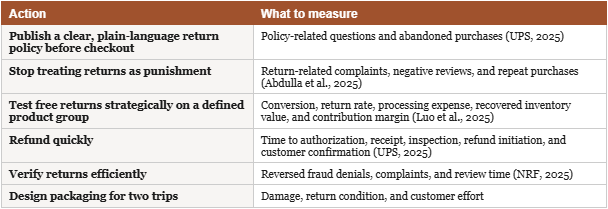
For a private-label seller, return planning should begin before the first inventory order. Ask the manufacturer who pays for defective units, what evidence is required for a claim, whether replacement or credit is available, and how recurring defects will be investigated. A customer-facing return promise is only as workable as the supplier agreement and operational process behind it.
InMyPersonalOpinion
The White & Private Label Expo demonstrated how easy it has become to launch a product, source inventory, and build a brand. What I did not see was the same level of enthusiasm for designing the return experience. This is a mistake. The evidence supports easier, thoughtfully designed returns, but the results depend on the policy, product, and customer (Abdulla et al., 2025; Duong et al., 2025; Gan et al., 2024; Luo et al., 2025).
Before buying, learn what happens if the product disappoints: where it must go, who pays to send it back, and when the refund begins.
Before selling, test the same journey from the customer’s side. Publish the terms clearly, identify recurring product problems, and measure whether a policy change improves retained profit—not merely gross sales.
My lesson from the White & Private Label Expo was not that every business should imitate Amazon. It was that a return policy belongs in the business plan, the supplier conversation, and the customer promise—not in the fine print after checkout. The businesses that understand this will earn loyalty. The businesses that do not will keep wondering why customers never come back.
The sale isn’t finished until the return works.
References
Abdulla, H., Ketzenberg, M., Abbey, J. D., & Heim, G. R. (2025). The point of no return? Restrictive changes to lenient return policies and consumer reactions to them. Journal of Operations Management, 71(1), 81–108. https://doi.org/10.1002/joom.1346
Amazon. (2026, March 25). Amazon expands free returns with no shipping box, tape, or label needed to over 10,000 U.S. locations. https://www.aboutamazon.com/news/retail/amazon-big-spring-sale-2026-best-deals
Duong, Q. H., Zhou, L., Meng, M., Dang, L. T. A., & Nguyen, T. D. (2025). Striking the right balance: Customising return policy leniency for managing customer online return proclivity and satisfaction. Journal of Retailing and Consumer Services, 85, 104315. https://doi.org/10.1016/j.jretconser.2025.104315
Federal Trade Commission. (2022, May 23). Using credit cards and disputing charges. https://consumer.ftc.gov/articles/using-credit-cards-and-disputing-charges
Gan, Z., Li, Y., & Li, Y. (2024). How return policy leniency affects customer patronage in online retailing: Moderating roles of novelty seeking and collectivism. Journal of Data, Information and Management, 6(4), 439–459. https://doi.org/10.1007/s42488-024-00136-x
Luo, X., Wang, L., Wu, Q., & Moriguchi, T. (2025). From stopping to shopping: A field experiment on free return and free shipping retargeting policies in online retail operations. Manufacturing & Service Operations Management, 27(4), 1224–1241. https://doi.org/10.1287/msom.2024.0779
National Retail Federation. (2025, October 15). Consumers expected to return nearly $850 billion in merchandise in 2025 [Press release]. https://nrf.com/media-center/press-releases/consumers-expected-to-return-nearly-850-billion-in-merchandise-in-2025
NYC311. (n.d.). Refund policy rules. https://portal.311.nyc.gov/article/?kanumber=KA-02953
United Parcel Service. (2025, December 29). Survey reveals: Easy returns can build customer loyalty. https://about.ups.com/us/en/our-stories/customer-first/5-things-every-business-should-know-about-returns-in-2025-and-be.html
White & Private Label Expo. (n.d.). The leading product sourcing event. https://www.whitelabelexpo.com/
Copyright © 2026 Dr. Elinor Garely and InMyPersonalOpinion.Life. All rights reserved under U.S. and international copyright laws. Unauthorized reproduction, distribution, or transmission, including digital republication, translation, or commercial use, is strictly prohibited without prior written consent. Brief quotations in scholarly, journalistic, or critical reviews are permitted with full attribution and a direct link to the original source. For syndication, licensing, or permission inquiries, contact EG@InMyPersonalOpinion.Life.
000