
By Dr. Elinor Garely, Editor-in-Chief | InMyPersonalOpinion.Life
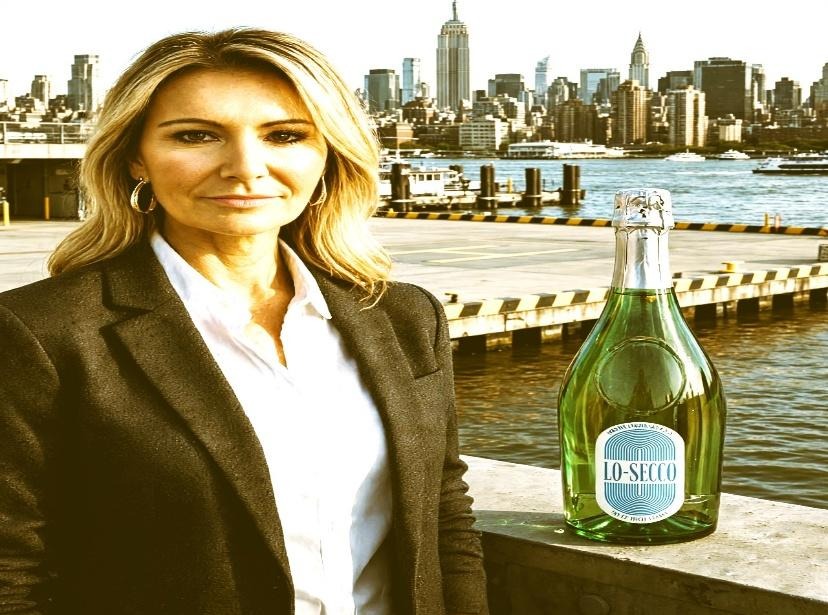
There is wine, and then there is the business of wine. For decades, wine producers competed on geography, heritage, winemaking tradition, and critical acclaim. Those factors remain important. Yet after years of interviewing wine executives, producers, importers, and retailers, I have noticed a subtle but important shift in consumer conversations. Increasingly, consumers are asking questions that would have been unusual a generation ago.
- How much sugar is in the bottle?
- What ingredients were used?
- Does this wine align with the way I eat, exercise, and think about wellness?
These questions are creating new opportunities for producers willing to rethink traditional wine marketing.
In The Beginning
I first connected with Monika Elling through LinkedIn in 2017. Over time, our conversations frequently centered on emerging consumer trends, changing wine consumption patterns, and the future of premium beverage brands. When she invited me to experience LO SECCO in Manhattan, I expected to encounter another Prosecco launch. Instead, I found myself examining a broader business proposition: Can transparency become a competitive advantage in a category traditionally built around taste, terroir, and tradition?
The answer, according to Elling, began nearly a decade ago. “The wine and spirits world badly needed nutritionally sound products, and consumers were getting almost no information about what they were drinking,” she told me. “I have always had a hard time with the sugar hidden across our food and drink, and when I looked at Prosecco, one of the fastest-growing categories in wine, I saw a gap no one was addressing.” This observation became the foundation for LO SECCO, a Prosecco DOC Brut Nature positioned around zero sugar, nutrition transparency, and premium branding. (DOC, or Denominazione di Origine Controllata, is Italy’s designation for wines made under strictly defined regional rules.)
The Opportunity Was Hiding in Plain Sight
The LO SECCO concept originated in 2017 after Elling and her daughter Bettina completed work on the launch strategy for Empress 1908 Gin. Rather than continue building brands exclusively for clients, they began exploring the possibility of creating a proprietary brand of their own. Later, daughter Stefanie joined as a co-founder, bringing digital expertise to the venture. The wine itself reached U.S. shelves much later, with its American launch in August 2025.
According to Elling, the market gap was obvious. “It was sweet, the sugar was undisclosed, and nobody was making a Prosecco Brut Nature with the crisp, aromatic, dry wine profile that aligns with clean nutrition.”
A word of context for readers who are not wine insiders. Brut Nature is an established style, the driest classification, and it permits only trace amounts of residual sugar (up to roughly three grams per liter), compared with Brut and Extra Dry, which are progressively sweeter. So the novelty here is less the category than the commitment to disclose and verify what is in the bottle.
What interested me is that Elling’s observation was not merely anecdotal. A study of consumers in four countries (Italy, France, Spain, and the United States) found meaningful interest in nutritional and health information on wine labels, although preferences varied by country and by consumer type (Annunziata et al., 2016). That is not proof of a trend, but it is a signal worth taking seriously.
More recently, consumer research conducted by the Wine Market Council found that ingredient and nutrition labels carry far less influence for alcohol than for other foods and beverages, but that the gap narrows among younger consumers (Wine Market Council, 2023). I think that qualification matters. Transparency is not yet a purchase driver for most wine drinkers. It may become one, and in other words, LO SECCO may have arrived at a moment when consumer curiosity is beginning to catch up with the founders’ original vision.
Beyond Zero Sugar: Lifestyle Nutrition
During my conversation with Elling, I was struck by how frequently the discussion returned to consumer behavior rather than alcohol content, vineyard practices, or wine scores. Many producers talk about winemaking. She talked about consumers. The distinction matters.
“LO SECCO tackles a bigger conversation dealing with something I’ve coined as ‘Lifestyle Nutrition,’” Elling said. “We understand consumers are seeking food and drink that aligns with increasingly rigorous nutritional standards. Ideally, they do not want to compromise on taste.”
I find that positioning strategically interesting because products built solely around restriction often struggle to become aspirational brands.
- Zero sugar.
- Low carb.
- Fewer calories.
These attributes may attract initial attention, but premium consumers generally purchase experiences, not restrictions. That is my observation from years of watching brands rise and stall, not a finding I can cite, and LO SECCO appears to recognize that reality.
Transparency as a Business Strategy
For much of the wine industry’s history, nutritional information played little role in brand identity. Today, that may be changing. Research published in the Journal of Consumer Marketing found that consumers who read nutrition information on wine labels rated the wine as significantly less healthy, and that sugar content shaped those perceptions more than calories did (Popovich & Velikova, 2023). For a zero-sugar wine, that finding cuts in an interesting direction. The authors also caution that most consumers are not currently motivated to read a nutrition label on wine at all, which is the challenge every brand in this space must solve.
“We stand behind our brand and have lab reports as the basis for LO SECCO’s TTB submission and nutritional content on the back label,” said Elling. (The TTB is the Alcohol and Tobacco Tax and Trade Bureau, the federal agency that regulates wine labeling.) “There are some brands in the market making ingredient claims but do not have any verified information on their back label, only on their marketing materials.”
As a journalist, I appreciate that distinction. Transparency has little value without credibility. The issue is not simply disclosure. The issue is substantiation. Consumers increasingly encounter claims involving ingredients, wellness, sugar content, calories, and carbohydrates. Trust ultimately depends on whether those claims can be verified.
The regulatory backdrop adds urgency. The European Union has moved to require ingredient and nutrition information for wine, often delivered through QR codes, and U.S. regulators have been weighing rules of their own. Producers who already substantiate their claims may find themselves ahead of the compliance curve.
Zero Sugar Begins in the Cellar
The founders are careful not to present zero sugar as a miracle solution. Instead, they frame it as the outcome of production decisions. “We start with high-quality fruit, select yeasts and our process is finished with refinement on fine lees. Our process takes 2+ times as long as standard Prosecco winemaking, and it shows in the captivating aromatics and crisp finish.”
As I learned more, I found myself returning to a simple conclusion. Zero sugar may encourage a consumer to pick up the bottle. Quality determines whether they purchase it again. Wine remains an experience business. No amount of branding can compensate for a disappointing product.

Lo Secco Brut
Fresh, poised, and effortlessly charming, Lo Secco Brut opens with notes of green apple, pear, and citrus, carried by delicate, persistent bubbles. Crisp and dry on the palate, it finishes with elegance and refreshing lift.
Tasting Notes
- Appearance: Pale straw, fine perlage
- Nose: Green apple, pear, citrus blossom
- Palate: Bright, crisp, and dry
- Finish: Clean, graceful, and lingering
- Pairings: Oysters, shellfish, sushi, antipasti, soft cheeses
Lo Secco Brut doesn’t shout for attention. It earns it. Crisp, dry, and elegantly balanced, it’s proof that like good manners and good wine, restraint never goes out of style.
Premium Pricing Requires Premium Performance
At a suggested retail price of $24.99, LO SECCO occupies a premium position within the Prosecco category and Elling has deliberately embraced this positioning. “The design screams modern luxury, and not a diet product, which was the exact intention behind our creative efforts.”
I think this may be one of the company’s smartest decisions. Consumers rarely aspire to purchase “less.” They aspire to purchase “better.” By emphasizing luxury rather than restriction, LO SECCO is attempting to transform nutrition transparency from a compliance feature into a premium attribute. Whether consumers consistently agree remains to be seen.
Distribution Is Progress. Reorders Are Proof.
The company reports distribution in 13 states, direct-to-consumer shipping in more than 45 states, and placements with retailers including Total Wine & More, Coborn’s, and Stew Leonard’s. These achievements deserve recognition. Still, after decades of watching products enter the marketplace, I have learned that distribution is only the beginning of the story. Retail placement provides opportunity. Consumer loyalty determines longevity.
I found Elling’s assessment refreshingly direct. “For me, the clearest measure is the reorder. Every dollar of our direct-to-consumer growth has come through word of mouth, with no paid acquisition. When people come back for a bottle without being asked to, that is brand equity you can’t buy.” This observation reflects a basic truth of consumer products. Awareness can be purchased. Loyalty must be earned.
A Family Business with a Modern Structure
LO SECCO is led by three co-founders whose skills complement one another. Monika brings more than two decades of experience in wine, spirits, brand development, and international business. Bettina serves as Chief Strategy Officer, leading creative design and brand experience. Stefanie, the company’s Chief Technology Officer, contributes the digital expertise she developed during her career with Capgemini. The structure is noteworthy because the company appears to think less like a traditional wine producer and more like a contemporary consumer packaged goods (CPG) enterprise.
As Elling explained: “We run LO SECCO like a modern CPG company: consumer-first, digitally driven, and transparent down to the nutrition facts on our back label, while honoring the DOC standards that make Prosecco special.” Then she offered what I consider the most revealing statement of the interview: “Legacy categories reward tradition, but today’s consumer rewards relevance.” The statement extends far beyond Prosecco. It speaks to the broader challenge facing much of the wine industry.
InMyPersonalOpinion.Life
The wine industry’s challenge is no longer simply convincing consumers to drink wine. The challenge is understanding how consumers have changed. Research from IWSR indicates that moderation and wellness-oriented drinking have become embedded features of global beverage alcohol markets (IWSR, 2025a, 2025b). Consumers are not necessarily abandoning wine. Many appear to be becoming more selective. More informed. More deliberate. LO SECCO is betting that transparency can become a premium proposition rather than merely a regulatory requirement.
I find that proposition more interesting than the wine itself. The founders are not attempting to reinvent Prosecco. They are attempting to rethink how Prosecco is presented, discussed, and evaluated. Whether that strategy ultimately succeeds will depend on repeat purchases, customer retention, profitability, and long-term brand equity. The larger question remains. What happens when consumers begin reading the back label as carefully as they read the front? If that behavior becomes commonplace, LO SECCO’s most important innovation may not be what it removed from the bottle. It may be what it chose to reveal.
Now I would like to hear from you. Do you read the back label? Would a number there change what you pour? Tell me at InMyPersonalOpinion.Life.
References
Annunziata, A., Pomarici, E., Vecchio, R., & Mariani, A. (2016). Do consumers want more nutritional and health information on wine labels? Insights from the EU and USA. Nutrients, 8(7), Article 416. https://doi.org/10.3390/nu8070416
IWSR. (2025a, July 24). How is the moderation trend evolving? https://www.theiwsr.com/insight/how-is-the-moderation-trend-evolving/
IWSR. (2025b, February 24). Shifts in moderation strategies for beverage alcohol. https://www.theiwsr.com/insight/shifts-in-moderation-strategies-for-beverage-alcohol/
Popovich, D., & Velikova, N. (2023). The impact of nutrition labeling on consumer perceptions of wine. Journal of Consumer Marketing, 40(6), 748–757. https://doi.org/10.1108/JCM-09-2020-4101
Wine Market Council. (2023, February 3). Wine Market Council research reveals what consumers think about ingredient and nutrition labels on wine. Wine Industry Advisor. https://wineindustryadvisor.com/2023/02/03/wine-market-council-research-reveals-consumers-opinions-ingredient-nutrition-labels/© 2026 Dr. Elinor Garely / InMyPersonalOpinion.Life
Protected by U.S. & international copyright + DMCA. No reproduction, reposting, scraping, archiving, or AI training allowed. Violations may result in takedowns + legal action. Permissions: EG@InMyPersonalOpinion.Life
000