
Why Andreola Took the Word “Prosecco” Off Its Label
By Dr. Elinor Garely Editor-in-Chief / 8 min read
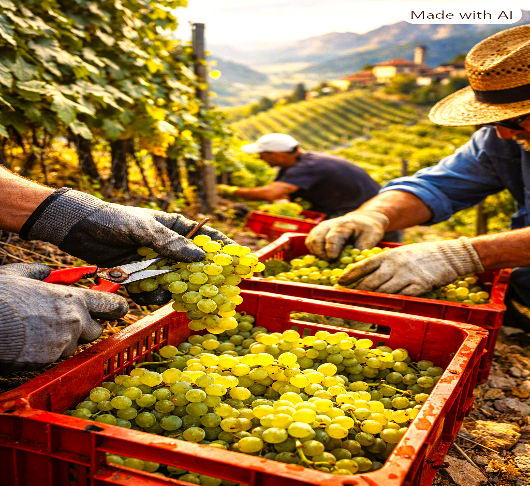
Hand harvest on the steep slopes of Valdobbiadene. (Image created with AI.)
There is Prosecco, and then there is Valdobbiadene. Cristina Binotto, Export Sales Specialist at Azienda Agricola Andreola, met me for lunch in New York recently, and our conversation made one point unmistakably clear: Andreola’s wines are built on a landscape that demands more, gives more, and deserves to be named.
The Voice of the Wines
Cristina Binotto brings a rare combination of technical fluency and territorial conviction to Andreola’s international presence. In person, she is precise, unhurried, and deeply protective of Valdobbiadene’s identity, the kind of communicator who can translate steep slopes, manual labor, and micro-parcel complexity into language that resonates far beyond the hills.
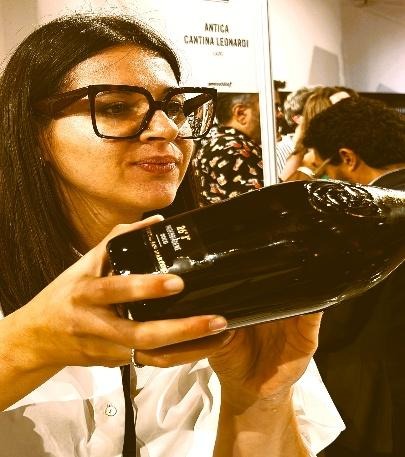
Cristina Binotto of Andreola at a recent tasting event. Photo: Dr. Elinor Garely.
At a recent tasting event, I photographed her pouring one of Andreola’s bottles with the same attentiveness she describes in the vineyards, a moment that captured her approach perfectly. She studies wine the way Andreola works its slopes: deliberately, with respect for detail, and with an insistence on authenticity.
Her background in export markets gives her a clear view of how Prosecco is perceived globally, and why the word has become both powerful and problematic. She speaks about heroic viticulture not as a marketing term but as lived reality, shaped by workers who climb 80% gradients and harvest by hand because machines cannot. Her insistence on territory, on naming Valdobbiadene first, comes from watching consumers respond to authenticity, precision, and place.
Binotto’s role is not simply to represent Andreola; it is to articulate why these wines matter now. She is the bridge between a demanding landscape and the international audience learning to distinguish mass-market Prosecco from the steep-slope DOCG wines that define Valdobbiadene.
The Math of Andreola
It takes roughly 70 hours of manual work per hectare per year to harvest grapes for Prosecco, compared with around 800 hours for Valdobbiadene. “Prosecco and Valdobbiadene Prosecco Superiore DOCG come from very different production environments,” Binotto stated, finding that “One is a very large and predominantly flat area. The other is a much smaller, hilly territory of steep slopes, with a great diversity of exposures, elevations, soils and microclimates.” The geography makes viticulture considerably more demanding, and it is what Andreola means by “heroic viticulture.”
It is also why Andreola has chosen not to put the word “Prosecco” on its labels. According to Binotto, “The name has undoubtedly made this wine famous all over the world, but it has also become associated with an increasingly broad and generalised category.”
The Winery
Andreola was founded in 1984 by Nazzareno Pola. According to the winery’s website, he spent ten years as a competitive cyclist, then a decade as a bartender while tending a small production of grapes in his family’s vineyards. Today his son, Stefano Pola, leads the estate.
Binotto describes Andreola as a family-run winery harvesting entirely by hand on steep, demanding slopes. It directly manages around 110 hectares of vineyards, divided into approximately 250 parcels.
The Identity: Valdobbiadene First
Binotto ties the decision to 2009, when today’s appellation system created a clearer distinction between the wider Prosecco category and the historic hillside area of Conegliano Valdobbiadene. “For us, this was an opportunity to make our identity even clearer,” she said.
“For years, our choice has been to identify our wines primarily through their territory: Valdobbiadene. We want consumers to associate our wines with a specific place, its landscape, its heroic viticulture and the quality that comes from that unique environment.”
The Hills Have a Rhythm
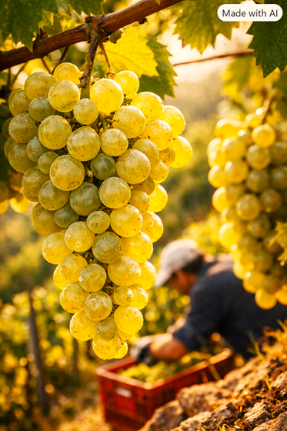
Ripe fruit on the hillside, harvest underway. (Image created with AI.)
“Heroic viticulture” means working vineyards in places where machines often cannot go, so most of the work has to be done by hand. In some parts of Valdobbiadene, slopes can reach 80%, making even basic vineyard operations physically demanding.
Climate change is making vineyard rhythms harder to predict, with unusual and extreme weather creating very short windows for essential work. “If several days of rain are followed by a short period of dry weather, you have to take that opportunity. Nature sets the timetable,” Binotto observed. The slopes give something back: more direct sunlight, faster drainage, healthier grapes, and, crucially, the ability for growers to make vine-by-vine decisions that machines cannot.
Beyond Easy Bubbles
Andreola uses only free-run juice and harvests in small bins to preserve fruit integrity. It avoids clarification practices that strip aromatic character. Binotto finds that “These choices allow us to preserve the purity of the fruit and aim for wines with greater aromatic intensity and finesse.” On the palate, the wines show verticality, freshness, and a fine, creamy texture. Elegance, Binotto says, is the common thread, and it brings versatility across an entire meal.
250 Parcels, No Cookie-Cutters
Working with 250 parcels can mean 100 to 150 separate vinifications each year. “When you work with this kind of diversity, the goal is not to make every wine taste the same. It is the opposite: to preserve and highlight the personality of each place,” according to Binotto.
The Rive category formalized distinctive hillside sites. Cartizze, at 107 hectares of steep, historic vineyards, is the qualitative peak. “We can think of Cartizze as our Grand Cru.” Dirupo, Andreola’s first label, represents the territory-based cuvée: a synthesis of vintage and denomination.
Why It Matters Now
Andreola does not compete on price. “We don’t compete in the entry-level segment,” Binotto says. “We have even chosen to remove the word ‘Prosecco’ from our bottles because we don’t want our wines to be perceived simply as part of a mass-market category.” With “Prosecco fatigue” rising, identity and authenticity matter more. “Consumers are drinking less, but looking to drink better.”
Handwork, with a Digital Assist
While vineyard work remains manual, Andreola is introducing an app to track hours, machinery, and products used per plot. Technology supports precision; it does not replace human expertise. In the cellar, intervention remains minimal: no clarification, open filtration, and a commitment to letting Valdobbiadene speak.
Tasting the Territory: Two Rive Wines That Define Andreola
Two Rive wines illustrate exactly why Andreola’s steep-slope identity matters. They show the verticality, finesse, and parcel-driven nuance that Binotto ties to free-run juice, minimal clarification, and heroic viticulture.
Rive di Col San Martino: 26° I° Valdobbiadene DOCG
Col San Martino is a clear expression of hillside tension. The nose carries white flowers and citrus, shaped by slopes that “help rainwater drain away more quickly.” On the palate, the wine shows a fine, creamy bead and a mineral line reflecting the demanding exposures of Valdobbiadene. Its elegance, the “common thread” Binotto identifies, is unmistakable.
Rive di Refrontolo: Col del Forno Valdobbiadene DOCG
Refrontolo offers a deeper mid-palate and more layered aromatics, still fresh and vertical but with greater textural presence. The bubbles remain refined, echoing Andreola’s pursuit of “a balance between tension, elegance and texture.” This site has long shown distinctive character, aligning with Binotto’s point that certain parcels consistently reveal individuality.
Together, these wines reinforce Andreola’s decision to focus on Valdobbiadene rather than the broader Prosecco category. Col San Martino delivers purity and lift; Col del Forno offers depth and elegance. Both demonstrate why “the name of the territory says much more: Valdobbiadene.”
◆ ◆ ◆
Copyright © 2026 Dr. Elinor Garely and InMyPersonalOpinion.Life. All rights reserved under U.S. and international copyright laws. Unauthorized reproduction, distribution, or transmission, including digital republication, translation, or commercial use, is strictly prohibited without prior written consent. Brief quotations in scholarly, journalistic, or critical reviews are permitted with full attribution and a direct link to the original source. For syndication, licensing, or permission inquiries, contact EG@InMyPersonalOpinion.Life.
000