
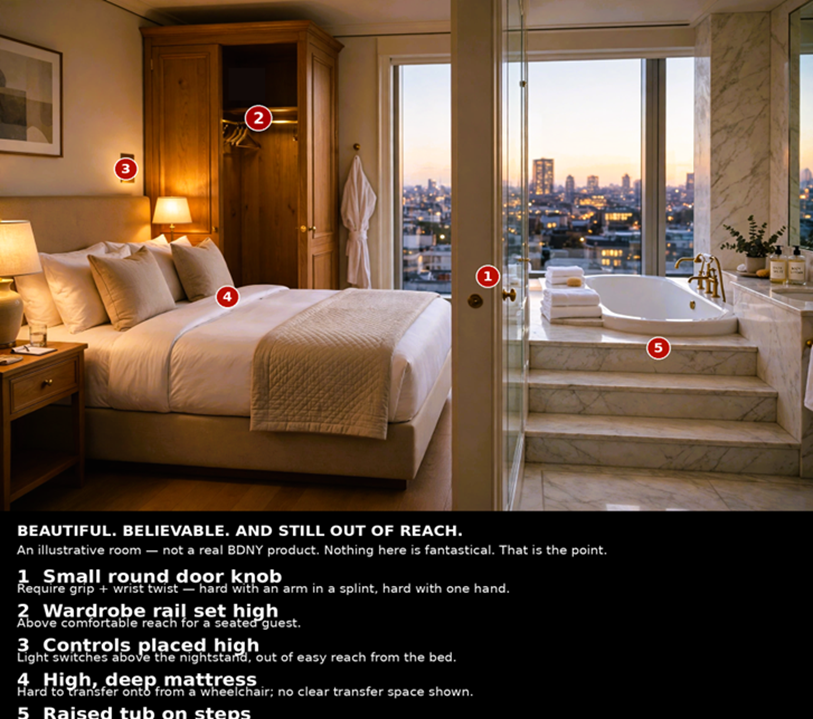
BDNY 2026 and hospitality’s next test: designing rooms that work for the people who actually check in
By Dr. Elinor Garely | InMyPersonalOpinion.Life
Looking for Tomorrow
I went to Boutique Design New York (BDNY) expecting to discover something new. Not another variation on an already familiar chair. Not a fashionable finish presented as a philosophical breakthrough. I wanted evidence that hospitality design was making the ordinary business of staying in a hotel easier, more comfortable, and more independent.
My disappointment was personal, not a scientific inventory of the exhibition. I cannot claim that no exhibitor offered useful innovation. I can say only that the products I encountered did not make practical usability impossible to ignore. That distinction matters: a visitor’s impression is a starting point for criticism, not proof of an industry-wide failure. Some exhibitors may well have shown products that prioritize operable force, reach ranges, or tested usability; my path through the floor simply did not make those solutions stand out as impossible to miss.
BDNY’s 2026 theme, “Designed to Be Remembered,” provides a useful test. Advance material carried by The Architect’s Newspaper — partner content, not independent reporting — described a program addressing wellness, changing definitions of luxury, adaptive reuse, and hospitality development (The Architect’s Newspaper, 2026). These subjects deserve attention. But a room can be remembered for the wrong reasons.
The Scale of the Room
BDNY 2026 took place November 8–9 at the Jacob K. Javits Convention Center in New York. Post-show reporting called it the largest audience in the fair’s history: more than 18,000 attendees, including 12,400 qualified industry professionals. The show floor held more than 750 exhibitors from more than 55 countries, over 100 of them first-time brands, and the conference drew more than 125 speakers. Inaugural pavilions from Korea and Norway added to the international mix (LODGING Staff, 2026b).
These are organizer-reported figures carried by trade press, not independently audited counts. They describe the scale of the marketplace. They do not tell us whether the products on display were more usable, more accessible, or more innovative.
What the Organizers Actually Promised
Fairness requires acknowledging that BDNY’s stated ambitions extended beyond visual distinction. The 2026 program included sessions such as “From Aesthetics to Experience: The New Role of Design.” Announced subjects, however, are not proof of what every presentation delivered.
Post-show coverage indicates that the program took up those subjects. Speakers included Marcel Wanders, Kai-Uwe Bergmann of BIG, Amy Fothergill of Four Seasons Hotels & Resorts, and Dane Patunoff of KHP Capital Partners. Conversations examined hotel development economics, adaptive reuse, wellness, the influence of food and beverage on brand identity, and the intersection of design, operations, and guest expectations (LODGING Staff, 2026b). The trade magazine that presents the show reported that, in the session on aesthetics and experience, Victor Schmick of Davidson Hospitality cautioned against designing spaces for photographs and awards rather than for the people who use them (Hospitality Design, 2026). That is the right instinct. Developers, operators, and owners shape what gets specified, which is why I would want them in the usability conversation.
The show also introduced Design With Purpose, a partnership with the nonprofit Humble Design, which transforms donated furnishings into homes for individuals, families, and veterans emerging from homelessness. The activation connected the event to furniture reuse (Boutique Design New York, 2026; LODGING Staff, 2026b).
That is the standard by which to judge the show. If the program promises experience, wellness, and memory, the test is not simply whether a chair photographs well. It is whether a person can sit in it, reach what matters, operate what matters, and leave without needing rescue by staff.
The Faucet Has a Vote
Consider an illustrative guest—created for this essay, not a report about any named BDNY 2026 exhibitor or product—with painful arthritic hands confronting an elegant faucet that requires a determined twist. The fixture may flatter the bathroom. It does not flatter the hotel’s understanding of hospitality. Luxury should be measured partly by the effort a guest does not have to expend. Independence is not an optional amenity.
The example is hypothetical. It makes an abstract procurement question concrete: when a buyer admires a finish, does anyone ask how much force, grip, reach, vision, or prior knowledge the product demands? No real exhibitor should be assumed to have displayed such a product. The question is larger: who is the room actually designed for?
The Guest Is Not a Rendering
The guest imagined in a design presentation appears wonderfully uncomplicated: rested, mobile, confident, and able to decipher every control. Actual travelers bring different bodies, abilities, and expectations. A beautiful room must survive contact with those differences. Otherwise, the designer has completed a picture rather than a service.
The World Health Organization (WHO, 2023) estimates that 1.3 billion people—approximately 16% of the global population—experience significant disability. That is not a count of hotel customers, and it cannot responsibly be converted into a hospitality revenue forecast. It does establish that disability is part of ordinary human diversity, not an obscure exception.
Research Without the Marketing Perfume
Stasell and Bathje (2021) interviewed eight adults with physical or sensory disabilities who had stayed in hotels at least twice during the previous year. Their analysis identified six themes: customer service, reservation process, built-environment challenges, traits and skills, technology, and safety and emergency preparedness. The problem extended beyond the bathroom.
Eight interviews cannot establish how frequently every hotel fails or rank competing brands. They can reveal problems that a satisfaction average may conceal. A guest may complete a stay by improvising, seeking assistance, or tolerating an obstacle. Completion alone does not demonstrate that the experience worked well.
Three Ideas, One Human Purpose
Hedvall et al. (2025) distinguish accessibility, usability, and universal design while arguing that they should work together to support participation. Their analysis frames universal design in rights-oriented terms, with accessibility and usability helping translate that vision into practice. For a hotel buyer, the implication is practical: a compliant specification is essential where required, but procurement should also ask whether people can use the finished room successfully.
In plain language, accessibility asks whether a person can enter and use a space; usability asks whether that use is effective, efficient, and workable in real tasks; universal design asks whether a solution can serve the widest range of people from the start, rather than relying only on a separate adapted version. These ideas overlap, but they are not interchangeable (Hedvall et al., 2025).
Compliance Is the Floor, Not the Chandelier
Some supposed mysteries of usable design already have technical answers. The U.S. Access Board (n.d.) explains that covered operable parts in accessible spaces and along accessible routes must work with one hand, without tight grasping, pinching, or twisting of the wrist. The general maximum operating force is five pounds. Scope and exceptions matter; this is not a blanket rule for every object in every guest room.
Reservations also belong in the design conversation. Federal lodging rules require covered properties to describe accessible hotel and guest-room features in enough detail for individuals to assess whether their needs will be met. They also impose requirements concerning the reservation and holding of accessible rooms (28 C.F.R. § 36.302(e), 2026). A reassuring adjective is not a substitute for usable information.
Why This Is a Business Story, Not Only a Moral One
The global hotel construction pipeline reached a record 15,976 projects and 2,433,948 rooms at the close of the second quarter of 2026 (LODGING Staff, 2026a). Of those projects, 6,174 (1,043,290 rooms) were under construction, 3,743 (530,326 rooms) were scheduled to start within 12 months, and 6,059 (860,332 rooms) were in early planning. Renovations and brand conversions, counted within those stages rather than added to them, accounted for 3,760 projects and 521,849 rooms.
The United States led with 5,975 projects and 703,001 rooms, followed by China with 3,588 projects and 632,256 rooms. Lodging Econometrics forecast that 2,742 new hotels with 379,921 rooms would open worldwide by the end of 2026 (LODGING Staff, 2026a). These figures show the scale of investment and the number of chances to get design decisions right, or to repeat avoidable mistakes.
Every new project and renovation creates decisions about furniture, fixtures, equipment, lighting, textiles, bath products, and operating technology. Accessibility and usability should be considered before specifications are locked and procurement contracts are signed, not after a guest discovers that a beautiful room is difficult to use.
Why the Marketplace Matters
A marketplace this large is where specifications begin. With more than 750 exhibitors and 12,400 qualified industry professionals on one floor, BDNY is a place where buyers can ask suppliers to demonstrate usability before a product reaches a guest room (LODGING Staff, 2026b). The business case for usability does not need inflated arithmetic. What does a property lose when a prospective guest cannot tell whether a room will work? Answering that takes local evidence, not a global disability count multiplied by an imagined nightly rate. Rights do not depend on profitability, but business planning still benefits from measurement.
Buy Performance, Not Adjectives
Before approving a room, test a full-scale mock-up with paid participants who have different access needs. Include people with mobility, vision, and hand-function limitations. Bring an accessibility professional into the process. Ask participants to perform ordinary tasks, and document where assistance becomes necessary. Consultation should influence decisions, not decorate a completed presentation.
Give suppliers the same assignment. Demonstrate the control. Show the approach space. Explain maintenance and replacement. Identify the users involved in testing and the conditions under which testing occurred. “Intuitive” should invite a demonstration, not end the discussion.
A buyer can use five prompts at any booth:
- Show me how this works with one hand, without a tight grip or wrist twist (U.S. Access Board, n.d.).
- Show me the reach range for a seated guest and for a guest with limited shoulder movement.
- Show me what users with different abilities changed in this product (Hedvall et al., 2025).
- Show me the operating force and where it is documented (U.S. Access Board, n.d.).
- Show me what happens when a guest cannot see the control, label, or status light (Stasell & Bathje, 2021).
Do Not Make Sustainability the Defendant
My criticism is not that sustainable materials receive too much attention. Environmental responsibility and usability are different dimensions of product quality; neither excuses neglecting the other. I would rather specify a repairable, attractive product that people can operate than stage a contest between recycled content and human independence. The brief should demand both, then make trade-offs explicit instead of hiding them behind reassuring vocabulary.
A Practical 30-Day Test for Hotel Management
For the next 30 days, I would ask a hotel to log access-related booking questions, unresolved requests, room changes, and complaints. Protect personal information and do not ask guests for diagnoses. Look for repeated obstacles, then assign an accountable manager to each correction. This is a proposed management practice, not a promise of a particular financial return.
A simple tracking sheet can be created in one afternoon: date, booking channel, task that failed, product or room feature involved, whether the guest needed staff help, whether the booking was completed, and the manager responsible for the corrective action. After 30 days, the pattern matters more than the total.
What Readers Can Do Before Check-In
Ask for descriptions rather than labels. If relevant to your needs, request the bed height, shower configuration, doorway measurements, and photographs showing the route through the room. Explain the features you require without accepting “accessible” as a complete answer. Obtain written confirmation of the agreed room features and keep it with the reservation. That request reflects the federal description requirement discussed above (28 C.F.R. § 36.302(e), 2026).
If a stay exposes a problem, describe the task that failed: reaching a control, operating a latch, identifying a switch, or using a shower. Send that account to management with a specific request for correction. A precise description gives an operator something more useful than either a vague complaint or a photograph of attractive décor. Task-level reporting is consistent with the themes identified by Stasell and Bathje (2021), including built-environment challenges, technology, and safety.
Tomorrow Must Be Easier to Use
For the next trade show, I want a demonstration area where products are judged by real tasks and varied users, not merely by their silhouettes. Show me a beautiful control that works easily. Show me storage a seated guest can reach. Tell me what testing changed. That would be a conversation about innovation worth having. The timing is promising. Beginning in 2027, ICFF moves from May to November 14–16 and will run concurrently with BDNY at the Javits Center (ICFF, n.d.), which would put a task-based demonstration area in front of both audiences.
I went looking for tomorrow. My standard remains straightforward: if the room makes the guest work harder, the design is not finished.
The Message
Beautiful rooms are not the enemy. Forgetting the person who must live in them is. BDNY 2026 brought together a large international marketplace and a program that spoke about experience, wellness, and memory (LODGING Staff, 2026b; Boutique Design New York, 2026). The global hotel pipeline raises the stakes: design decisions made now will shape rooms that guests use for years (LODGING Staff, 2026a). The next step is to make those ambitions operational: test with real users, publish what the testing revealed, specify by task rather than adjective, and treat independence as part of luxury.
A remembered room should be remembered because it worked beautifully, not because it made a guest work hard to use it.
If you exhibited at BDNY 2026 or design for hospitality, I would like to hear from you. Send me the accessible products you make or specify, and what user testing changed in them, at EG@InMyPersonalOpinion.Life. With your permission, I will share what I learn with readers.
A Note on Evidence and Voice
This is an opinion essay prompted by the author’s visit to BDNY 2026, not a census of the exhibition floor or a reported investigation of every exhibitor. First-person judgments, proposals, and recommendations are the author’s and are not presented as research findings. The faucet example is illustrative, not a documented product test. Event statistics are organizer-reported figures carried by trade press, drawn from post-show coverage published November 18, 2026, and have not been independently audited. Hotel pipeline figures are Lodging Econometrics’ Q2 2026 data as reported by LODGING. The cited qualitative study involved eight participants and should not be treated as a representative survey. No exhibitor or hotel is accused of a specific failure in this essay.
References
The Architect’s Newspaper. (2026, November 5). The ideas, designers, and new products shaping hospitality at BDNY 2026 [Partner content]. https://www.archpaper.com/2026/11/bdny2026/
Boutique Design New York. (2026). The ideas, designers & new products shaping hospitality at BDNY 2026 [Press release]. OfficeInsight. https://officeinsight.com/officenewswire/the-ideas-designers-new-products-shaping-hospitality-at-bdny-2026/
Hedvall, P.-O., Ståhl, A., & Iwarsson, S. (2025). Accessibility, usability and universal design—still confusing? Harmonisation of key concepts describing person-environment interaction to create conditions for participation. Disability and Rehabilitation, 47(25), 6750–6759. https://doi.org/10.1080/09638288.2025.2491831
Hospitality Design. (2026, November 9). BDNY 2026: Day one session recap. https://hospitalitydesign.com/news/bdny-2026-day-one-recap/644149
ICFF. (n.d.). Nov. 14–16, 2027 • Javits Center, NYC. https://icff.com/fair/about/
LODGING Staff. (2026a, August 19). Lodging Econometrics: Global hotel construction pipeline reaches record-high project count in Q2 2026. LODGING. https://lodgingmagazine.com/lodging-econometrics-global-hotel-construction-pipeline-reaches-record-high-project-count-in-q2-2026/
LODGING Staff. (2026b, November 18). BDNY 2026 sets new attendance records and announces award winners. LODGING. https://lodgingmagazine.com/bdny-2026-sets-new-attendance-records-and-announces-award-winners/
Nondiscrimination on the Basis of Disability by Public Accommodations and in Commercial Facilities, 28 C.F.R. § 36.302(e) (2026). https://www.ecfr.gov/current/title-28/section-36.302
Stasell, M. R., & Bathje, M. M. (2021). Hotel experiences of people with physical and sensory disabilities: A qualitative study. American Journal of Occupational Therapy, 75(4), Article 7504180020. https://doi.org/10.5014/ajot.2021.044792
U.S. Access Board. (n.d.). Chapter 3: Operable parts. https://www.access-board.gov/ada/guides/chapter-3-operable-parts/
World Health Organization. (2023, March 7). Disability. https://www.who.int/news-room/fact-sheets/detail/disability-and-health
© 2026 Dr. Elinor Garely / InMyPersonalOpinion.Life Protected by U.S. and international copyright + DMCA.
No reproduction, reposting, scraping, archiving, or AI training allowed. Violations may result in takedowns and legal action. Permissions: EG@InMyPersonalOpinion.Life
000