
Why Wine Retail Needs to Rediscover the Art of Selling
By Dr. Elinor Garely | InMyPersonalOpinion.life
A Retail Experience Unlike Any Other
Imagine walking into a shoe store. You pick up six pairs. Try on three. Walk around. Stare at yourself in a mirror. Ask a salesperson whether the black shoes make you look sophisticated or like a klutz. Take them home. If they hurt your feet, or your best friend hates them, you may be able to return them, depending on the store’s policy. Many retailers offer similar reassurance for sweaters, lamps, coffee makers, and even mattresses. The premise is simple: reduce customer risk.
Retail? Not Wine
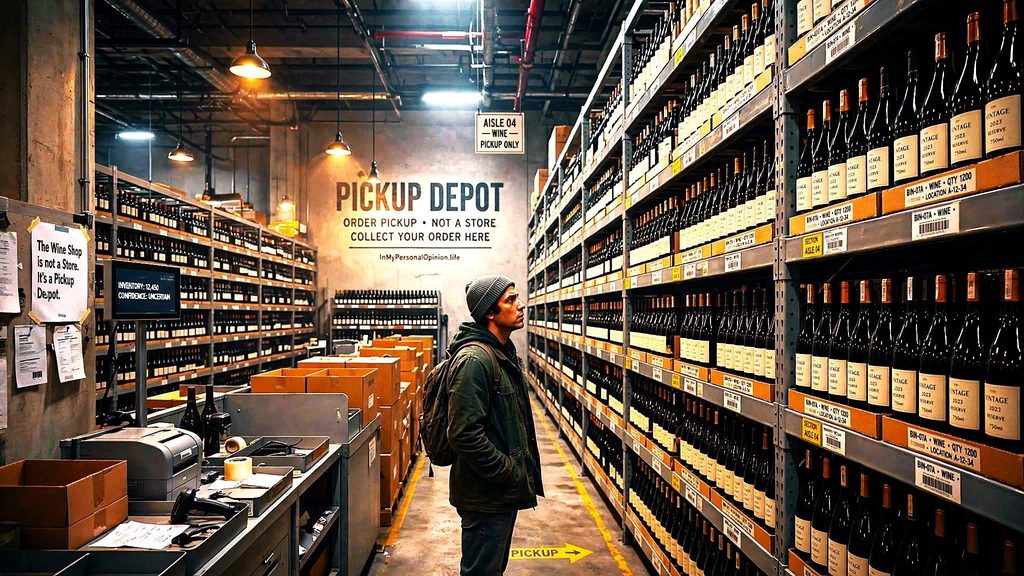
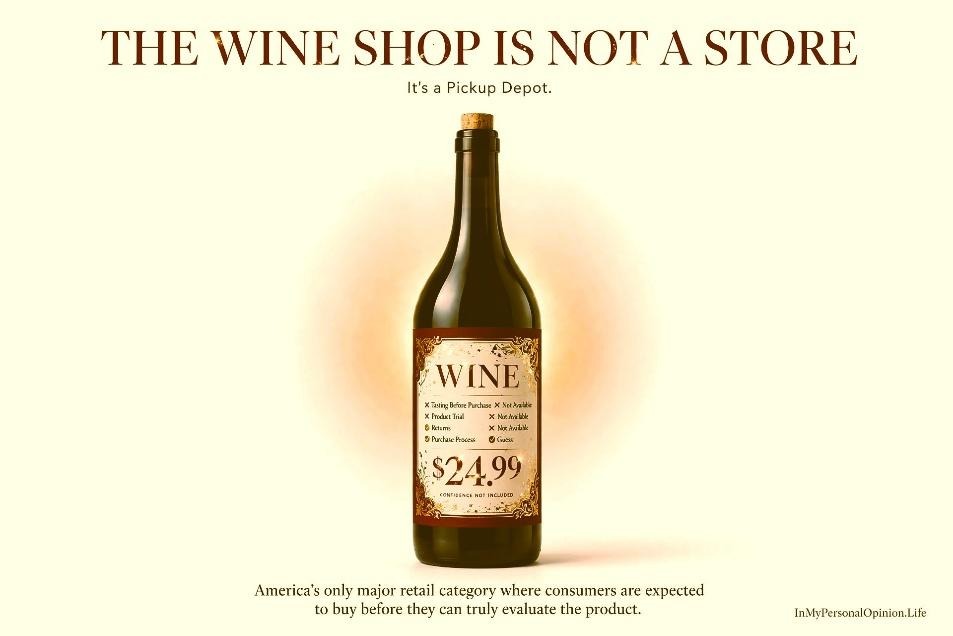
Wine operates differently. During a recent visitto a highly rated wine shop on Manhattan’s East Side, I was expected to buy a product I had no opportunity to taste, smell, or compare side by side. Nor did I have the reassurance of an explicit satisfaction guarantee if I disliked it.
Wine is not a pair of shoes. Opening the bottle changes what a retailer can resell. But customers should not have to guess about the policy as well as the product. Before buying, they should know how the shop handles defective wine, mistaken purchases, and bottles that simply do not suit their taste. Any proposed refund, credit, or exchange policy needs to comply with the rules governing that retailer.
If every industry followed the experience I encountered, shoe stores would say: “We’re sorry your shoes are uncomfortable, but you’ve already looked at them. The sale is final.” Consumers would riot. Yet wine buyers are too often asked to accept uncertainty. In my personal opinion, they shouldn’t have to. My experience is not a representative study of American wine retail; it is the starting point for an argument about what better selling could look like.
America’s $72.9 Billion Guessing Game
This is not a niche problem. U.S. Bureau of Labor Statistics data available through FRED put sectoral output for beer, wine, and liquor stores (NAICS 4453) at approximately $72.9 billion in 2025, the latest annual observation available in the series (U.S. Bureau of Labor Statistics, 2026). That is the combined category—not wine shops alone, not all wine sold through every retail channel, and not a simple retail-sales total. It is nevertheless a substantial business in which to leave customers guessing.
Despite that scale, the shopping process I encountered felt remarkably unsophisticated:
- Customer enters.
- Customer stares.
- Customer guesses.
- Customer pays.
- Customer hopes.
This is not a retail strategy. That is a lottery ticket.
The Label Is Doing Most of the Selling
The uncomfortable truth is that many bottles sell themselves—or at least attempt to. Research offers a reason to take labels seriously. In a study of 114 participants in a simulated supermarket in Colombia, Escandon-Barbosa and Rialp-Criado (2019) examined how attention to origin, nutritional information, and health warnings related to purchase intention. Their findings suggest that consumers with different levels of wine experience do not read label information in the same way.
That study does not establish how all American shoppers choose wine. Nor does it prove that a label can replace a knowledgeable salesperson. My concern is what happens when the label is left to do the job alone.
Think about that. Winemakers spend years nurturing vineyards, carefully harvesting grapes, managing fermentation, and refining blends. A customer may spend seconds evaluating a label featuring a rooster, a castle, or an animal wearing sunglasses. In my personal observation, the label is frequently doing more selling than the salesperson.
Wine’s Confidence Problem
Consumer confidence also belongs in this conversation. Barber et al. (2007) examined label information, label fluency, and consumer self-confidence. Their respondents with low self-confidence preferred modern label color paired with classic label information. That is a specific finding—not proof that every uncertain shopper behaves alike—but it puts confidence squarely inside the purchasing decision.
This finding should concern every wine retailer. Consumers are not simply buying wine. They are purchasing confidence. Or attempting to.
Wine writer Jamie Goode (2026) offers an important counterpoint. In “Is wine really too complicated – or just too expensive?” he argues that education probably does not scare ordinary consumers away and identifies price as the principal intimidating factor for newcomers. He cautions the industry against projecting its own assumptions onto shoppers. Fair enough. My concern is narrower: whatever the role of price or complexity, the shop can still make a purchase more welcoming and better informed. The customer’s question remains simple: Will I enjoy this bottle tonight?
What the Consultative Wine Shop Understands
The model I want is a wine shop that functions as a place of discovery and counsel, not just a transaction. Call it a neighborhood wine merchant. Call it a destination. The important distinction is not European versus American. It is guidance versus guesswork.
Imagine a shop built around tastings, education, food pairings, producer events, and personal guidance. The conversation begins with the customer, not the bottle. A visitor might say: “I’m serving grilled lamb.” “I usually enjoy Rioja.” “I need something under $20.” The shop responds with guidance. This is selling. Inventory management gets the bottle onto the shelf. Customer engagement helps it find the right home.
What the Experience Should Say
People rarely buy wine merely to possess it. They buy it to enjoy an experience. That is the principle I want retailers to remember before they deliver another lecture about soil or another shelf full of scores.
A customer should be able to say, “I like this,” without feeling obliged to pass an examination. Knowledge should enhance enjoyment, not become an entrance requirement.
For me, the lesson is simple: Wine education is valuable. Wine intimidation is expensive.
The Cost of Poor Selling
A customer who buys a disappointing bottle may not complain. They may simply disappear. The potential costs are easy to imagine: fewer repeat purchases, weaker loyalty, and a relationship that never develops. These are business risks to investigate, not outcomes established by my shop visits. Retailers should test whether better guidance improves satisfaction and return visits. Losing a customer because the shop failed to ask a useful question strikes me as a self-inflicted wound.
From Depot to Destination: Five Fixes I Recommend to Every Shop Owner
- 1. Record taste, not just transactions: Ask three questions—What did you last enjoy? What are you eating tonight? What is your budget? With the customer’s permission, keep a simple preference profile. Remember the palate, not just the payment.
- 2. Make sampling routine, not just an event: Offer small, optional tastings where permitted and practical, following the rules applicable to the license and location. New York’s State Liquor Authority expressly permits wine and liquor stores to conduct tastings of products they may sell (New York State Liquor Authority, n.d.). That does not mean every bottle must be open. It does mean tasting deserves a place in the service plan. Where pouring is not possible, offer clear explanations of style and pairing; those are useful tools, not substitutes for tasting the wine.
- 3. Replace shelf talkers with confidence talkers: Instead of “92 points, black cherry, limestone soil,” try “Enjoy a soft, fruit-forward Pinot Noir? Ask us how this bottle compares.” Then explain the differences honestly. A familiar reference point can start a conversation. It should not become a promise that the customer will love the wine.
- 4. Make the satisfaction policy clear—and legal: Publish a legally reviewed policy explaining how the shop handles defective wine, mistaken purchases, and customer dissatisfaction. Offer refunds, credits, or exchanges only where permitted. An exchange is not a workaround for a legal restriction. Where a remedy is unavailable, listen to the feedback and use it to make the next recommendation better.
- 5. Follow up: With the customer’s permission, a short message the next day—“How was the Sancerre with the fish?”—can help build a relationship. Make follow-up optional and use the customer’s preferred contact method. I want shops to measure customer satisfaction alongside inventory turnover.
InMyPersonalOpinion.Life
A wine shop should not resemble an Amazon fulfillment center with prettier lighting. Yet that is how the experience I encountered felt.
Rows of bottles. Minimal interaction. Limited guidance. Too little risk reduction. Too little relationship-building. Too little selling.
The irony is that wine retailers already possess the solution. It is standing behind the counter.
I have spent the last decades writing about hospitality, tourism, and wine from Israel to Italy to New York. The shops I return to are never the biggest. They are the ones where someone asked what I was cooking, remembered I don’t like very sweet, and handed me something I would never have found on my own.
The future competitive advantage of wine retail, in my personal opinion, will not be larger selections, deeper inventories, or bigger discounts alone. It will be trust. Because the most important product in a wine shop is not Cabernet Sauvignon, Chardonnay, Rioja, or Champagne. It is confidence. And confidence is the one thing no customer can pull off a shelf.
References
Barber, N., Ismail, J., & Taylor, D. C. (2007). Label fluency and consumer self-confidence. Journal of Wine Research, 18(2), 73–86. https://dialnet.unirioja.es/servlet/articulo?codigo=2950021
Escandon-Barbosa, D., & Rialp-Criado, J. (2019). The impact of the content of the label on the buying intention of a wine consumer. Frontiers in Psychology, 9, Article 2761. https://doi.org/10.3389/fpsyg.2018.02761
Goode, J. (2026, February 2). Is wine really too complicated – or just too expensive? Winemag.co.za. https://winemag.co.za/wine/opinion/jamie-goode-is-wine-really-too-complicated-or-just-too-expensive/
New York State Liquor Authority. (n.d.). Wine store/liquor store quick reference. https://sla.ny.gov/wine-storeliquor-store-quick-reference-0
U.S. Bureau of Labor Statistics. (2026, June 3). Sectoral output for retail trade: Beer, wine, and liquor stores (NAICS 4453) in the United States [Data set]. FRED, Federal Reserve Bank of St. Louis. Retrieved November 1, 2026, from https://fred.stlouisfed.org/series/IPUHN4453T300000000
© 2026 Dr. Elinor Garely / InMyPersonalOpinion.Life. Protected by U.S. & international copyright + DMCA. No reproduction, reposting, redistribution, adaptation, or AI training allowed. Brief quotes only with full credit + link. Permissions: EG@InMyPersonalOpinion.Life