
NAWR Says the Current System Cannot Stand
The Economic and Constitutional Case for Reform: Why the U.S. Retail Wine Industry Must Look to the Italian Model

Dr. Elinor Garely
I recently attended a conference organized by the National Association of Wine Retailers (NAWR) in New York. More than a hundred people filled the room, including winemakers, retailers, importers, distributors, lawyers, and academic analysts, each searching for new ways to keep the American wine industry alive and competitive. They talked about technology, marketing, sales funnels, consumer trends, digital platforms, soil and weather conditions, and generational shifts among Millennials and Gen Xers.
They talked about everything except the one thing that actually determines whether any of those ideas can succeed: the structure of the U.S. wine market itself. Hour after hour, economic experts and legal scholars stood at the podium and described the same obstacles: barriers to interstate shipping, wholesalers blocking access to products, state laws that treat wine as a controlled substance rather than an agricultural product, and a regulatory system that seems designed to prevent innovation rather than support it. The frustration in the room was palpable. Everyone knew the problems. No one could agree on the solution.
Italy Has a Solution
And then it hit me: there is a solution. It already exists. And it’s working — just not here, it’s in Italy. It’s the Italian model. Italy treats wine as agriculture. The United States treats wine as alcohol. That single difference explains why Italy’s wine sector is modern, competitive, and economically coherent, while the U.S. retail wine industry remains trapped in a Prohibition-era framework that no longer serves producers, retailers, or consumers.
The more I listened to NAWR’s speakers and academic analysts, the clearer the contrast became. Italy’s system is built on agricultural logic, rural development, and export strategy. The U.S. system is built on fear — fear of tied houses, fear of monopolies, fear of alcohol abuse, fear of losing control. Italy regulates wine as a crop. The U.S. regulates wine as a risk.
By the end of the conference, I realized that the American wine industry is not suffering from a lack of creativity, talent, or entrepreneurial spirit. It is suffering from a structural misclassification. Until that changes, no amount of marketing or technology will fix the problem.
The path forward is not mysterious. It is agricultural. It is constitutional. And it is long overdue.
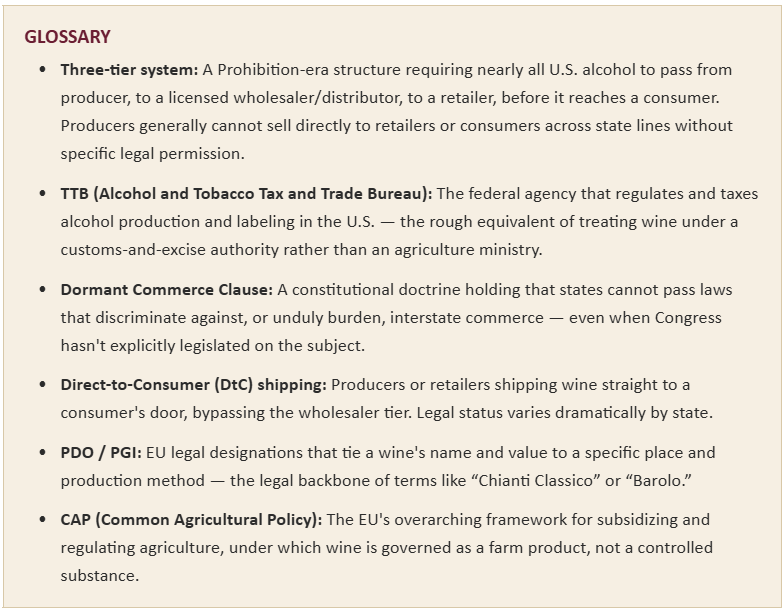
A Quick Glossary, for Readers Outside the U.S. System
Reality Check: Wine Started as a Grape
Imagine sitting in a room at the Italian Ministry of Agriculture, where wine is discussed in the same breath as wheat, olives, and citrus. It is treated not as a vice or a public safety hazard, but as a crop, a rural livelihood, and a strategic economic export. Now cross the Atlantic to the United States, where wine falls under the purview of the Tax and Trade Bureau (TTB) and state alcohol control boards, legally lumped into the same restrictive regulatory category as tobacco, firearms, and gambling.
This single foundational difference, treating wine as agriculture versus treating it as a controlled substance, creates a chasm between a modern, coherent European market and an American retail framework trapped in the post-Prohibition architecture of 1933.
For readers of InMyPersonalOpinion.Life, the implications stretch far beyond commerce; they strike at the heart of economic freedom, massive financial losses, constitutional law, and whether the Supreme Court of the United States should finally step in.
It’s not just Italy. France regulates wine primarily through its Ministry of Agriculture and its own appellation system (AOC), built on the same terroir-as-asset logic as Italy’s PDO/PGI framework. Spain does the same through its Denominación de Origen system, and Australia — outside the EU altogether — treats wine as a core agricultural export sector with dedicated trade-promotion bodies rather than public-safety regulators. Italy is the clearest and most fully agricultural example, but it reflects a broader pattern among major wine-producing nations: treat wine as a farm product first, and the market coheres. The U.S. is the outlier, not Italy.
Two Universes: Agriculture vs. Alcohol Control
In Italy and across the European Union, wine is structurally supported by agricultural policy. Under the EU’s Common Agricultural Policy (CAP), wine is codified as “a pillar of rural identity and economic stability” (WineNews, 2026).
Economists E. Pomarici, A. Corsi, S. Mazzarino, and R. Sardone (2021) note that Italy’s wine supply chain is globally competitive precisely because instruments like Protected Designation of Origin (PDO) and Protected Geographical Indication (PGI) treat terroir as an enforceable economic asset rather than marketing fluff. Backed by analyses from financial institutions such as IMI Intesa Sanpaolo (2025), which reports that Italy ended the year with $8.7 billion USD in annual wine exports, Italy demonstrates how treating wine as an agricultural asset rather than a controlled substance creates a more resilient, competitive, and future-proof market.
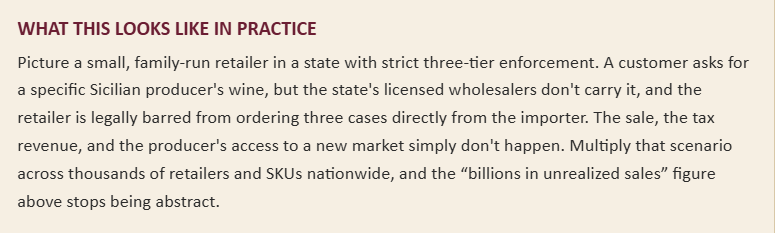
Conversely, the U.S. market operates under what trade law scholars have described as an “alcohol-control market” rather than an open agricultural framework. Governed by the rigid three-tier system — producers must sell to wholesalers, who sell to retailers, who sell to consumers — the American market suppresses modernization. Industry surveys reported by Wine Meridian (2026) found that more than half of U.S. wine businesses want the freedom of self-distribution to bypass mandatory middlemen. Retailers find themselves legally barred from purchasing directly from out-of-state producers or shipping to consenting, legal-age consumers across state lines.
Separately, research on distribution economics helps explain why that access matters so much. Hirche, Loose, Lockshin, and Nenycz-Thiel (2023), studying the relationship between shelf distribution and market share in wine retailing, found that a wine’s distribution reach is one of the strongest drivers of its retail performance, reinforcing the point that being locked out of a market’s shelves and warehouses, as U.S. three-tier rules routinely do to smaller producers and retailers, is not a minor inconvenience but a direct constraint on revenue.
More broadly, the economic literature on spatial fragmentation supports the underlying mechanism NAWR describes. Redding and Rossi-Hansberg’s (2017) widely cited review of spatial economics documents how barriers between jurisdictions, regulatory, logistical, or otherwise, raise transaction costs and produce inefficient, fragmented markets relative to open ones. That is a general finding about market friction, not a study of wine specifically, but it is directly applicable to a market carved into fifty separate state-level regulatory regimes.
The Massive Economic Cost of Archaic Control
The legal misclassification of wine as a dangerous controlled substance rather than a dynamic agricultural product exacts a massive, quantifiable toll on the U.S. economy. While European producers benefit from fluid supply chains, agricultural integration, and open markets, the American wine ecosystem remains locked inside a rigid, post-Prohibition labyrinth.
Examining the economic losses of the U.S. model, and contrasting them with the efficiencies of the Italian framework, reveals an urgent imperative for systemic reform:
Geographic Monopolization: Because mid-tier wholesalers often focus heavily on mega-brands, independent wineries struggle to secure shelf space. This lack of access restricts consumer choice and deprives regional economies of the multiplier effects generated by thriving artisan viticulture (Mazzanti, 2018).
Artificial Market Fragmentation and Deadweight Loss: Treating the wine market as an alcohol-control mechanism rather than an open agricultural space creates severe market friction (Redding & Rossi-Hansberg, 2017). State-by-state protectionist bans prevent rational national distribution, raising transaction costs and forcing smaller wineries and retailers out of business.
Suppressed Small Business Revenue: According to Wine Meridian (2026), more than half of U.S. wine businesses actively seek self-distribution rights to bypass mandatory wholesalers. The inability to source directly forces independent retailers to turn away consumer demand, resulting in billions of dollars in unrealized sales across the retail sector.
The Retailer’s Dilemma and the NAWR Challenge
Caught in this legal labyrinth is the National Association of Wine Retailers (NAWR). While many industry players complain behind closed doors, NAWR has publicly challenged the current system as structurally indefensible, discriminatory, and unconstitutional.
NAWR points to key legal contradictions that mirror a constitutional crisis:
- Protectionist Interstate Bans: States frequently shut down online retail delivery to shield in-state wholesalers and retailers from fair competition (National Association of Wine Retailers, 2025a).
- Dormant Commerce Clause Violations: Allowing in-state retailers to ship locally while banning out-of-state retailers creates a discriminatory barrier that violates the U.S. Constitution (National Association of Wine Retailers, 2025c).
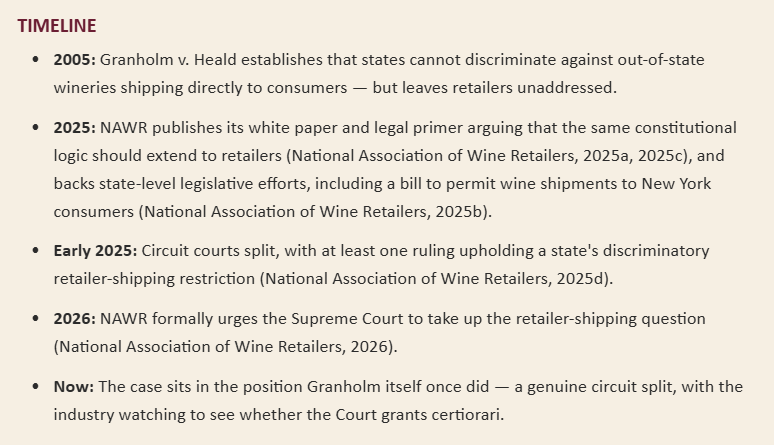
- The Producer-Retailer Double Standard: While the Supreme Court ruled in Granholm v. Heald (2005) that states cannot discriminate against out-of-state wineries in direct-to-consumer shipping, lower courts and state regulators have stubbornly refused to extend that same logical protection to retailers.

Where the Legal Fight Stands
The Positive Transformation: Adopting and Adapting the Italian Model
If the United States were to adapt the rational, agricultural-first principles embodied by Italy and the European Union, the economic upside for the American wine market would be transformative:
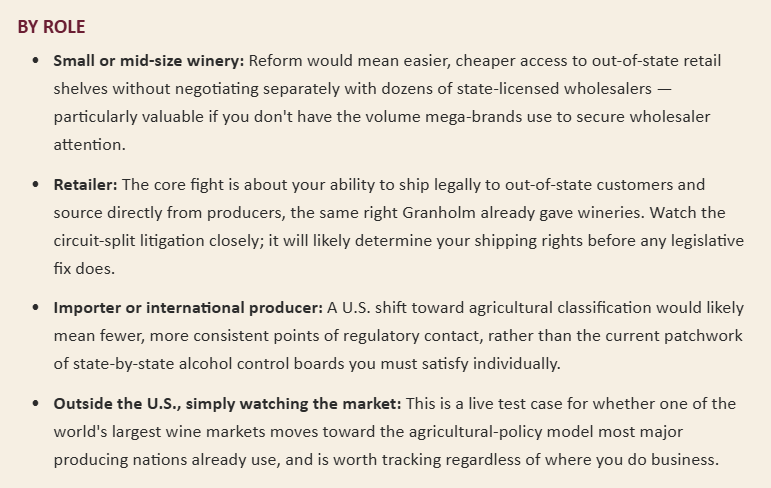
- Integrating Wine into Agricultural Policy: In Italy, wine is managed under agricultural frameworks like the EU’s Common Agricultural Policy (CAP), which treats it as “a pillar of rural identity and economic stability” (WineNews, 2026). Adopting this perspective in the U.S. would shift the regulatory burden from the Tax and Trade Bureau (TTB) and penal control boards to agricultural departments, unlocking agricultural subsidies, targeted rural development grants, and streamlined interstate commerce protections (Caruso, 2021).
- Legalizing Direct-to-Consumer (DtC) and Direct-to-Retailer Trade: Italy’s market relies on transparent, enforceable designations of origin (PDO/PGI) that turn terroir into immediate economic value without throttling supply chain actors (Pomarici et al., 2021). Extending the logic of Granholm v. Heald (2005) from wineries to retailers would dismantle interstate shipping bans, inject agility into the market, lower consumer prices, foster e-commerce growth, and generate billions in new taxable economic activity. Research on the winery side of this question backs the point: Pesavento (2022) found that state DtC shipping laws measurably affect the number and size distribution of U.S. wineries, evidence that market access rules, not just talent or capital, shape who survives in this industry.
- Fostering Competitive Coherence: Italy’s agricultural model generates over $8.7 billion USD in annual exports (IMI Intesa Sanpaolo, 2025) by encouraging market competition, regional consortia, and collaborative innovation rather than defensive gatekeeping. A modernized U.S. framework would free retailers to meet actual consumer demand, empower craft winemakers to reach national audiences organically, and replace carceral enforcement with market-driven competitiveness (Scienza, 2019).
What This Means for You
The Supreme Court Standard: Time for Consistency
If this issue were formally argued before the Supreme Court, the core constitutional question would be stark: Is it defensible to treat wine as a dangerous contraband substance in the United States when peer nations treat it as agriculture, and when that misclassification demonstrably harms interstate commerce and consumer welfare?
The legal precedent is already laid out. Granholm v. Heald established that the Twenty-First Amendment does not grant states a blank check to override the Commerce Clause. Extending that doctrine to retailers is not a radical judicial leap; it is the logical continuation of ensuring a free, national market. Economically, the broader literature on spatial and regulatory fragmentation demonstrates that protectionist fragmentation breeds inefficiency (Redding & Rossi-Hansberg, 2017), while agricultural integration breeds success (Pomarici et al., 2021).
References
Caruso, S. (2021). Agricultural policy and regional wine development in the European Union. Journal of Rural Studies, 84, 112–124. https://doi.org/10.1016/j.jrurstud.2021.03.008
Hirche, M., Loose, S., Lockshin, L., & Nenycz-Thiel, M. (2023). Distribution velocity in wine retailing. Wine Economics and Policy, 12(2), 31–41. https://doi.org/10.36253/wep-14190
IMI Intesa Sanpaolo. (2025). Italian wine production and exports: Future trends. Economind. https://imi.intesasanpaolo.com/en/insights/economind/italian-wine-industry-2024/
Mazzanti, A. (2018). Terroir, regulation, and rural development: The economic impact of PDO and PGI systems in Italy. European Review of Agricultural Economics, 45(3), 421–447. https://doi.org/10.1093/erae/jbx035
National Association of Wine Retailers. (2025a, January 7). First-ever white paper on interstate wine retailer shipping released. NAWR. https://nawr.org
National Association of Wine Retailers. (2025b, January 27). New bill allowing wine shipments to New Yorkers supported by white paper. NAWR. https://nawr.org
National Association of Wine Retailers. (2025c). Interstate retailer wine shipping: A primer for lawmakers, regulators, and stakeholders. NAWR. https://nawr.org
National Association of Wine Retailers. (2025d, March 5). Wine retailers disappointed with court’s endorsement of discriminatory shipping law. NAWR. https://nawr.org
National Association of Wine Retailers. (2026, February 18). Retailers urge Supreme Court to take up key wine shipping case. NAWR. https://nawr.org
Pesavento, M. T. (2022). The impact of direct to consumer shipping laws on the number and size distribution of U.S. wineries. Journal of Wine Economics, 17(4), 270–295. https://doi.org/10.1017/jwe.2022.49
Pomarici, E., Corsi, A., Mazzarino, S., & Sardone, R. (2021). The Italian wine sector: Evolution, structure, competitiveness and future challenges of an enduring leader. Italian Economic Journal, 7(2), 259–295. https://doi.org/10.1007/s40797-021-00144-5
Redding, S. J., & Rossi-Hansberg, E. (2017). Quantitative spatial economics. Annual Review of Economics, 9, 21–58. https://doi.org/10.1146/annurev-economics-063016-103713
Scienza, A. (2019). Wine and terroir: The agricultural foundations of Italian viticulture. Italian Journal of Agronomy, 14(2), 95–104. https://doi.org/10.4081/ija.2019.1412
Wine Meridian. (2026). US wine market reform: Overcoming the three-tier system. Wine Meridian.
WineNews. (2026). The “Wine Package” faces the CAP challenge in a changing scenario, on the supply chain table. WineNews. https://winenews.it
© 2026 Dr. Elinor Garely / InMyPersonalOpinion.Life Protected by U.S. & international copyright + DMCA. No reproduction, reposting, redistribution, adaptation, or AI training allowed. Brief quotes only with full credit + link. Permissions: EG@InMyPersonalOpinion.Life
000