
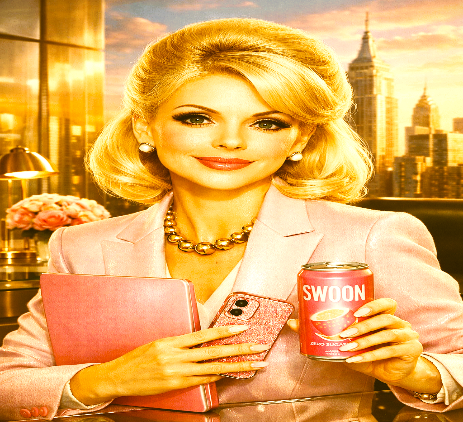
Turning Culture into Cash: The Gerwig-Ross-Blankfein Strategy
A Cultural Moment Built by Women
The summer of 2023 was not defined by a film or a beverage. It was defined by three women, Greta Gerwig, Jennifer Ross, and Cristina Ros Blankfein, whose work converged into a cultural and commercial moment that was measurable, intentional, and historically significant. Gerwig’s Barbie became the highest-grossing film ever directed by a woman, earning $1.448 billion globally (Variety, 2023; Wikipedia, 2024). But its deeper impact was cultural: the film reframed Barbie from a nostalgic toy into a modern inquiry about autonomy, identity, and the emotional labor of womanhood. It created a behavioral environment where women felt seen, energized, and ready to participate in something larger than entertainment (Retail Brew, 2023).
Greta Gerwig: Rewriting Hollywood’s Power Structure
Gerwig’s achievement was not simply financial. It was structural. Only five of the 100 highest-grossing films in history have been directed or co-directed by women (Ettenheim & Whelan, 2023). Gerwig’s ascent into that list was a public demonstration of what happens when female-led storytelling is given budget, distribution, and cultural permission. Her film sparked measurable shifts across fashion, beauty, wellness, and consumer behavior, with “Barbiecore” surpassing 500 million TikTok views during peak release (MutualMarkets, 2025). Gerwig built the cultural runway. SWOON took off on it.
Jennifer Ross & Cristina Ros Blankfein: Redesigning the Beverage Aisle
While Gerwig was reshaping Hollywood, Ross and Blankfein, both Harvard MBAs, were reshaping the beverage aisle. SWOON did not begin as a flavor experiment; it began as a health and behavior question. Ross, diagnosed with Type 1 diabetes at age six, understood the metabolic consequences of sugar. Blankfein, trained in finance and consumer strategy, understood the emotional consequences of asking consumers to give up pleasure (Fryc, 2023; Blankfein, 2023). Together, they built SWOON around monk fruit, a non-nutritive sweetener recognized as Generally Recognized as Safe (GRAS) by the U.S. Food and Drug Administration (FDA) and evaluated favorably within WHO guidance on non-sugar sweeteners (FDA, 2010; WHO, 2022). Their product line, lemonade, sweet tea, raspberry tea, was deliberately familiar. The innovation was not in flavor but in metabolic profile: zero sugar, zero glycemic impact, and no artificial sweeteners.
Market Conditions Made for SWOON
SWOON’s emergence aligned with broader shifts in consumer behavior. Functional beverages are projected to reach $204 billion by 2030, driven by demand for products that promise health benefits beyond hydration (Grand View Research, 2024). At the same time, 60–70 percent of U.S. adults are actively reducing sugar intake (WHO, 2022), and more than 40 percent report distrust of artificial sweeteners (Blankfein, 2023). SWOON entered a market where demand was accelerating and offered a product that met both medical and emotional needs. It was not a niche wellness brand; it was a solution.
Why These Women Connected
The connection between Barbie and SWOON was not a random licensing opportunity. It was a case study in high-fit co-branding. A meta-analysis of co-branding research found that partnerships succeed when brand images “naturally belong together” and when consumers perceive the collaboration as inevitable rather than engineered (Wasim et al., 2021).
Gerwig’s film argued that joy and autonomy can coexist. SWOON’s founders argued that joy and wellness can coexist. Female consumers were already living both arguments. When SWOON approached Mattel, the proposition was philosophical: let the beverage embody the film’s promise that women can have delight without self-betrayal (Retail Brew, 2023).
Measurable Commercial Impact
The collaboration produced results that can be verified. Trade coverage reported that Barbie x SWOON Pink Lemonade delivered SWOON’s highest monthly velocity in brand history, with Whole Foods expanding distribution based on sales data rather than aesthetics (Beverage Industry, 2023). Academic work on film tie-ins suggests that such partnerships can increase trial rates by 20–40 percent and enhance brand recall when the entertainment property and the product are featured together (Karray et al., 2015; MutualMarkets, 2025). In this case, the can functioned as a physical extension of the film experience, a “drinkable ticket stub,” allowing consumers to signal participation in the cultural moment.
Women are Cultural Amplifiers
The amplification effect was driven largely by women. Research on fan communities shows that when brands enter a fandom with genuine value alignment, fans can significantly amplify brand equity through advocacy, content creation, and social signaling (Vega, 2024). Barbie‘s fanbase is multi-generational and emotionally layered, encompassing childhood nostalgia, feminist critique, and contemporary wellness trends. By making Barbie‘s “official pink lemonade” zero sugar, female-founded, and metabolically sensible, SWOON positioned itself as an ally to that evolved fandom rather than a superficial opportunist. The result was visible across platforms: cans in manicured hands, perched on Pilates reformers, photographed outside theaters.
The Strategic Lesson: Women Built This
- Gerwig built the cultural narrative.
- Ross and Blankfein built the product narrative.
- Female consumers built the amplification narrative.
Together, they created cultural relevance, retail velocity, investor confidence, and multi-industry impact. This is not a story of marketing. It is a story of female leadership, and the markets that move when women build for women.
References
Beverage Industry. (2023, July 19). Barbie magic hits the beverage aisle. https://www.bevindustry.com/articles/95980-barbie-magic-hits-the-beverage-aisle
Blankfein, C. R. (2023, June 11). “Zero sugar isn’t a trend”: Swoon co-founder discusses beverage evolution, Barbie collaboration and nostalgia. FoodNavigator-USA. https://www.foodnavigator-usa.com/Article/2023/06/11/zero-sugar-isn-t-a-trend-swoon-co-founder-discusses-beverage-evolution-barbie-collaboration-and-nostalgia
Business Wire. (2023, August 6). Warner Bros. Pictures’ “Barbie” and director Greta Gerwig make history together as the box office sensation passes a billion dollars worldwide. https://www.businesswire.com/news/home/20230806347879/en/Warner-Bros.-Pictures%E2%80%99-%E2%80%9CBarbie%E2%80%9D-and-Director-Greta-Gerwig-Make-History-Together-as-the-Box-Office-Sensation-Passes-a-Billion-Dollars-Worldwide
Ettenheim, R., & Whelan, R. (2023, August 1). “‘Barbie’ joins ranks of biggest moneymaking movies by a female director.” The Wall Street Journal. https://www.wsj.com/articles/barbie-joins-ranks-of-biggest-moneymaking-movies-by-a-female-director-6b8f6c3a
Fryc, D. (Host). (2023, August 27). From syrup to success: How Swoon navigated it all with Jennifer Ross [Audio podcast episode]. Retail Voodoo. https://retailvoodoo.com/podcasts/from-syrup-to-success-how-swoon-navigated-it-all-with-jennifer-ross
Grand View Research. (2024). Functional beverages market size report, 2024–2030. https://www.grandviewresearch.com/industry-analysis/functional-beverages-market-report
Karray, S., Smimou, K., & Sud, B. L. (2015). Tie-in promotions in the motion picture industry: An empirical study. In K. Kubacki (Ed.), Ideas in marketing: Finding the new and polishing the old (pp. 1065–1069). Springer. https://doi.org/10.1007/978-3-319-10951-0_385
MutualMarkets. (2025). Co-marketing entertainment partnerships in online advertising [White paper]. https://mutualmarkets.com/resources/co-marketing-entertainment-partnerships-online-advertising
Retail Brew. (2023, May 3). Inside beverage brand Swoon’s Barbie collaboration. https://www.retailbrew.com/stories/2023/05/04/inside-beverage-brand-swoon-s-barbie-collaboration
U.S. Food and Drug Administration. (2010). Agency response letter GRAS notice: Monk fruit extract. https://www.fda.gov/food/generally-recognized-safe-gras/gras-notice-inventory
Variety. (2023, September 2). “Barbie” is officially the highest-grossing release of the year with $1.36 billion globally. https://variety.com/2023/film/news/barbie-highest-grossing-movie-2023-box-office-1235717790
Vega, K. (2024). Popular fan culture as an impeller of brand equity: The case of BTS. Journal of Ecohumanism. https://journals.uni-plovdiv.bg/index.php/jecoh/article/view/13033
Wasim, A., et al. (2021). Success drivers of co-branding: A meta-analysis. International Journal of Consumer Studies, 45(6), 1234–1256. https://doi.org/10.1111/ijcs.12668
Wikipedia. (2024). Barbie (film). https://en.wikipedia.org/wiki/Barbie_(film)
World Health Organization. (2022). Non-sugar sweeteners and health: WHO guideline. https://www.who.int/publications/i/item/9789240073616
000
© 2026 Dr. Elinor Garely / InMyPersonalOpinion.Life. Protected under U.S. and international copyright law, including the DMCA. All rights reserved. Unauthorized use, reproduction, or inclusion in AI training datasets is prohibited. Brief, non-substantive quotations allowed only with full attribution and active link. Licensing inquiries: EG@InMyPersonalOpinion.Life
000