
Dr. Elinor Garely
Argentine wine has no shortage of glossy sustainability language, but B Corp certification is one of the few signals that forces wineries to prove it. As one researcher put it, credible certifications move sustainability “from marketing copy to audited, measurable practice” (Bringas-Fernández et al., 2024). And that’s exactly why Trivento’s B Corp status is worth paying attention to.
Winemakers Set Priorities
I met with Germán Di Cesare, Trivento’s chief winemaker, while he was in New York. Di Cesare joined the winery in 2002 and now oversees its top ranges, including Golden Reserve and Eolo. In 2025, Tim Atkin MW named him Winemaker of the Year, a nod to his influence on the global profile of Argentine Malbec (Viña Concha y Toro, 2026). During our conversation, one detail stood out: Trivento isn’t just talking about sustainability—it’s certified as a B Corporation.
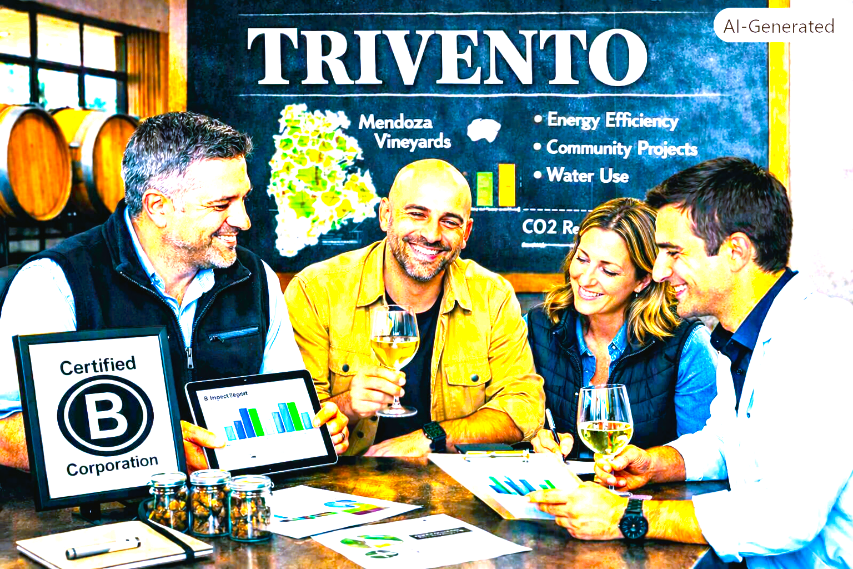
Trivento earned its certification in 2021, becoming the largest agricultural-sector B Corp in Argentina (Wine Industry Advisor, 2022). CEO Marcos Jofré summed it up simply: “Sustainability is our raison d’être,” describing the certification as a formalization of work already underway (Decanter, 2021).
For casual drinkers, B Corp might look like another logo on the back label. But for a winery of Trivento’s scale, part of Viña Concha y Toro and one of Argentina’s top exporters—it’s a public commitment to be measured on more than sales.
What B Corp Actually Signals
Awareness of the B Corp logo is still low; approximately one in four consumers in the Global North recognize it (B Lab, 2024). But unfamiliar doesn’t mean ineffective. B Corp standards evaluate performance across five key categories to ensure holistic accountability.

Certification isn’t a quick PR win. Research shows newly certified B Corps often see tighter financial returns in the first two years, largely because they’re investing in systems that strengthen long-term resilience (Bringas-Fernández et al., 2024). B Lab UK’s data suggests those investments payoff: certified firms outperform peers on revenue growth, headcount, and social-environmental metrics (B Lab UK, 2025).
Other winemakers echo this sentiment. Rob Symington of Portugal’s Symington Family Estates said B Corp appealed to him because it’s broad, “not just certifying your farming practices” (VinePair, 2020). Keith Scott of Oregon’s A to Z Wineworks calls it “a good overall stamp” for overwhelmed shoppers (VinePair, 2020).
A Desert That Demands More Than Marketing
Mendoza is a high-altitude desert where vines survive only through carefully managed irrigation fed by Andean snowmelt. As climate change accelerates glacial retreat, water scarcity becomes existential. Meeting B Corp standards forces wineries to track and improve water use, energy efficiency, and carbon emissions, all with independent verification.
Local sustainability programs already push wineries toward efficient irrigation, waste reduction, and renewable energy adoption (Sommelier Business, 2024). A comprehensive review of recent literature shows that climate adaptation and resource management dominate wine sustainability research, with life-cycle assessment and integrated soil and pest management offering the most systemic benefits (Jițăreanu et al., 2026).
Territorial sustainability studies show that rigorous certifications can strengthen both economic performance and regional reputation (Ceccacci et al., 2024). Di Cesare often talks about expressing Mendoza’s identity, its terroir, climate, and winds, through Trivento’s wines (Decanter, 2014). In that context, B Corp certification is a long-term survival strategy.
Cutting Through Greenwash in Global Markets
In export hubs like London and New York, “sustainable” labels blur together. B Corp stands out because it’s holistic and externally governed. Marketing research shows credible third-party certifications reduce consumer skepticism and strengthen brand differentiation (Ivanova, 2018; Kalfus, 2019). Legal analysts argue B Corp gives wineries a values-driven identity that builds trust and long-term reputation (Rogoway, 2023).
Consumer surveys back this up: respondents say they’re significantly more likely to trust and favor B Corp brands (B Lab UK, 2025). For an Argentine winery fighting for shelf space, that trust signal can be the difference between being just another Malbec and becoming a default choice for values-driven buyers.
Better Governance in a Volatile Economy
Operating in Argentina means navigating currency swings, policy shifts, and unpredictable conditions. One quiet advantage of B Corp certification is governance. To qualify, firms must legally commit to considering workers, communities, and the environment, not just short-term shareholder returns.
Academic literature adds a caution: across empirical studies, social sustainability remains the least standardized pillar (Jițăreanu et al., 2026). For a certification built on stakeholder governance, that gap matters, because good governance translates into real benefits: lower employee turnover, stronger engagement, and more stable supplier relationships.
Who Benefits: Everyone
For winemakers, wine buyers, sellers, sommeliers, and consumers alike, the Certified B Corporation seal represents more than compliance, it’s a covenant of trust. It signals that every bottle poured reflects a conscious choice: to protect the land that nurtures the vines, to honor the people who craft the wine, and to ensure transparency from vineyard to glass.
References
B Lab. (2024). About B Corp certification.
B Lab UK. (2025, March 5). B Corps outperforming ordinary businesses, new data shows.
Bringas-Fernández, V., Sánchez-Bruno, A., & Egea, P. (2024). B-Corp certification and financial performance: A panel data analysis. PLOS ONE.
Ceccacci, A., Vrontis, D., & Cavalli, E. (2024). Enhancing wineries’ sustainability through territorial certification. International Journal of Wine Business Research.
Decanter. (2014, September 7). Germán Di Cesare of Trivento on winemaking.
Decanter. (2021, December 1). Argentinian winery Trivento receives corporate sustainability recognition.
Ivanova, A. (2018). Moderating factors on the impact of B Corporation certification on consumer purchase intention. Academy of Marketing Studies Journal.
Jițăreanu, A.-F., Prigoreanu, I., & Ignat, G. (2026). Sustainability evolution in the wine industry: A systematic review. Agriculture.
Kalfus, L. (2019). The business case for the B Corporation certification.
Nicholas, A. J. (2017). People, planet, profit: Benefit and B certified corporations.
Rogoway, S. (2023, February 15). B Corporation certification: A guide for wineries and beverage businesses.
Sommelier Business. (2024, August 23). Wines of Argentina: Pioneering sustainability and export growth.
VinePair. (2020, March 5). How to make sense of sustainable wine certifications.
Viña Concha y Toro. (2021, May 5). Viña Concha y Toro and subsidiaries join the community of B Corporations.
Viña Concha y Toro. (2026, July). Bodega Trivento celebrates its 30th anniversary.
Wine Industry Advisor. (2022, October 12). Trivento named top Argentinian wine brand worldwide again.
Wines of Argentina. (2023, October 9). More wineries certified in sustainability in Argentina.
© 2026 Dr. Elinor Garely / InMyPersonalOpinion.Life. Protected by U.S. & international copyright and DMCA. No reproduction, reposting, redistribution, adaptation, or AI training allowed. Brief quotes only with full credit and link. Permissions: EG@InMyPersonalOpinion.Life
000