

InMyPersonalOpinion.Life. Dr. Elinor Garely
Entering a Silent Room Made of Rhythm
When I walked into the Valerie Goodman Gallery on an early New York evening, it felt as if I had entered a room made of rhythm and air. The stillness was luminous, rippling softly with the reflections of Jacques Jarrige’s sculptures, whose hand-hammered surfaces caught and released light with the delicacy of breath. Each form, whether suspended as a mobile or grounded as a console, seemed to hover between movement and stillness, quietly alive.
Origins of a Quiet Visionary
Born in Paris in 1962, Jarrige was raised in a family where science and art intertwined. His fascination with the emotional resonance of form began in childhood, stirred by encounters with African sculpture in Saint-Germain. Though he briefly trained in architecture at the École Nationale Supérieure des Beaux-Arts, he left academia for the immediacy of craft. Inside his studio, everything begins by hand, bending, hammering, carving, without blueprints or digital mediation. Creation, for him, is a conversation with material.
Listening Through the Hands
“I don’t design; I listen,” Jarrige has said. “The material speaks, and I follow.” That declaration, simple and poetic, radiates through his work. Each curve feels spontaneous yet deliberate, like a line drawn mid-thought. His sculptures are three-dimensional sketches, raw yet refined, inviting empathy. He shapes light and emotion from wood, brass, and especially aluminum, his preferred medium for works that gleam and drift as if caught between sculpture and cloud.
A Philosophy of Calm Design
For those of us craving serenity in our living and working environments, Jarrige’s world feels vital. In residential and interior design, every piece must earn its presence, and Jarrige’s creations do so by changing the atmosphere around them. A console can steady a room. A screen filters light like a heartbeat. His suspended forms transform a corner into contemplation. His aesthetic, human, tactile, quietly spiritual, moves in the opposite direction of industrial minimalism’s stark restraint.
Where to Discover His Work
Jarrige’s newest works shimmer within the white stillness of the Valerie Goodman Gallery on the Upper East Side. Collectors can discover his evolving path from rough-hewn wooden furniture to fluid aluminum sculptures on platforms like 1stDibs, Artsy, and InCollect. His larger installations, meanwhile, live within European museums, private estates, and architectural collaborations that dissolve the boundary between art and environment.
The Human Alternative to Minimalism
As trends shift toward the handmade and emotionally resonant, Jarrige’s work stands as both anchor and antidote. Where industrial minimalism strips feeling away, his art restores it, through curves, imperfections, and the generosity of touch. His aluminum ribbons twist like thought itself, vulnerable yet assured, inviting both eye and hand to follow their rhythm.
Leaving With Light
When I stepped back into the Manhattan air, I realized Jarrige’s work does more than decorate space, it defines it. His sculptures carve moments of stillness in motion; gestures of empathy wrought from metal and wood. They whisper the quiet truth that beauty, at its most human, is never complete. It lives, breathes, and grows with us.
InMyPersonalOpinion
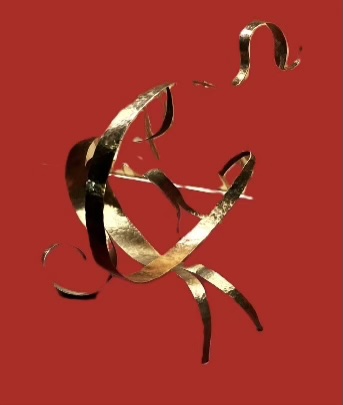
Gilded Spirals: Poems of Light
Spiral gold ribbons twist like short, elegant poems of light, their surfaces catching and scattering shimmer against the red backdrop, balancing buoyancy and tension gracefully.
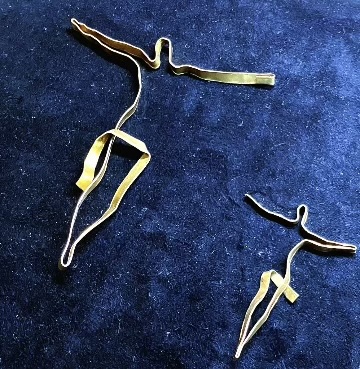
Kinetic Minimalist Figures
Two minimalist wire figures leap and dance; single‑line silhouettes convey dynamic motion, balance, and playful intimacy.
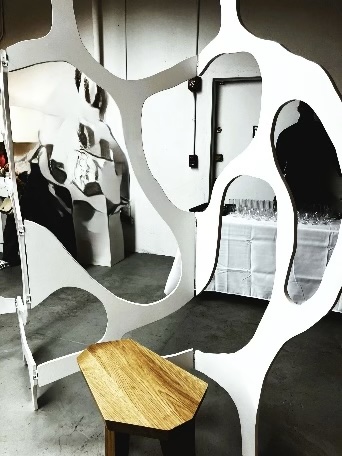
White Partition
Painted panels pierced by organic cutouts create a freestanding relief that modulates light and sightlines. Its undulating negative spaces feel botanical and topographical, balancing tactile presence with formal precision to animate the room while preserving privacy and mystery. Its plaster‑like surface invites the eye to wander through framed fragments of the room beyond. This partition succeeds as both object and operator. It animates the room without dominating it, offering rhythm and a controlled sense of mystery that complements minimalist interiors.
Golden Wooden Table
The table presents as a low, geometric, honey-toned sculpture with chamfered supports, and matte tactile surface. It is human-scaled and unadorned, grounds the scene, moderates the partition’s cutouts, and enables the sculptural composition without competing and reinforces a conversation between solids and voids. It never competes with the art, instead enabling the partition’s rhythms to read more clearly.
Copyright and International Rights Notice
All content on this website, including articles, commentary, photographs, and research — is the intellectual property of Dr. Elinor Garely and InMyPersonalOpinion.Life. All rights are reserved under U.S. law (Title 17, U.S. Code) and international treaties, including the Berne Convention for the Protection of Literary and Artistic Works and the WIPO Copyright Treaty. Unauthorized reproduction, distribution, or transmission of any content, in whole or in part, is strictly prohibited without prior written consent. This includes commercial use, digital republication, translation, or adaptation. Exceptions are granted for brief quotations used in scholarly, journalistic, or critical contexts, provided that full credit and a direct link are given to Dr. Elinor Garely and InMyPersonalOpinion.Life. For permissions, syndication, or licensing inquiries,
contact: ???? EG@InMyPersonalOpinion.Life
000