
A Nation at a Crossroads
The United States, long viewed as a beacon of prosperity and democracy, faces a moral and economic test. At the center lies its complex and often misunderstood social safety net, a vast system of programs that protects tens of millions of Americans from poverty, illness, hunger, and economic collapse. Today, this safety net is unraveling under mounting political polarization, fiscal hawkishness, and cultural upheaval.
While much of the world embraces universal programs that promote equity and resilience, the U.S. remains trapped in a bitter debate: Should the government guarantee basic welfare, or should individuals sink or swim on their own?
???? Winners and Losers: Programs for Poor, Axed
Social programs like Medicaid, SNAP, Social Security, Medicare, and housing assistance keep tens of millions of Americans afloat. These programs:
- Cut poverty by 45%
- Prevent hundreds of thousands of deaths
- Reduce food insecurity and homelessness
- Support elderly, disabled, working families, and children
Despite being framed as “fiscal responsibility” or “reducing government dependency,” cuts to safety net programs are not about efficiency. They are about redistributing public wealth upwards.
The Winners
Millionaire politicians and their donors are beneficiaries of the Republican’s Big Beautiful bill. It is important to note that over 50 percent of U.S. Senators are millionaire and over 200 members of Congress own significant stocks or collect dividends. In addition, many vote for policies that slash aid while cutting their own taxes. These same officials often receive campaign funds from Wall Street, private insurers, and billionaire-backed PACs.
???? Ultra-Wealthy Americans and the Top 1%.
Every dollar cut from Medicaid or SNAP is a dollar that can go to tax shelters, stock buybacks, or offshore account
| Group | Gains from Safety Net Cuts |
| Top 0.1% of income earners | Up to $860/day in tax breaks |
| Top 1% | ~$200,000/year from capital gains and estate tax changes |
| High-income investors | More loopholes, less oversight |
| Large corporations | Reduced payroll tax obligations, fewer regulations |
???? Lobbyists and Industries That Monetize Crisis
???? Cuts to the safety net aren’t neutral, they supercharge industries that profit from poverty, debt, illness, and instability.
???? Molina Healthcare
???? Molina Healthcare shed around 500,000 Medicaid members in 2023 as pandemic-era protections expired and redeterminations returned. That kind of churn would rattle most insurers, but Molina countered with tactical plays, expanding into Iowa, acquiring plans in Wisconsin, and tightening operational margins. The net result? $40.65 billion in 2024 revenue, with $42 billion projected for 2025. In an industry bruised by volatility, Molina is proving that scale, strategy, and agility still sell.
???? Encore Capital Group
???? Encore Capital Group, with a current market value of approximately $961 million (NASDAQ: ECPG), remains one of the most aggressive debt buyers in the U.S. In 2024, it filed millions of debt collection cases and acquired $1.35 billion in non-performing loans, marking a record-breaking year for portfolio expansion. Collections surged to $2.16 billion, a 16 percent increase over 2023, driven by rising charge-offs and delinquencies. While some see warning signs in consumer credit deterioration, Encore is capitalizing on the chaos.
???? CoreCivic
???? CoreCivic operates over 70 facilities across the U.S., housing approximately 70,000 inmates. In Georgia, where poverty-related offenses, such as unpaid fines and fees, are widespread, CoreCivic-run prisons remain at or near capacity. Nationally, the U.S. spends an estimated $182 billion annually on incarceration. Within this system, private prison operators continue to profit from the criminalization of poverty and systemic inequities.
????️ Hunter Properties
Faced a lawsuit for rejecting applicants with any prior eviction, including sealed or dismissed cases. In Cook County, Black renters are 5 times more likely to face eviction filings than white renters, amplifying the discriminatory impact of such policies.
????️ Ballard Partners
Founded in 1998 by Brian Ballard, the firm, Ballard Partners, is a U.S.-based lobbying and public affairs firm that helps corporations, foreign governments, and industry groups navigate political and regulatory landscapes. Two top Trump officials, Susie Wiles and Pam Bondi, are firm alumni. Since the 2024 election, Ballard has signed 130+ new clients, including JPMorgan Chase, Chevron, and Netflix, and tripled Q1 revenue to $14 million. He also bundled $1.8 million for Trump’s campaign, cementing his role as a conduit between corporate interests and policymaking.
???????????????? WHO LOSES
The Trump administration’s “One Big Beautiful Bill” has triggered sweeping reductions in public support programs, disproportionately impacting vulnerable American communities while delivering substantial financial gains to corporate allies and lobbying firms. Cuts to Medicaid, projected at $1 trillion over 10 years, could result in 11.8 million people losing coverage, including low-income workers and disabled Americans, while rural hospitals face $50.4 billion in lost funding, putting over 300 facilities at risk of closure.
Children’s welfare is jeopardized by an estimated $230 billion reduction in SNAP benefits, stripping 5 million children of vital food assistance and further eroding school nutrition programs.
Seniors are hit by Medicare Advantage cost spikes, $84 billion in 2025 alone, alongside privatization proposals that threaten future Social Security solvency. Meanwhile, single parents and students face tighter work requirements and reduced access to food, healthcare, and housing support.
These changes reflect a sharp pivot toward privatization and deregulation, yielding short-term gains for multinational stakeholders but triggering long-term risks for tens of millions of Americans.
???? Illusion: “We’re Cutting Waste”
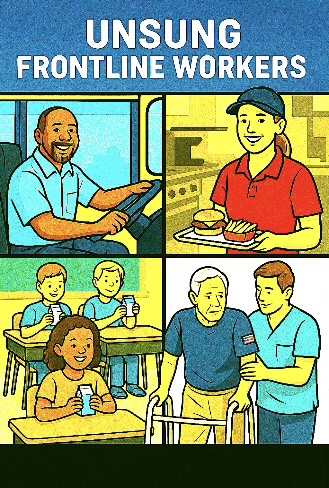
Despite political messaging portraying U.S. safety net programs as wasteful or misused, data reveals that these programs are essential lifelines for working families, the elderly, and vulnerable populations. Roughly 60 percent of SNAP recipients live in households with earned income, and in 2025, 42.1 million Americans received food assistance each month, funded by $112.8 billion in federal spending.
Cuts under the new Trump legislation are projected to slash SNAP by $230 billion over 10 years, threatening access for over 5 million children. Meanwhile, 71.3 million Americans rely on Medicaid, nearly one in five citizens, including 36 million children, with the program covering half of all U.S. births. The proposed $1 trillion reduction in Medicaid funding could strip healthcare coverage from 11.8 million people and trigger $50.4 billion in losses for rural hospitals, placing over 300 facilities at risk of closure.
For seniors, the impact is equally stark: 40 percent depend solely on Social Security, with average monthly benefits of $2,002 in 2025. Without these benefits, elder poverty would triple, and government aid costs could rise by $34 billion annually.
These facts dismantle the myth that safety nets serve only the “lazy” or “undeserving”—instead, they underscore the economic fragility facing millions of Americans who work, care for children, live with disabilities, or age into retirement with limited resources. For global leaders and executives navigating U.S. policy, understanding the true demographics behind public assistance is key to assessing long-term social and market stability.
© Dr.Elinor.Garely, InMyPersonalOpinion.Life.2025]. All rights reserved. No part of this content may be reproduced, distributed, or used without permission. For inquiries, contact EG@InMyPersonalOpinion.Life