

How to be Noughty and Nice
In my personal opinion, love doesn’t need a lift, but it does deserve a very good bottle of wine. For centuries, Valentine’s Day has paired beautifully with a little red, a little white, or something blush in between. Wine doesn’t just fill the glass; it fills the space between two people. It loosens conversation, signals intention, and turns an ordinary evening into something that means something.
The Persian poet Omar Khayyam believed a lover’s glance and a drop of wine could create paradise anywhere. Casanova agreed; wine, he said, “heightens every pleasure.” Even Goethe called it the “spirit of love,” a liquid that softens hearts while keeping secrets safe.
And now, along comes Noughty, proving that passion doesn’t require a punch. Same clink. Same color. Same chemistry. Just better recall in the morning. Because wine, at its best, has always been a metaphor for love itself: layered, expressive, occasionally unpredictable, and always better when shared.
So, whatever your Valentine’s story looks like this year—solo, spoken-for, or deliciously undefined—choose your hue and pour your mood. After all:
- Red stirs the heart.
- White clears the mind.
- And rosé? Rosé was made for the maybes.
Valentine’s Day: Love Letter or Line Item?
We talk about love. We buy gifts to prove it. But Valentine’s Day has quietly evolved from tender sentiment into a global invoice printed on pink cardstock. The public calls it romance; the economy treats it like a first-quarter performance review (Camoin Associates, 2025; Vested, 2025).
From Saints to Sales Funnels
Valentine’s Day began not as a marketing brainstorm but as a messy intersection of saints, legends, and poetry (Thunderbird School of Global Management, 2018). By the nineteenth century, mass printing and affordable postage transformed intimacy into a product. Today, affection may be sincere, but the gift categories are unmistakably focus-grouped.
The Money Machine in Heels
Economically, Valentine’s Day behaves like a mini-holiday season balanced on stilettos. U.S. spending reached approximately $27.5 billion in 2025, a record high (National Retail Federation, 2025). The average consumer spends between $150 and $190, navigating the thin line between thoughtful and negligent (Bankrate, 2023).
Wine: Cupid’s Liquid Sidekick
Wine remains Valentine’s most reliable emotional support beverage. During Valentine’s week, U.S. consumers move more than two million bottles of wine (Beverage Industry, 2013). On delivery platforms, wine can account for nearly half of all alcohol orders, outperforming spirits and beer (CSP Daily News, 2022). Cupid may shoot arrows, but consumer behavior suggests the cash flow prefers bottles.
When Wine Starts Talking Instead of You
Add alcohol to emotional expectation and financial pressure, and the risks sharpen. Research shows couples with mismatched drinking patterns report lower relationship satisfaction and higher conflict (Homish & Leonard, 2007). Alcohol is also linked to increased risk of intimate partner aggression due to impaired judgment (Fairbairn & Testa, 2017). Not exactly candle-lit bliss.
Dry-(ish) Love: Why Less Buzz Helps
The counterpoint is surprisingly hopeful. Even short-term reductions in alcohol consumption are associated with improvements in sleep, well-being, and confidence (de Visser & Piper, 2020). The goal isn’t abstinence; it’s agency—the ability to participate fully and remember the night clearly.
Same Romance, Better Ending
Non-alcoholic wine preserves everything that says the moment matters: the bottle, the glass, the toast. What it removes is the compound most likely to turn a playful misunderstanding into a three-hour emotional autopsy. The result? Fewer slurred confessions and fewer February 15 conversations that start with, “We should probably talk about last night.”
From Broadcast Booth to Bottle: The Path of Amanda Thomson

Thanks to Amanda Thomson, we can now have our wine guilt-free. A former BBC arts broadcaster, Thomson swapped studio lights for cellar doors, studying for her Diploma in Wine at Le Cordon Bleu in Paris.
Raised by a health-conscious mother, she asked a simple question: Why couldn’t wine be both delicious and transparent? That question led her to found Thomson & Scott, a B Corp–certified company. Her brand, NOUGHTY, is the world’s first premium non-alcoholic wine portfolio designed explicitly for wine lovers who want the ritual without the regret.
Today, NOUGHTY is poured in the world’s most prestigious hotels, from the Mandarin Oriental to The Ritz-Carlton, embedding non-alcoholic wine squarely where fine wine has always lived.
InMyPersonalOpinion: The Noughty Collection
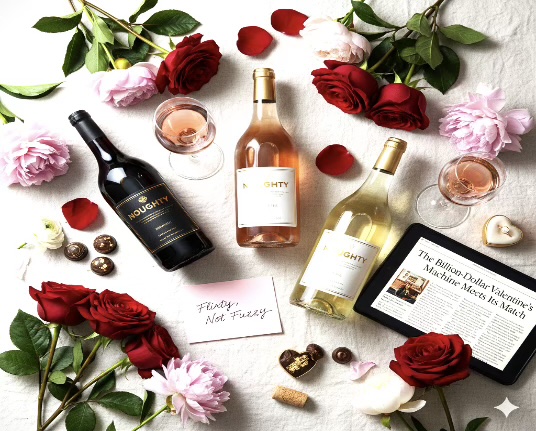
???? 1. Noughty Dealcoholized Red — Rouge
Noughty Rouge is a Syrah-based non-alcoholic red made from grapes grown in South Africa’s Darling region, dealcoholized gently under vacuum to less than 0.5% alcohol. The process is designed to preserve structural elements, body, color, and some
If you’re leaning red, Noughty’s Dealcoholized Rouge has become something of a sommelier favorite, not because it tries to imitate a fullstrength Syrah, but because it respects what a nonalcoholic red can be when it’s made thoughtfully.
Wine reviewers have been surprisingly enthusiastic:
- Sam Slaughter, Wine & Spirits Writer at The Manual, praised its “deep burgundy color with a warm vanilla aroma” and called it “mediumbodied, smooth, and impressively tannic for a nonalcoholic wine.”
- Sarah Kate, NA wine critic and founder of Some Good Clean Fun, describes Noughty’s reds as “category standouts with real structure and balance,” noting Rouge’s popularity among both NA drinkers and sommeliers.
- The New Bar Tasting Panel, a team of certified tasters in Los Angeles, highlights its “ripe red fruit, crushed black pepper, dried rose petal, and Frenchoaklike tannins,” calling it “one of the most complete NA reds available.”
The sensory notes match the praise: a deep ruby pour, berry and soft spice on the nose, hints of red fruit, black pepper, dried rose petal, and candied cherry on the palate.
It doesn’t pretend to be a fullstrength Syrah, and that’s exactly why it works. It offers balance, acidity, and a surprisingly convincing redwine feel without the syrupy sweetness that plagues many nonalcoholic reds. Because the most romantic thing you can bring to Valentine’s Day isn’t a buzz, it’s your full attention.
2.Noughty Dealcoholized White — Blanc
If you’re more of a whitewine person, Noughty’s Dealcoholized Blanc is one of those bottles that quietly wins people over. Made from certified organic Chardonnay grapes and gently dealcoholized to keep its structure intact, it leans crisp, bright, and refreshingly clean. The sensory profile is exactly what you want from a dry, modern Chardonnay: citrus, green apple, pear, and a little minerality, all finishing with a clean, refreshing snap. It’s not trying to be a buttery, oakheavy white, it’s aiming for clarity and balance, and it delivers.
Sommeliers and wine pros have taken notice:
- Derek Brown — Sommelier & Founder, The Mindful Drinking Movement (Washington, D.C.) calls Blanc “one of the most winelike nonalcoholic whites available,” praising its crisp acidity and clean finish, which he notes are “shockingly rare” in NA whites.
- Amanda Victoria — Wine & Spirits Educator, CoFounder of SipClean Highlights its “real Chardonnay character, citrus, pear, minerality, without the cloying sweetness that dominates the category.”
- The New Bar Tasting Panel, led by Certified Sommelier Dylan Melvin (Los Angeles) describes Blanc as “zesty, elegant, and beautifully balanced,” with lemon peel, green apple, and soft floral notes, calling it “one of the most versatile NA whites for pairing.”
- Sarah Kate — NA Wine Critic, Some Good Clean Fun praises it as “a proper nonalcoholic Chardonnay with structure, acidity, and a real finish,” emphasizing that it tastes like wine, not “flat juice.”
Put simply: Blanc gives you the ritual, the moment, without the fog. It’s bright, clean, and genuinely winelike, which is why it keeps getting recommended.
3.Noughty Rose – Still
Noughty Rosé — Still stands out in the nonalcoholic category for its clean fruit, dryness, and balance. The wine’s pale salmon color and subtle aromatics align with what sommeliers often identify as hallmarks of a wellmade, Provencestyle rosé.
Wine writer Julia Coney has emphasized that nonalcoholic wines succeed when they “focus on balance, texture, and honest fruit expression” (Coney, 2021). Noughty Rosé follows that principle closely: the palate shows fresh strawberry, light peach skin, and a clean mineral finish without the candied sweetness common in many NA rosés.
Master Sommelier Rajat Parr has noted that dealcoholized wines work best when producers “preserve acidity and avoid overextraction” (Parr, 2018). Noughty’s approach reflects this: the acidity is bright but not sharp, giving the wine lift and structure without bitterness.
Sommelier and educator Amanda McCrossin has also pointed out that the best NA wines “taste like wine first — not like a substitute” (McCrossin, 2022). Noughty Rosé fits that description: it feels intentional, dry, and adult, with a finish that reads as genuinely vinous.
Noughty Rosé — Still is a clean, balanced, and credible option for drinkers seeking a dry, Provencestyle nonalcoholic rosé that respects the category’s technical constraints while delivering clarity and freshness.
Choose Your Own Valentine’s Ending
Valentine’s Day will continue to monetize affection. What’s changing is our tolerance for the fallout. The emerging alternative isn’t joyless; it’s intentional. Social. Fully remembered. In a holiday designed to signal care, choosing clarity over “fuzzy” might just be the most romantic upgrade of all.
References
Bankrate. (2023). Valentine’s Day spending survey. https://www.bankrate.com/personal-finance/valentines-day-spending-survey/
Beckett, F. (2024, January 12). The best alcohol-free wines for 2024. The Guardian. https://www.theguardian.com/food/2024/jan/12/fiona-beckett-best-alcohol-free-wines
Beverage Industry. (2013, February 14). Sparkling wine sales explode during Valentine’s Day week, research shows. https://www.bevindustry.com/articles/86146-sparkling-wine-sales-explode-during-valentines-day-week-research-shows
Camoin Associates. (2025). Economic impact of Valentine’s Day spending. Industry report.
Coney, J. (2021). On balance and texture in non-alcoholic wine. Black Wine Professionals. https://www.blackwineprofessionals.com
CSP Daily News. (2022). Alcohol delivery trends on Valentine’s Day. https://www.cspdailynews.com/alcohol/alcohol-delivery-trends-valentines-day
de Visser, R. O., & Piper, R. (2020). Short- and longer-term effects of temporary alcohol abstinence. Health Psychology, 39(11), 1030–1039. https://doi.org/10.1037/hea0000897
Fairbairn, C. E., & Testa, M. (2017). Alcohol and intimate partner aggression: A meta-analytic review. Psychological Bulletin, 143(2), 123–147. https://doi.org/10.1037/bul0000089
Homish, G. G., & Leonard, K. E. (2007). The drinking partnership and marital satisfaction. Journal of Studies on Alcohol and Drugs, 68(3), 364–372. https://doi.org/10.15288/jsad.2007.68.364
Lascelles, A. (2025). The rise of the premium zero-percent cellar. Financial Times. https://www.ft.com/content/lifestyle
Mackelden, A. (2024, May 15). Why Noughty is the fashion world’s favorite non-alcoholic pour. Harper’s Bazaar. https://www.harpersbazaar.com
McCrossin, A. (2022). What makes a great non-alcoholic wine. SommVivant. https://www.sommvivant.com
Milliken, M. (2023, November 3). Why texture is the next frontier for NA wine. The Drinks Business. https://www.thedrinksbusiness.com
National Retail Federation. (2025). NRF survey: Valentine’s Day spending reaches record $27.5 billion. https://nrf.com/media-center/press-releases/nrf-survey-valentines-day-spending-reaches-record-275-billion
Parr, R. (2018). Thoughts on dealcoholized wine and structure. Sandhi Wines Journal. https://www.sandhiwines.com
Richards, L. (2024). The best non-alcoholic drinks to try in London right now. Time Out. https://www.timeout.com
Robinson, J. (2023). Tasting notes: The evolution of alcohol-free. JancisRobinson.com. https://www.jancisrobinson.com
Thunderbird School of Global Management. (2018). The history and commercialization of Valentine’s Day. https://thunderbird.asu.edu/knowledge-network/history-valentines-day
Vested. (2025). Seasonal consumer spending trends. https://www.vested.co/
000
© 2026 Dr. Elinor Garely / InMyPersonalOpinion.Life. Protected by U.S. & international copyright + DMCA. No reproduction, reposting, redistribution, adaptation, or AI training allowed. Brief quotes only with full credit + link. Permissions: EG@InMyPersonalOpinion.Life