
It’s a quiet epidemic in modern workplaces: companies are hiring managers who lack the experience, decisiveness, and strategic thinking required to lead. These individuals, often in their 30s and 40s, are placed in operational roles where they’re expected to drive outcomes, yet they consistently defer decisions, check with higher-ups for even minor calls, and avoid taking initiative. The result? Bottlenecks, burnout, and a slow erosion of trust in leadership.
More Than Anecdotal: The Data Is Stark
Recent evidence from Gallup’s 2024 State of the Workplace report reveals that managers alone account for 70% of the variance in employee engagement, directly impacting productivity, retention, and profitability (Gallup, 2024). A 2024 survey by Robert Walters found that 71% of U.S. employers knowingly hired underqualified staff, citing budget constraints and talent shortages (Robert Walters, 2024). Meanwhile, 80% of employees reported increased stress from supporting these hires (Robert Walters, 2024).
The Society for Human Resource Management (SHRM, 2023) estimates the average company loses up to $225,000 per year from avoidable managerial turnover and disengagement. Other studies suggest poor hiring decisions account for up to 80% of employee turnover, and that a single bad hire can cost organizations between $17,000 and $240,000 depending on job level (U.S. Department of Labor, n.d.).
Case Studies Across Sectors: No Organization Is Immune
- Luxury Fitness Organization | Loyalty Over Leadership Promotions are based on tenure, not talent. Entry-level staff ascend to management roles without relevant education, experience, or operational training. Glassdoor reviews cite “lack of leadership training” and “managers who don’t know how to manage.”
- NYC Gym Chain | Energy Without Expertise High energy, rapid promotions, and high turnover lead to inconsistent leadership and fractured operations.
- Residential Property Management | Inaccessible and Rigid A major NYC property firm emphasizes customer flexibility publicly, but managers internally defer upward, avoid accountability, and demonstrate disdain for co-op resident shareholders. The result is a leadership void filled with silence, evasion, and shareholder frustration.
- Boutique PR Firm | Passion Over Performance Celebrates enthusiasm over strategic capability. Underprepared managers in client-facing roles lead to media coverage gaps.
- Family Supermarket Chain| Entry-Level Chaos Rapid internal promotions result in untrained, unprofessional managers. One Indeed review states: “New hires are trained by staff who’ve only been on the job a few weeks.” Consequences include customer complaints and revenue loss.
- New York City Hospital | Prestige Without Precision Strong clinical mentoring, weak non-clinical leadership. Glassdoor reviews highlight “poor management,” “favoritism,” and “disorganization.”
- University-Based Healthcare Systems | Status Over Substance Facilities advertise global excellence, while managers are rewarded for maintaining the status quo rather than pushing innovation, resulting in poor patient care.
- Public University System | Bureaucracy Over Merit Leadership development is derailed by bureaucracy and politics. Promotions follow loyalty instead of performance.
- Private University | Prestige ≠ Excellence Despite Ivy League cachet, internal reviews cite “communication breakdowns,” “favoritism,” and “risk-averse management.” Ethical standards are suspended due to management’s inability to enforce accountability, model principled behavior, and recognize the long-term consequences of short-term decisions. When managers lack the experience or courage to challenge unethical practices—or worse, fail to notice them—compliance becomes optional and workplace integrity erodes.
The Broader Pattern: Poor Managers Are Expensive
Gallup’s 2024 report reaffirms that ineffective managers account for up to 70% of the variance in employee engagement, a figure consistent with prior years. The financial toll is staggering: low engagement cost the global economy an estimated $438 billion in lost productivity in 2024, with U.S. companies bearing a significant share of that burden. This pain isn’t just internal. According to Zendesk’s 2023 Customer Experience Trends Report, companies in the lowest quartile for managerial quality show 32% lower Net Promoter Scores compared to their better-led peers.
What the Best Do Differently: Champions of Smart Leadership
Google’s “Project Oxygen” famously found that great managers—those who coach, empower, and avoid micromanaging—drive significantly better outcomes. According to Harvard Business Review (Garvin, 2013), teams led by high-scoring managers showed higher performance and lower turnover, with some internal reports citing up to 25% reduction in attrition.
At companies like Costco and Southwest Airlines, promotion is often contingent on technical proficiency, operational acumen, and emotional intelligence. This approach has been linked to high employee retention and superior customer service, as highlighted in Forbes’ 2023 analysis of Southwest’s culture and Costco’s strategic talent development.
Classic Wisdom Revisited: The Management Thinkers’ Warning
- Peter Drucker cautioned against confusing activity for productivity: “There is nothing so useless as doing efficiently that which should not be done at all.” (Drucker, 1967)
- Jim Collins celebrated Level 5 Leaders as modest yet fiercely results-driven. These leaders, he wrote, display “a powerful mixture of personal humility and indomitable will. They are incredibly ambitious, but their ambition is first and foremost for the cause, for the organization and its purpose, not themselves” (Collins, Good to Great, 2001).
- Marcus Buckingham demonstrated that star performers don’t always make strong leaders. His research—featured in First, Break All the Rules (1999) and Now, Discover Your Strengths (2001)—shows that the skills that make someone an exceptional individual contributor often do not translate into effective management or leadership. As Buckingham noted in Harvard Business Review (2005), great managers succeed by identifying and leveraging the unique strengths of each team member, rather than assuming high performers will naturally excel in leadership roles.
- Ram Charan reminded executives that execution begins with front-line leadership. In Execution: The Discipline of Getting Things Done (Bossidy & Charan, 2002), the authors emphasize that “leaders who execute focus on very few clear priorities, ones everyone can grasp,” and that real execution depends on strong, engaged front-line management.
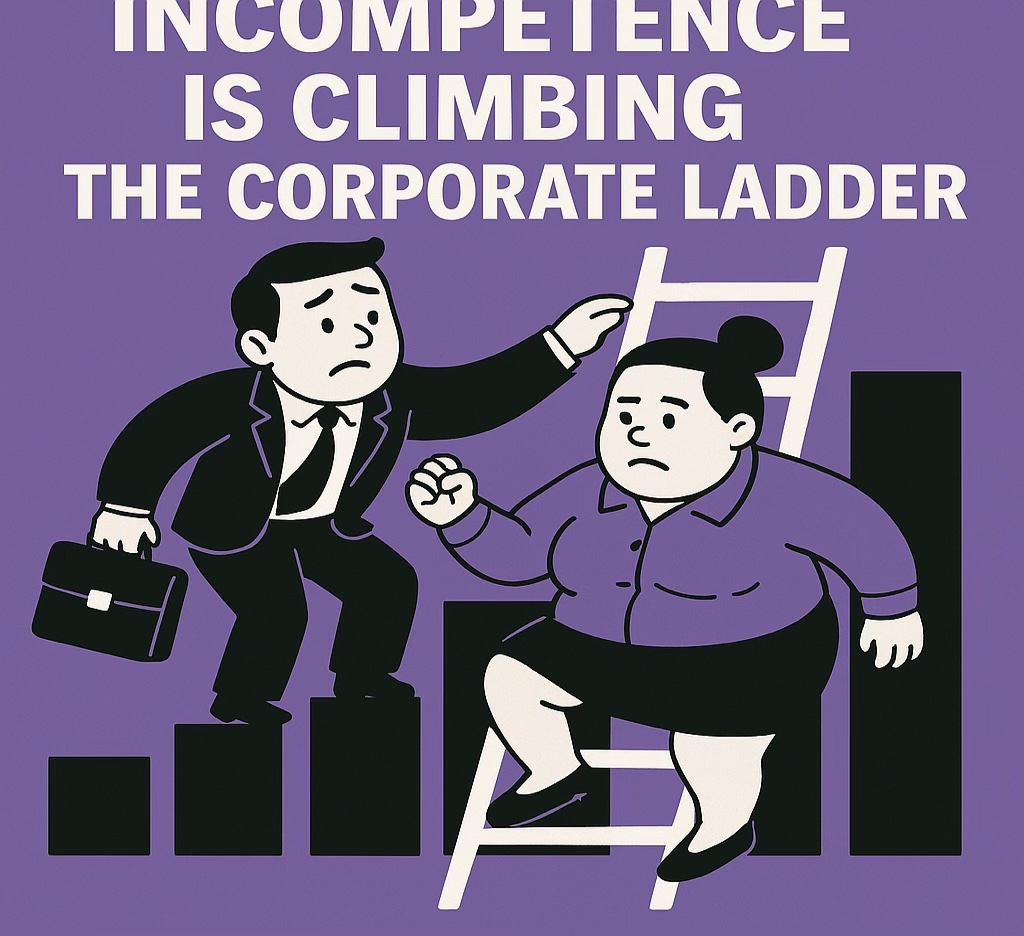
- Laurence J. Peter famously theorized the Peter Principle: people rise to their level of incompetence. As he and Raymond Hull wrote in The Peter Principle (1969), “In a hierarchy, every employee tends to rise to his level of incompetence”.
- Liz Wiseman, author of Multipliers, emphasized the critical role of frontline managers: “Your frontline managers are your profit centers—or your blind spots. The difference lies in who you choose and how you support them” (Wiseman, 2010; Wiseman Group, 2022).
InMyPersonalOpinion
A Blueprint for Change: What Organizations Must Do Now
- Reform hiring criteria to prioritize strategic thinking, operational capability, and people leadership—not just technical expertise.
- Use evidence-based assessments, including 360-degree reviews and simulation-based leadership centers, which have been shown to improve leadership accuracy and development outcomes.
- Empower and reward managers for making timely, well-informed decisions autonomously, reinforcing trust and accountability at every level.
- Audit and redesign promotion pathways to reward measurable outcomes—such as team performance, retention, and innovation—rather than tenure or internal politics.
- Invest in robust management training. According to the Association for Talent Development (ATD), organizations with comprehensive leadership development programs report 218% higher income per employee and 23% greater profitability compared to those without such programs.
???? It’s Time to Restore Rigor
The future of work demands a reckoning. We must reclaim discipline, evidence, and excellence in how leaders are chosen and shaped. Organizations can no longer afford managers who wait for permission, they need decision-makers who act with clarity, courage, and competence. This is not just a leadership gap; it’s a silent epidemic. And with data-driven tools and a renewed commitment to capability, we still have time to reverse it, before dysfunction becomes the default.
⚠️ **No Brand Is Safe
The names are redacted—legal’s orders. But the dysfunction? Undeniable. From wellness to education, retail to infrastructure, the logos change, but the story doesn’t: mismanaged, misaligned, and mysteriously still in business.
© Dr.Elinor.Garely, InMyPersonalOpinion.Life.2025]. All rights reserved. No part of this content may be reproduced, distributed, or used without permission. For inquiries, contact EG@InMyPersonalOpinion.Life, Dr.Elinor Garely.
References
Association for Talent Development. (2023). Developing leadership talent. Retrieved from https://www.td.org/
Brucerosenstein.com. (n.d.). 15 powerful Peter Drucker quotes: Achievement, productivity, teaching, time management. Retrieved from https://brucerosenstein.com/15-powerful-peter-drucker-quotes-achievement-productivity-teaching-time-management/
Collins, J. (2001). Good to great: Why some companies make the leap and others don’t. HarperBusiness.
Cyc-net.org. (2010, November). Peter principles. Retrieved from https://cyc-net.org/cyc-online/cyconline-nov2010-peter.html
Drucker, P. F. (1967). The effective executive. Harper & Row.
Ericjacobsononmanagement.blogspot.com. (2012, June). Buckingham talks about the power of effective teams. Retrieved from https://ericjacobsononmanagement.blogspot.com/2012/06/buckingham-talks-about-power-of.html
Evansamek.substack.com. (2023, April 4). Execution, by Larry Bossidy & Ram Charan. Retrieved from https://evansamek.substack.com/p/execution-by-larry-bossidy-and-ram
Gallup. (2024). State of the global workplace: 2024 report. Retrieved from https://www.gallup.com/workplace/349484/state-of-the-global-workplace.aspx
Harvard Business Review. (2005, March). What great managers do. Retrieved from https://hbr.org/2005/03/what-great-managers-do
Harvard Business Review. (2013, December 13). How Google sold its engineers on management. Retrieved from https://hbr.org/2013/12/how-google-sold-its-engineers-on-management
Ideatovalue.com. (2019, February 6). Peter Drucker on the importance of doing the right type of work. Retrieved from https://www.ideatovalue.com/lead/nickskillicorn/2019/02/peter-drucker-on-the-importance-of-doing-the-right-type-of-work/
Jimcollins.com. (n.d.). Concepts—Level 5 leadership. Retrieved from http://www.jimcollins.com/concepts/level-five-leadership.html
Jimcollins.com. (n.d.). Can you grow into level 5 leadership. Retrieved from https://www.jimcollins.com/article_topics/articles/can-you-grow-into-level-5.html
Joelgaslin.com. (2018, April 4). Peter Drucker quotes—my favorites. Retrieved from https://www.joelgaslin.com/peter-drucker-quotes-favorites/
Leadersgetreal.com. (2017, November 30). Guest: Liz Wiseman – best-selling author of Multipliers. Retrieved from https://leadersgetreal.com/2017/11/30/liz-wiseman/
LinkedIn. (2024, May 27). Frontline leadership: Empowering teams for success. Retrieved from https://www.linkedin.com/pulse/frontline-leadership-empowering-teams-success-mohamed-buccas-fen4f
Peter, L. J., & Hull, R. (1969). The Peter principle: Why things always go wrong. William Morrow and Company.
Psychology Today. (2022, January 31). Time management the Peter Drucker way. Retrieved from https://www.psychologytoday.com/us/blog/the-peter-drucker-files/202201/time-management-the-peter-drucker-way
Reddit. (2016, February 18). There is nothing so useless as doing efficiently that which should not be done at all. Retrieved from https://www.reddit.com/r/QuotesPorn/comments/469l4l/there_is_nothing_so_useless_as_doing_efficiently/
Reddit. (2024, November 24). There is nothing so useless as doing efficiently that which should not be done at all. Retrieved from https://www.reddit.com/r/quotes/comments/1gyjvyy/there_is_nothing_so_useless_as_doing_efficiently/
Robert Walters. (2024). Hiring trends 2024: U.S. report. Retrieved from https://www.robertwaltersgroup.com/news.html
Society for Human Resource Management. (2023). The high cost of a bad hire. Retrieved from https://www.shrm.org/
The Positive Encourager. (2025, March 7). C is for Jim Collins: Level 5 leadership. Retrieved from https://www.thepositiveencourager.global/jim-collins-talking-about-level-5-leadership-video/
The Wiseman Group. (2019, July). Multipliers: The multiplier effect (Chapter 1) [PDF]. Retrieved from https://thewisemangroup.com/wp-content/uploads/2019/07/multipliers-chapter-1-the-multiplier-effect.pdf
U.S. Department of Labor. (n.d.). Cost of a bad hire. Retrieved from https://www.dol.gov/
Wall Street Prep. (2024, July 18). Peter principle: Definition + examples. Retrieved from https://www.wallstreetprep.com/knowledge/peter-principle/
Wiseman, L. (2010). Multipliers: How the best leaders make everyone smarter. Harper Business.
Wiseman Group. (2022). Multipliers research and impact. Retrieved from https://thewisemangroup.com/