
By Dr. Elinor Garely
The Age of Exclusion
It was not a confrontation. No one told me to leave. No one shoved me toward the door, lowered a velvet rope, or said aloud what the club had already decided. Instead, I encountered a chart.
I finished my usual two-hour workout—the daily sequence of cadence, resistance, balance, and discipline that keeps this body responsive and the mind clear. The workout is neither vanity nor nostalgia. At a certain age, movement becomes maintenance; strength is independence; stamina is insurance against a world that assumes decline is inevitable.
On my way to the elevator and sun roof, I passed a promotional station where a gym trainer was testing members’ grip strength. The presentation was polished: a digital screen, performance language, bright graphics, and the familiar luxury-wellness promise that every measurement might reveal a better version of yourself. The screen displayed a chart showing “optimal performance” by age. The chart stopped at 60. Not tapered. Not extended with a caveat. Not marked “60+.” Stopped.
The End
At an age well beyond that neatly designed endpoint, I stood there looking at a small digital act of disappearance. The machine did not have a category for me. The fitness club that had accepted my membership money, welcomed my body through its doors, and marketed itself as an authority on health and longevity had apparently decided that people past 60 were outside the range of human performance worth measuring.
The trainer did not look embarrassed. No one rushed over to explain that the chart was incomplete. No one said, “Of course it goes farther.” The display remained where it was, glowing with the confidence of an institution that had not considered it necessary to imagine me.
That was the moment the club became frightening. Not because a chart ended at 60—technology is often lazy, data is frequently biased, and software can be outdated. It was frightening because the chart fit everything else: a luxury brand with a blind spot.
“It’s Not Fitness. It’s Life.”
Luxury fitness sells a particular fantasy. It is not simply the promise of exercise, health, or competent instruction. It sells youth as an atmosphere: hard bodies in perfect lighting, recovery rituals, designer water bottles, eucalyptus towels, flawless locker rooms, and the suggestion that if you work hard enough, purchase enough, and optimize enough, time itself may become negotiable.
But aging does not disappear because a brand refuses to market it. The irony is especially sharp inside a fitness facility. Older adults are among the people who may benefit most from safe, accessible, well-designed exercise: strength training, cardiovascular work, mobility, balance, and programs adapted for changing joints, bones, recovery times, disabilities, and chronic conditions. Wellness should expand with age. Instead, in too many spaces, it narrows.
The grip-strength chart was not merely an awkward marketing artifact. It revealed the question beneath the glossy surface: Who, exactly, is this place designed to serve? If the answer is only those young enough to be used in the advertising, then “wellness” is not a mission. It is a casting call.
The absence was not personal. That made it worse. A personal insult can be answered. A rude employee can be confronted. A dismissive trainer can be reported. But what do you do when the exclusion is built into the system—when it lives inside the software, the temperature settings, the programming choices, the physical access points, the complaint procedures, and the corporate language used to define value?
You cannot argue with a machine that has no field for your age. You can only recognize what it has already told you: You are not part of the future this brand is selling.
The Building Begins to Speak
Once I noticed exclusion, the environment changed. The club no longer looked like an expensive sanctuary; it started to look like evidence. For years, exterior scaffolding has wrapped the building’s perimeter—metal poles, braces, damaged pavement, and construction material that seems to have become permanent. What might be an annoyance to a younger, agile member is something else entirely to an older person, someone with balance concerns, a cane, a mobility limitation, a compromised knee, or a fear of falling. Uneven surfaces are not aesthetic flaws. They are risks. A misstep on that broken pavement is not an inconvenience—it is a broken hip, a hospitalization, a loss of independence—because someone decided maintenance was optional for bodies they do not value.
Inside, the HVAC system has produced another kind of warning. In summer, parts of the club become punishingly hot while other areas deliver blasts of cold air. A younger member may treat the discomfort as an inconvenience or a sign of a hard workout. For older members—those managing cardiovascular issues, temperature sensitivity, arthritis, respiratory conditions, medication side effects, or simply the physical demands of aging—such extremes can turn a workout into a calculation: Is this worth the risk?
A luxury gym is supposed to anticipate needs before members have to articulate them. That is part of what the membership price supposedly buys: competence, care, controlled conditions, and an environment that supports the body rather than tests its tolerance for neglect. Yet the building tells another story. It says: Endure it. It says: Adapt. It says: If the conditions do not suit you, perhaps you do not belong here.
The pool offers its own version of this message. To a corporate schedule, a lap pool can be treated as an athletic asset: lanes, speed, efficiency, performance. But for many older members, a pool is not a racetrack. It is relief. It is rehabilitation. It is a place where damaged knees, arthritic hips, stiff shoulders, and fragile balance can move with less pain and less fear. Requests for water temperatures that support therapeutic use can be dismissed as special pleading. Requests for exercise classes accessible to people with disabilities can be delayed, redirected, or lost inside administrative language.
The issue is not whether every request can be granted. The issue is whether the people making those requests are treated as legitimate members of the fitness community, or as inconvenient exceptions to the brand’s preferred image. That difference is where ageism lives.
The Story Behind the Smile
It would be comforting to imagine that these are isolated club-level failures: a careless trainer, a neglected maintenance problem, or a local manager who does not understand the needs of an older membership base. However, the public legal record involving Equinox suggests a more troubling possibility—that age and disability bias may not be limited to the experience of members on the gym floor.
Several lawsuits have alleged discriminatory practices involving employees, including older trainers and workers with disabilities. Those allegations concern employment matters, not the individual membership experience described here, and they should be understood in that legal context. Still, the cases matter because workplace culture and customer culture rarely exist in separate universes. If a company treats its own older employees as disposable, why would its software treat older members any differently?
A corporation does not need to issue a memo saying, “Older people are unwelcome,” for older people to receive the message. The message can arrive in a hundred smaller ways: who appears in the marketing, whose needs are considered routine, whose complaints receive urgency, whose bodies are treated as aspirational, whose limitations are treated as an inconvenience, and whose existence disappears from the data. A club can advertise longevity while quietly organizing itself around youth.
The Complaint That Goes Nowhere
There is another feature of this kind of exclusion: exhaustion. A member can complain about the broken HVAC, hazardous pathways, a performance metric that ends at 60, or a pool temperature that fails to recognize the real needs of people who are no longer 25.
Then comes the modern obstacle course:
- Automated acknowledgments
- Customer-service portals
- Generic responses
- Silence
- A promise that the issue has been “forwarded to the appropriate team”
Bureaucracy can be a form of disappearance, too. It turns a person’s concern into a ticket number, a health need into a service request, and a reasonable question into a thread that eventually dies in an inbox.
Mandatory arbitration provisions and class-action waivers add another layer of insulation. They make it harder for individuals to pursue public litigation or to join collectively with others who have had similar experiences. The effect is predictable: each person feels alone, each complaint appears isolated, and the company retains control over the setting in which grievances are heard. The system does not have to say no directly. It only has to make “yes” unreachable.
The Terror of Missing Numbers
The most disturbing part of the grip-strength chart was its ordinariness. It was not a shouted insult. It was not even a human judgment, at least not visibly. It was a clean interface, a modern screen, an apparently harmless tool designed to make fitness feel measurable and exciting. That is precisely why it matters.
Ageism is often most powerful when it looks procedural. When it becomes a default setting. When no one needs to make a cruel remark because the system has already performed the cruelty quietly. The chart had no place for people older than 60. It had converted a huge and growing portion of humanity into blank space.
And what does that blank space communicate?
- That strength after 60 is uninteresting.
- That function after 60 is unmeasurable.
- That health after 60 is not part of the story.
- That the person standing directly in front of the screen is not an athlete, a customer, a body in motion, or a person worthy of being counted.
She Is the Problem
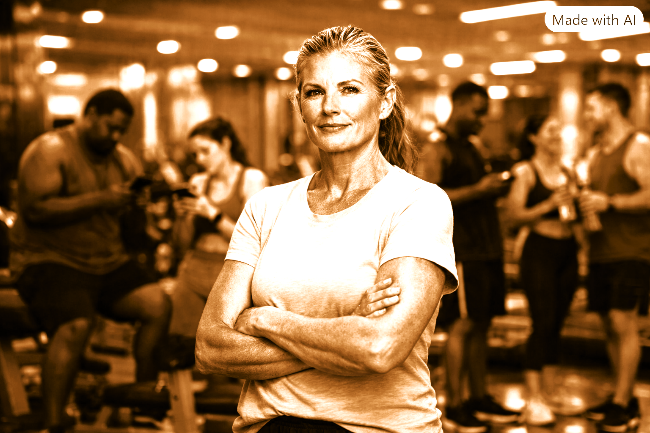
She is the problem… the software has not been designed to recognize HER. Luxury wellness brands have become highly skilled at selling the language of self-care. They speak of transformation, resilience, recovery, longevity, mindfulness, and whole-person health. Yet those words become hollow when the institution offering them cannot imagine a healthy, active, demanding, paying member beyond the age of 60.
The real question is not whether older adults belong in elite fitness spaces. They do. The real question is whether elite fitness spaces are prepared to accept that aging is not a failure of branding. It is life. It is global. It is universal—if we are fortunate enough to live long enough to experience it.
The chart stopped at 60…..the people did not. They were on the treadmills. They were sweating, lifting, stretching, rebuilding strength, protecting their hearts, managing injuries, recovering balance, and doing the unglamorous daily work of remaining independent.
They Are Here
This is not a complaint about a chart, a drafty gym, or a pool manager who refuses to recognize the difference between athletic performance and therapeutic survival. It is about a luxury industry that monetizes longevity while quietly editing older people out of the picture.
The global population is aging; adults 60 and older are already a vast, economically powerful, and rapidly growing part of the world’s consumer base. Yet in too many premium wellness spaces, their bodies are treated as a branding problem—useful at the billing desk, inconvenient on the training floor, and invisible in the data.
A grip-strength screen that ends at 60 is not merely bad programming. It is corporate values rendered in pixels. And every ignored accessibility request, unsafe walkway, icy air blast, overheated studio, and unanswered complaint repeats the same instruction: Pay us, but do not expect to be recognized or acknowledged.
What to Demand
To make exclusion visible and unacceptable, members, policymakers, and the public should insist on:
- Age-inclusive performance metrics
- Accessible design and maintenance standards
- Transparent HVAC and pool temperature regulation policies
- ADA-compliant aquatic and mobility programming
- Public reporting of member complaints and resolutions
- Mandatory age-bias audits for wellness brands
- Clear accountability for facilities that market longevity while excluding the people who embody it
This is not about special treatment. It is about basic respect in spaces that claim to sell health.
A grip-strength screen that ends at 60 is not a glitch. It is the brand telling every older member, in plain data, exactly how much they matter here: not at all. Erasure doesn’t happen by accident. It happens because leadership approved the software, ignored the complaints, tolerated the hazards, and decided—quietly but deliberately—that older bodies fall outside the image they want to sell. That is the truth they hope no one names. I just did.
000
It was not a confrontation. No one told me to leave. No one shoved me toward the door, lowered a velvet rope, or said aloud what the club had already decided. Instead, I encountered a chart.
I finished my usual two-hour workout; the daily sequence of cadence, resistance, balance, and discipline that keeps this body responsive and the mind clear. The workout is neither vanity nor nostalgia. At a certain age, movement becomes maintenance; strength is independence; stamina is insurance against a world that assumes decline is inevitable.
On my way to the elevator and sun roof, I passed a promotional station where a gym trainer was testing members’ grip strength. The presentation was polished: digital screen, performance language, bright graphics, the familiar luxury-wellness promise that every measurement might reveal a better version of yourself. The screen displayed a chart showing “optimal performance” by age. The chart stopped at 60. Not tapered. Not extended with a caveat. Not marked “60+.” Stopped.
The End
At an age well beyond that neatly designed endpoint, I stood there looking at a small digital act of disappearance. The machine did not have a category for me. The fitness club that had accepted my membership money, welcomed my body through its doors, and marketed itself as an authority on health and longevity had apparently decided that people past 60 were outside the range of human performance worth measuring.
The trainer did not look embarrassed. No one rushed over to explain that the chart was incomplete. No one said, “Of course it goes farther.” The display remained where it was, glowing with the confidence of an institution that had not considered it necessary to imagine me.
That was the moment the club became frightening. Not because a chart ended at 60. Technology is often lazy. Data is frequently biased. Software can be outdated. It was frightening because the chart fit everything else: a luxury brand with a blind spot.
“It’s Not Fitness. It’s Life.”
Luxury fitness sells a particular fantasy. It is not simply the promise of exercise, health, or competent instruction. It sells youth as an atmosphere: hard bodies in perfect lighting, recovery rituals, designer water bottles, eucalyptus towels, flawless locker rooms, and the suggestion that if you work hard enough, purchase enough, optimize enough, time itself may become negotiable.
But aging does not disappear because a brand refuses to market it. The irony is especially sharp inside a fitness facility. Older adults are among the people who may benefit most from safe, accessible, well-designed exercise: strength training, cardiovascular work, mobility, balance, and programs adapted for changing joints, bones, recovery times, disabilities, and chronic conditions. Wellness should expand with age. Instead, in too many spaces, it narrows.
The grip-strength chart was not merely an awkward marketing artifact. It revealed the question beneath the glossy surface: Who, exactly, is this place designed to serve? If the answer is only those young enough to be used in the advertising, then “wellness” is not a mission. It is a casting call.
The absence was not personal. That made it worse. A personal insult can be answered. A rude employee can be confronted. A dismissive trainer can be reported. But what do you do when the exclusion is built into the system—when it lives inside the software, the temperature settings, the programming choices, the physical access points, the complaint procedures, and the corporate language used to define value?
You cannot argue with a machine that has no field for your age. You can only recognize what it has already told you: You are not part of the future this brand is selling.
The Building Begins to Speak
Once I noticed exclusion, the environment changed. The club no longer looks like an expensive sanctuary. It starts to look like evidence.
For years, exterior scaffolding has wrapped the building’s perimeter—metal poles, braces, damaged pavement, construction material that seems to have become permanent. What might be an annoyance to a younger, agile member is something else entirely to an older person, someone with balance concerns, a cane, a mobility limitation, a compromised knee, or a fear of falling.
Uneven surfaces are not aesthetic flaws. They are risks. A misstep on that broken pavement is not an inconvenience. It is a broken hip, a hospitalization, a loss of independence—because someone decided maintenance was optional for bodies they do not value.
Inside, the HVAC system has produced another kind of warning. In summer, parts of the club have become punishingly hot while other areas deliver blasts of cold air. A younger member may treat the discomfort as an inconvenience or a sign of a hard workout. For older members, people managing cardiovascular issues, temperature sensitivity, arthritis, respiratory conditions, medication side effects, or simply the physical demands of aging, such extremes can turn a workout into a calculation: Is this worth the risk?
A luxury gym is supposed to anticipate needs before members have to articulate them. That is part of what the membership price supposedly buys: competence, care, controlled conditions, and an environment that supports the body rather than tests its tolerance for neglect. Yet the building tells another story. It says: endure it. It says: adapt. It says: if the conditions do not suit you, perhaps you do not belong here.
The pool offers its own version of this message. To a corporate schedule, a lap pool can be treated as an athletic asset: lanes, speed, efficiency, performance. But for many older members, a pool is not a racetrack. It is relief. It is rehabilitation. It is a place where damaged knees, arthritic hips, stiff shoulders, and fragile balance can move with less pain and less fear. Requests for water temperatures that support therapeutic use can be dismissed as special pleading. Requests for exercise classes accessible to people with disabilities can be delayed, redirected, or lost inside administrative language.
The issue is not whether every request can be granted. The issue is whether the people making those requests are treated as legitimate members of the fitness community, or as inconvenient exceptions to the brand’s preferred image. That difference is where ageism lives.
The Story Behind the Smile
It would be comforting to imagine that these are isolated club-level failures: a careless trainer, a neglected maintenance problem, a local manager who does not understand the needs of an older membership base. However, the public legal record involving Equinox suggests a more troubling possibility—that age and disability bias may not be limited to the experience of members on the gym floor.
Several lawsuits have alleged discriminatory practices involving employees, including older trainers and workers with disabilities. Those allegations concern employment matters, not the individual membership experience described here, and they should be understood in that legal context. Still, the cases matter because workplace culture and customer culture rarely exist in separate universes. If a company treats its own older employees as disposable, why would its software treat older members any differently?
A corporation does not need to issue a memo saying, “Older people are unwelcome,” for older people to receive the message. The message can arrive in a hundred smaller ways: who appears in the marketing, whose needs are considered routine, whose complaints receive urgency, whose bodies are treated as aspirational, whose limitations are treated as an inconvenience, and whose existence disappears from the data. A club can advertise longevity while quietly organizing itself around youth.
The Complaint That Goes Nowhere
There is another feature of this kind of exclusion: exhaustion. A member can complain about the broken HVAC. A member can complain about hazardous conditions around a building. A member can ask why a performance metric ends at 60. A member can request a pool temperature or class schedule that recognizes the real needs of people who are no longer 25.
Then comes the modern obstacle course.
- Automated acknowledgments.
- Customer-service portals.
- Generic responses.
- No response.
- A promise that the issue has been “forwarded to the appropriate team.”
Bureaucracy can be a form of disappearance, too. It turns a person’s concern into a ticket number, a health need into a service request, and a reasonable question into a thread that eventually dies in an inbox.
Mandatory arbitration provisions and class-action waivers add another layer of insulation. They make it harder for individuals to pursue public litigation or to join collectively with others who have had similar experiences. The effect is predictable: each person feels alone, each complaint appears isolated, and the company retains control over the setting in which grievances are heard. The system does not have to say no directly. It only has to make “yes” unreachable.
The Terror of a Missing Number
The most disturbing part of the grip-strength chart was its ordinariness. It was not a shouted insult. It was not even a human judgment, at least not visibly. It was a clean interface, a modern screen, an apparently harmless tool designed to make fitness feel measurable and exciting. That is precisely why it matters.
Ageism is often most powerful when it looks procedural. When it becomes a default setting. When no one needs to make a cruel remark because the system has already performed the cruelty quietly. The chart had no place for people older than 60. It had converted a huge and growing portion of humanity into blank space.
And what does that blank space communicate?
- That strength after 60 is uninteresting.
- That function after 60 is unmeasurable.
- That health after 60 is not part of the story.
- That the person standing directly in front of the screen is not an athlete, a customer, a body in motion, or a person worthy of being counted.
SHE is the Problem

She is the problem… the software has not been designed to recognize HER. Luxury wellness brands have become highly skilled at selling the language of self-care. They speak of transformation, resilience, recovery, longevity, mindfulness, and whole-person health. Yet those words become hollow when the institution offering them cannot imagine a healthy, active, demanding, paying member beyond the age of 60.
The real question is not whether older adults belong in elite fitness spaces. They do. The real question is whether elite fitness spaces are prepared to accept that aging is not a failure of branding. It is life. It is global. It is universal—if we are fortunate enough to live long enough to experience it.
- The chart stopped at 60.
- But the people did not.
They were on the treadmills. They were in the pool. They were sweating, lifting, stretching, rebuilding strength, protecting their hearts, managing injuries, recovering balance, and doing the unglamorous daily work of remaining independent.
THEY Are Here
This is not a complaint about a chart, a drafty gym, or a pool manager who refuses to recognize the difference between athletic performance and therapeutic survival. It is about a luxury industry that monetizes longevity while quietly editing older people out of the picture. The global population is aging; adults 60 and older are already a vast, economically powerful, and rapidly growing part of the world’s consumer base. Yet in too many premium wellness spaces, their bodies are treated as a branding problem—useful at the billing desk, inconvenient on the training floor, and invisible in the data. A grip-strength screen that ends at 60 is not merely bad programming. It is corporate values rendered in pixels. And every ignored accessibility request, unsafe walkway, icy air blast, overheated studio, and unanswered complaint repeats the same instruction: pay us, but do not expect to be recognized or acknowledged.
What to Demand
To make exclusion visible and unacceptable, members, policymakers, and the public should insist on:
- Age-inclusive performance metrics
- Accessible design and maintenance standards
- Transparent HVAC and pool temperature regulation policies
- ADA-compliant aquatic and mobility programming
- Public reporting of member complaints and resolutions
- Mandatory age-bias audits for wellness brands
- Clear accountability for facilities that market longevity while excluding the people who embody it
This is not about special treatment. It is about basic respect in spaces that claim to sell health.
A grip-strength screen that ends at 60 is not a glitch. It is the brand telling every older member, in plain data, exactly how much they matter here: not at all. Erasure doesn’t happen by accident. It happens because leadership approved the software, ignored the complaints, tolerated the hazards, and decided—quietly but deliberately—that older bodies fall outside the image they want to sell. That is the truth they hope no one names. I just did.
000
© 2026 Dr. Elinor Garely / InMyPersonalOpinion.Life. Protected by U.S. & international copyright + DMCA. No reproduction, reposting, redistribution, adaptation, or AI training allowed. Brief quotes only with full credit + link. Permissions: EG@InMyPersonalOpinion.Life