
Dr. Elinor Garely
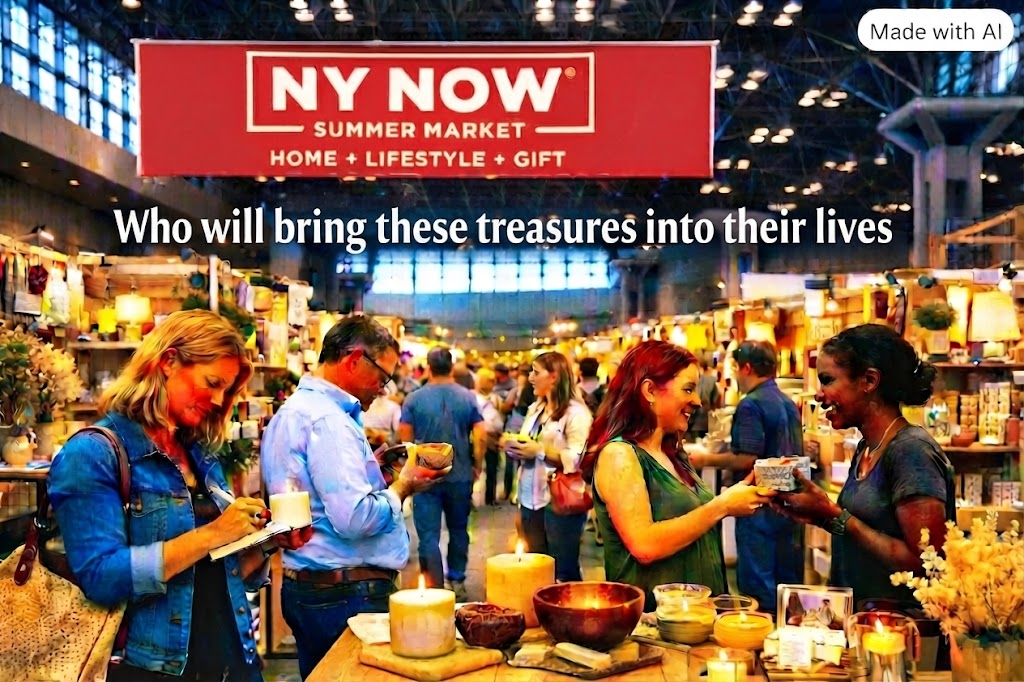
I went to NY NOW at the Javits Center in New York this summer looking for trends. Not a dress to buy. Not a new candle for my bathroom. Not a fountain pen. I wasn’t shopping. I wanted to know what the industry thinks consumers will want next week, at Thanksgiving, for a Holiday gift. Almost immediately, I found myself asking a much more basic question: Who is buying all this stuff? Candles. Fountain pens. Hand-carved bowls. Stationery. Textiles. Fragrance. Decorative objects. Wellness products. Gifts. Beautiful things, clever things, exquisitely made things—and, in many cases, things that seem to contradict the story we’ve been telling ourselves about today’s consumer.
We’re constantly told that Millennials and Gen X are less interested in collecting possessions. They’re mobile. They rent. They move. They buy vintage and secondhand. They furnish apartments with pieces from thrift stores, hand me downs from family, friends, and charity shops. They browse at the Salvation Army and Good Will. They care about sustainability and experiences. They don’t necessarily want a home that looks like a celebrity’s red-carpet reveal.
“The narrative that younger generations reject material possessions is a retail myth; they haven’t stopped buying, they’ve simply swapped status clutter for intentional micro-luxuries.”
— Dr. James Sterling, Retail Anthropologist and Consumer Behavior Lead at the Global Commerce Institute (Ref. The New Consumer Paradox: Value, Provenance, and the Modern Home, Retail Futures Press, 2025)
NY NOW Is Very Much Alive
NY NOW is not a showroom full of desperate sellers hoping someone will take their merchandise. The Summer 2026 edition, under the new leadership of Rockview Management Group, felt remarkably energetic. The show brought together 460 exhibiting brands and 4,041 buyers from 49 states and 40 countries, with buyer attendance up 5 percent. For a trade show that has spent several years trying to regain momentum, the difference was noticeable.
Purposeful. Motivated
Buyers were walking the aisles with purpose. Exhibitors were writing orders. Brands that had not seen certain accounts in years were seeing them again. As CEO Dorothy Belshaw put it, the energy and feedback were overwhelming. I agree. There was a pulse in the place. But the pulse raised another question.
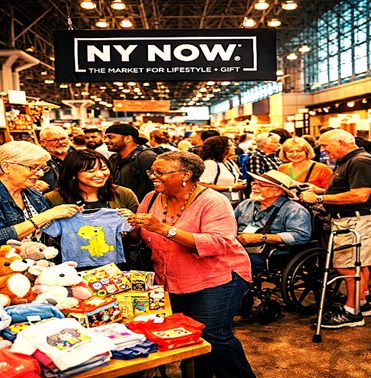
What, exactly, is it telling us about the consumer? The Buyer at NY NOW Is Not the Consumer! This distinction is easy to miss. The person walking into NY NOW is not necessarily the person who will eventually light the candle, write with the fountain pen or put the carved bowl on the kitchen table. The buyers at Javits are the gatekeepers. More than half are owners or primary buyers, and they represent independent boutiques, museum stores, department stores, online retailers, resorts and specialty lifestyle businesses. They are looking for discovery. Loren and Marisa of Love Letters in New Jersey, determined that, “We found great new items for our customers.” Elizabeth of Home Grown in Pennsylvania described NY NOW as finally being “on its way back to its heyday.”
The comments say something important. The demand is real. The question is what happens after the order is written. So, Who Is the Consumer? This is where I think we need to challenge some of our assumptions.
Maybe Millennials and Gen X really are less interested in collecting. But perhaps we’ve confused collecting less with wanting less. There is a difference. A consumer who doesn’t want a house packed with furniture may still want one extraordinary ceramic bowl. Someone who buys a vintage dining table may happily buy a new handmade candle. Someone who lives a highly mobile life may prefer possessions that are small, portable, useful, beautiful—or consumable. A candle disappears. A notebook gets filled. A fragrance gets used. A bowl moves from apartment to apartment. A fountain pen can fit in a pocket.
These aren’t necessarily signs of a consumer returning to old-fashioned accumulation. They may be signs of something else: selective possession. The consumer doesn’t necessarily want more; the consumer may want better.
The Fountain Pen Question
Take the fountain pen. In an increasingly digital world, why would someone buy one? They don’t need it to communicate. They don’t need it for work. They don’t even need it to write. But perhaps that’s exactly the point. The fountain pen offers something a smartphone cannot: tactility, ritual, craftsmanship and a physical connection to an activity that has become almost entirely digital. The same is true of the hand-carved bowl. Nobody needs a hand-carved bowl. But people don’t always buy things because they need them. Sometimes they buy them because an object changes the experience of an ordinary moment. That may be the consumer trend hiding in plain sight at NY NOW.
The Small Luxury of Being Somewhere
Candles may be an even better example. A candle is almost the perfect possession for a mobile consumer. It doesn’t require a permanent commitment. It doesn’t take up much space. It can make a rental apartment feel personal. It creates an atmosphere. It is relatively affordable. And eventually, it disappears. In other words, the consumer who doesn’t want to own a roomful of furniture may still want to control how a room feels. That is a very different relationship with stuff. And it may explain why categories such as fragrance, wellness, stationery, small home décor and gift products remain so resilient. The object isn’t necessarily the destination; the experience is.
The Brands Are Seeing It
The exhibitors I spoke with weren’t describing a dying appetite for things. They were describing discovery and renewed business. At ZPOTS, Noelle Van Hendrick said, “The vibe was unreal—buyers we hadn’t seen in years came back.” At Rubyzaar, Sarah Rubin reported that more than 60 percent of orders were from new accounts. The show also attracted more than 100 prospective exhibitors scouting the floor for Winter 2027, while Belshaw said NY NOW was tracking toward a 96 percent renewal rate. The numbers don’t look like a consumer abandoning objects. They look like a marketplace trying to figure out which objects matter now.
But There Is a Problem
This is where my second discovery began. I could understand the buyer. I could see the exhibitor. I could see the products. What I couldn’t see was the consumer at the end of the chain. As a journalist, I would look at something and think: People are going to want this. Then I’d ask the obvious question: Where can they get it? And that was where the trail frequently disappeared. A wholesaler might tell me that the product is sold to boutiques, specialty retailers or online stores. But which ones? There was often no simple answer. No retailer list. No “where to buy.” No inventory information. No digital breadcrumb that would allow me to take a product from a trade-show floor to a reader’s computer or phone. The irony was striking. The industry had become extremely good at helping buyers discover products. It was much less consistent at helping consumers discover where those products were available.
I’m Not Asking NY NOW to Become Amazon
This is not an argument for turning NY NOW into a consumer bazaar. Wholesale is wholesale. Exhibitors have retail relationships. Some of those relationships are private. Inventory changes. Retailers come and go. A manufacturer may not want to publish every account. I understand. But there is a vast difference between revealing confidential wholesale information and giving a consumer a legitimate path to purchase. A brand doesn’t have to sell directly. It simply has to know where its products can be found. One current retailer link would be enough. A searchable “where to buy” page would be even better. A media kit containing product information and authorized retailers would be better still. None of this requires a wholesale company to become a direct-to-consumer retailer. It requires something much simpler: retail visibility.
The Mystery Consumer
And perhaps that is what bothered me most about NY NOW. The consumer is everywhere in the conversation and almost nowhere in the room. Buyers are thinking about consumers. Exhibitors are designing for consumers. Retailers are ordering for consumers. Media is trying to introduce consumers to products. But somewhere between the order being written and the story being published, the consumer can disappear. That is a problem in 2026. A reader sees a product online and doesn’t want a scavenger hunt. She and he want to click. They want to know if it is available and where to buy it. And if they can’t, there are a thousand other things competing for their attention. The product loses. The retailer loses. The manufacturer loses. And, eventually, the media outlet loses credibility because we have shown someone something wonderful and then effectively said: Good luck finding it.
Perhaps We Have the Consumer Wrong
I left NY NOW less convinced than ever that younger consumers have simply rejected possessions. Maybe they have rejected indiscriminate possession. Maybe they don’t want rooms filled with things. Maybe they want fewer, more interesting things. Maybe they want objects with a story, a texture, a smell, a history or a sense of craft. Maybe the future isn’t a world without stuff.
Maybe it’s a world where people are much more selective about what stuff deserves to enter their lives. The hand-carved bowl suddenly makes more sense. So does the candle. So does the fountain pen. So does the beautifully made notebook. And that may be the real trend NY NOW revealed to me. We haven’t stopped wanting things. We’ve become much more demanding about which things we want.
NY NOW Has Its Pulse Back
NY NOW appears to have accomplished something important. The buyers are returning.
The exhibitors are energized. New accounts are being opened. Orders are being written. The marketplace is moving again. The next challenge isn’t simply finding more products. It is understanding the person at the other end of the transaction. Who buys the candle? Who buys the fountain pen? Who buys the carved bowl? Why? Where do they live? What else do they buy? And, when a journalist shows that person something wonderful, where can they actually get it?
What Happens Next
NY NOW has rediscovered its pulse. Now the industry needs to follow that pulse all the way to the consumer. Because the product may begin with the maker, move through the buyer and land on a retailer’s shelf. But the story doesn’t end there. It ends when someone wants it badly enough to buy it.
© 2026 Dr. Elinor Garely / InMyPersonalOpinion.Life. This work is protected in full under U.S. and international copyright law, including the Digital Millennium Copyright Act (DMCA).
All rights strictly reserved. Any unauthorized reproduction, republication, redistribution, adaptation, extraction, or use in AI training datasets constitutes a violation of federal and international law and will be pursued accordingly. Only brief, non-substantive quotations are permitted, and only with full attribution and an active link to the original publication. For licensing or permissions, contact: EG@InMyPersonalOpinion.Life
000