
Deere Bets Pennies. Growers Bet the Farm
By Dr. Elinor Garely — Founder & Editor-in-Chief, InMyPersonalOpinion.Life
John Deere’s $10 million R&D bet on “rugged AI” sounds like a revolution, but a closer look at the economics reveals a heavy risk transfer onto growers. Is automated farming solving labor shortages, or is it masking a deeper crisis of cost and consolidation? Read the full analysis on InMyPersonalOpinion.Life.
The Automation Mirage
John Deere calls it innovation. Reservoir calls it the future of agriculture. The numbers tell a more complicated story. On August 26, 2026, the agtech incubator Reservoir announced a $10 million, three-year research-and-development partnership with John Deere aimed at what it calls “rugged AI,” robotics and artificial intelligence built to survive heat, dust, vibration and the general punishment of commercial farm work. The announcement came at Reservoir’s first Ruggedize conference in Salinas, California, where the company said its Salinas and Sonoma facilities had already hosted more than twenty agricultural startups since opening in spring 2026 (Reservoir, 2026a).
This is the promotional version. The harder question is who controls the pipeline through which this technology reaches farmers, and who bears the cost if the promised productivity gains do not materialize.
The Real Story Predates the $10 Million
The more consequential fact is older than this week’s headline. In August 2025, Deere became Reservoir’s exclusive original-equipment-manufacturer (OEM) partner, a status that gave it branding presence at Reservoir’s facilities, access to early-stage startups, co-developed R&D programs and curated field demonstrations. A Deere representative described the arrangement as a “front-row seat” to the next generation of agricultural technology (Schultz, 2025).
An OEM is not a passive sponsor. Its equipment, technical standards, interfaces and service infrastructure shape whether emerging technologies can actually reach customers. Reservoir’s own startup program charges for that access: current published pricing runs from a free associate tier up to $3,000 per month for membership, and from $5,000 to $6,000 per month for residency, depending on whether the startup builds software or hardware (Reservoir, 2026b). Reservoir, in other words, is not simply providing a field. It is building an access-controlled commercialization ecosystem, and Deere sits inside it as the exclusive equipment partner.
Deere Can Afford to Wait
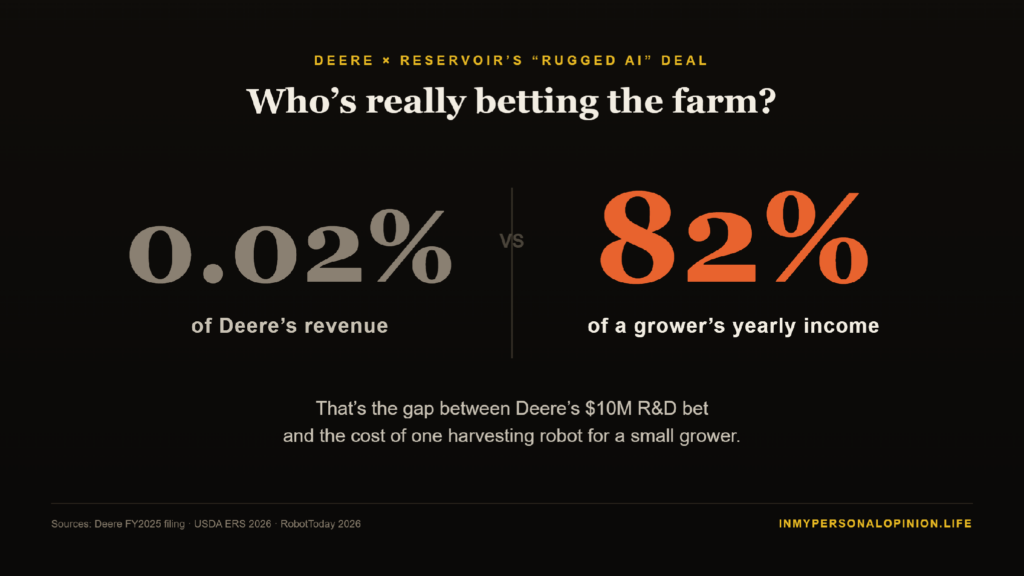
For fiscal year 2025, Deere reported $45.684 billion in consolidated net sales and revenue and $5.027 billion in net income; its equipment operations alone generated $38.917 billion in net sales (John Deere, 2025). Against those figures, the new $10 million Reservoir commitment amounts to roughly 0.02 percent of 2025 revenue and 0.2 percent of net income. For Deere, this is not a bet that moves the needle financially; it is strategic positioning.
This positioning is part of a broader pattern. In August 2025, Deere acquired GUSS Automation, a California company whose semi-autonomous orchard- and vineyard-spraying systems had already logged more than 250 deployed machines and roughly 2.6 million acres of operation (Marston, 2025). Reservoir sits inside that same strategy of high-value-crop automation, not apart from it.
Western Growers Is Betting on Proof, Not Hype
Western Growers, the trade association representing growers across the western United States, has committed $1.5 million over three years to Reservoir Farms, $500,000 annually, on top of $250,000 it had already provided (Western Growers Association, 2026a). Notably, the association frames the money as funding evaluation, not endorsement: its stated purpose is to let members test automation’s performance, scalability and return on investment under real commercial conditions. That is a meaningful qualifier. The industry’s own institutional backers are treating ROI as a question still to be answered, not a foregone conclusion.
Why a $61 Billion Industry Cares
The stakes are large because California agriculture is large. The state’s farms and ranches generated $61.2 billion in cash receipts in 2024, up 3.6 percent from 2023, across more than 400 commodities; California accounts for roughly half of the nation’s fruits and vegetables and more than three-quarters of its fruit and nut production (California Department of Food and Agriculture [CDFA], 2025). Strawberries alone generated $3.46 billion in farm value in 2024 (CDFA, 2025).
Strawberries are also a useful reality check on what “automation” actually means. Peer-reviewed research notes that harvest labor accounts for less than 60 percent of total strawberry production costs, and that picking requires real judgment: berries are perishable, must be harvested at a precise ripeness stage, and must avoid bruising to meet market grading standards (Biscaro et al., 2021). A field study of a collaborative-robot harvest-aiding system found that pairing one robot with three human pickers cut nonproductive walking time by roughly 60 percent, and improved harvesting efficiency by about 10 percent (Peng et al., 2022) — a real gain, but assistance, not replacement. The humans stayed in the loop.
The Labor Shortage Is Demographic and Political
It is tempting to read “rugged AI” purely as an engineering story. It isn’t only that. Peer-reviewed research has long documented that the U.S. farm labor supply has been tightening for structural, demographic reasons such as an aging workforce and reduced migration flows from Mexico that have thinned the pipeline of new farmworkers (Hill, Ornelas, & Taylor, 2021), with related research finding that labor availability, not just labor cost, increasingly constrains what growers can plant and harvest (Rutledge & Mérel, 2023).
But 2026 has added a second, faster-moving pressure on top of the slow demographic one: federal immigration enforcement. Since January 2026, executive orders declaring a national border emergency have expanded U.S. Immigration and Customs Enforcement’s 287(g) partnerships with local law enforcement to more than 200 jurisdictions; ICE reported over 1.2 million removals in fiscal year 2025, with 2026 projections exceeding 1.5 million, a substantial share in agricultural regions (VisaVerge, 2026). Congress has backed the buildup with roughly $170 billion in additional funding for ICE and Border Patrol operations running through 2029, aimed at pushing deportations toward one million people a year (Wisconsin Public Radio, 2026).
The effect on farms has been immediate and measurable, not theoretical. A preliminary economic analysis of 2025 ICE operations in Oxnard, California, not yet peer-reviewed, but built on USDA and enforcement data, estimated a 20–40 percent reduction in the local agricultural workforce, $3–7 billion in crop losses, and a 5–12 percent rise in produce prices, concentrated in labor-intensive crops such as strawberries (Li, 2025).
Newsweek reported that in several major agricultural states, as many as 70 percent of workers stopped showing up for work following ICE actions, leaving crops unharvested (Newsweek, 2025). By spring 2026, growers in California’s Central Valley were describing crew losses of up to 30 percent during the narrow strawberry and almond harvest windows (VisaVerge, 2026). And as recently as August 12, 2026, two weeks before Reservoir’s Deere announcement, Rio Grande Valley farmers met with a member of Congress and the acting U.S. Secretary of Labor specifically because ongoing ICE actions were emptying their crews, part of a broader push to reform the H-2A guest-worker visa program (MyRGV.com, 2026).
The distinction matters for how to read “rugged AI” as a business proposition, not only a technological one. A company selling autonomous harvesting equipment benefits directly from a policy environment that is making human labor scarcer and less reliable in real time, regardless of whether that scarcity is the government’s intended goal. Western Growers’ own language about “escalating labor and other food-production input costs” threatening farm viability (Western Growers Association, 2026a) sits directly downstream of this enforcement wave, not apart from it.
None of this means Deere or Reservoir bear responsibility for federal immigration policy, or that automating harvest work is improper. But it does mean the “rugged AI” pitch is not landing in a political vacuum. It is landing at the exact moment federal enforcement is making the alternative, human labor, actively more expensive, riskier to employ, and less available. A grower’s decision to finance a $250,000 harvesting robot looks different read against a labor force being deliberately depleted by policy this year than against one simply graying out over a generation. Increasingly, automation isn’t just competing with human pickers on cost and speed. It is competing with a labor force the government is making it harder, and riskier, to employ at all, which is precisely the kind of political tailwind that makes a company like Deere’s $10 million look less like a gamble and more like a bet on a trend Washington itself is accelerating.
Can Growers Actually Afford It?
This is where the economics get uncomfortable. Industry cost analysis puts the purchase price of a commercial strawberry-harvesting robot at roughly $200,000 to $350,000, with annualized capital and maintenance costs of $68,000 to $130,000 (RobotToday, 2026). USDA’s Economic Research Service forecasts average 2026 net cash farm income of $305,300 for specialty-crop operations, a category that includes fruit, tree nuts, vegetables and nursery production (U.S. Department of Agriculture, Economic Research Service [USDA ERS], 2026). An average, though, tells us nothing about distribution. A grower with substantial acreage can spread a $250,000 machine’s cost across many rows and absorb a season of downtime while the technology matures. A smaller producer, closer to that $305,300 average income figure, cannot as easily do the same. If the technology that survives Reservoir’s pipeline is only affordable at scale, automation could ease one problem, labor scarcity, while deepening another: industry consolidation.
Deere’s Recent History with Repair Access
This is not a hypothetical concern about corporate control. On July 8, 2026, the Federal Trade Commission and five states reached a settlement with Deere over an antitrust lawsuit concerning farmers’ and independent repair providers’ access to Deere’s repair tools and software. The FTC alleged Deere had restricted certain electronic repair tools to authorized dealers, forcing farmers to rely on those dealers and contributing to higher costs and delays (Federal Trade Commission [FTC], 2026). Under the settlement, Deere must make specified repair resources, electronic fault-code functions, component reprogramming and technical repair information available to farmers and independent repair shops on fair and reasonable terms for ten years (FTC, 2026).
This settlement doesn’t establish that Deere’s Reservoir arrangement is unlawful or improper. But it does establish a documented, recent history of regulatory concern about Deere’s control over the software and repair ecosystem around its machinery, which makes it fair, not paranoid, to ask who will own the data, the intellectual property and the repair architecture that come out of an exclusive OEM partnership inside an emerging robotics ecosystem.
Who Wins, Who’s Exposed
Deere gains privileged access to startups, R&D and field demonstrations for a rounding error on its balance sheet. Reservoir gains $10 million from Deere, $1.5 million from Western Growers, and recurring membership and residency revenue from the startups it hosts. Startups gain something hard to build on their own: real farms to prove their technology works. Large, well-capitalized growers stand to gain lower labor exposure and more consistent output, if the technology delivers.
Farmworkers have the least control over any of it. Their labor is the very thing the technology is built to reduce, and if the current wave of automation underperforms, growers will simply keep looking for the next attempt. Smaller growers face a parallel risk: they may need the labor-saving technology most, yet have the weakest ability to absorb its cost, financing and downtime. And the broader public has a stake too; California’s $61.2 billion agricultural sector is not a private hobby; it is regional economic infrastructure, and its trajectory toward either broad-based productivity gains or further consolidation will shape rural communities well beyond this one partnership (CDFA, 2025).
The Real Test of “Rugged AI”
The easy question is whether a robot can pick a strawberry without bruising it. The harder questions are who owns the data these machines generate, who controls the repair and software architecture, whether independent technologies can compete inside a Deere-anchored ecosystem, and, most fundamentally, who captures the value when/if a machine finally does replace human labor.
Reservoir and Deere are building something real: a physical environment where agricultural robotics can be tested under actual farm conditions, addressing a labor shortage that is well documented in the economic literature, not manufactured by a press release. This shouldn’t be dismissed. But neither should the architecture around it—an equipment giant, an exclusive OEM relationship, a paid-access incubator, and a multibillion-dollar market waiting for a technology that, on the best available evidence, still costs more than most growers can easily afford and still can’t fully replace a human picker.
Rugged AI isn’t a revolution. It’s a risk transfer. Deere wagers pocket change; growers wager solvency. Reservoir gets innovation theater; farmworkers get displacement dressed as progress. Until the economics match the rhetoric, automation isn’t a solution, it’s a bill someone else is expected to pay.
Copyright and International Rights Notice
All content, including articles, commentary, photographs, and research are the intellectual property of Dr. Elinor Garely and InMyPersonalOpinion.Life. All rights are reserved under U.S. law (Title 17, U.S. Code) and international treaties, including the Berne Convention for the Protection of Literary and Artistic Works and the WIPO Copyright Treaty. Unauthorized reproduction, distribution, or transmission of any content, in whole or in part, is strictly prohibited without prior written consent. This includes commercial use, digital republication, translation, or adaptation. Exceptions are granted for brief quotations used in scholarly, journalistic, or critical contexts, provided that full credit and a direct link are given to Dr. Elinor Garely and InMyPersonalOpinion.Life. For permissions, syndication, or licensing inquiries, contact EG@InMyPersonalOpinion.Life
References
Biscaro, G. A., Bolda, M. P., Zalom, F. G., Coates, W. W., & Daugovish, O. (2021). Socioeconomic challenges of California strawberry production and disease resistant cultivars. Frontiers in Sustainable Food Systems, 5, 764743. https://doi.org/10.3389/fsufs.2021.764743
California Department of Food and Agriculture. (2025). California agricultural production statistics. https://www.cdfa.ca.gov/Statistics/
Federal Trade Commission. (2026, July 8). FTC, states secure settlement with Deere & Company, advancing farmers’ right to repair. https://www.ftc.gov/news-events/news/press-releases/2026/07/ftc-states-secure-settlement-deere-company-advancing-farmers-right-repair
Hill, A. E., Ornelas, I., & Taylor, J. E. (2021). Agricultural labor supply. Annual Review of Resource Economics, 13(1), 39–64. https://doi.org/10.1146/annurev-resource-101420-090129
John Deere. (2025, November 26). Deere reports net income of $1.065 billion for fourth quarter, $5.027 billion for fiscal year [Press release]. U.S. Securities and Exchange Commission. https://www.sec.gov/Archives/edgar/data/315189/000110465925116130/de-20251126xex99d1.htm
Li, X. (2025, August 23). Quantifying the economic impact of 2025 ICE raids on California’s agricultural industry: A case study of Oxnard (Preprint). arXiv. https://arxiv.org/pdf/2508.03787
Marston, J. (2025, August 27). John Deere makes another high-value crop automation play with GUSS acquisition. AgFunderNews. https://agfundernews.com/john-deere-makes-another-high-value-crop-automation-play-with-guss-acquisition
MyRGV.com. (2026, August 13). Valley farmers seek solutions as ICE raids lead to labor shortages. https://myrgv.com/local-news/2026/08/13/valley-farmers-seek-solutions-as-ice-raids-lead-to-labor-shortages/
Newsweek. (2025, June 30). ICE raids on US farms leaves crops rotting. Newsweek. https://www.newsweek.com/ice-immigration-raids-farms-crops-rotting-2092749
Peng, C., Li, S., Miao, Y., Zhang, M., & Ge, Y. (2022). A strawberry harvest-aiding system with crop-transport collaborative robots: Design, development, and field evaluation. Journal of Field Robotics. https://doi.org/10.1002/rob.22106
Reservoir. (2026a, August 26). Reservoir announces $10 million multi-year partnership with John Deere to accelerate rugged AI for agriculture. https://reservoir.co/
Reservoir. (2026b). For startups: Build, test, and prove rugged AI in the field. https://reservoir.co/for-startups/
RobotToday. (2026, March). Harvesting robots: A $6.9 billion market and the last frontier of farm automation. RobotToday. https://robottoday.com/article/harvesting-robots-a-6-9-billion-market-and-the-last-frontier-of-farm-automation
Rutledge, Z., & Mérel, P. (2023). Farm labor supply and fruit and vegetable production. American Journal of Agricultural Economics, 105(2), 644–673. https://doi.org/10.1111/ajae.12366
Schultz, B. (2025, August 25). John Deere partners on high-value crop innovation. Power Progress. https://www.powerprogress.com/partnerships-joint-ventures/news/john-deere-partners-on-high-value-crop-innovation/8083908.article
U.S. Department of Agriculture, Economic Research Service. (2026). Farm sector income & finances: Farm business income. https://www.ers.usda.gov/topics/farm-economy/farm-sector-income-finances/farm-business-income
VisaVerge. (2026, April 1). US farm labor shortages 2026: H-2A visas & ICE impact. VisaVerge. https://www.visaverge.com/news/trumps-immigration-policies-and-their-impact-on-u-s-agriculture/
Western Growers Association. (2026a, May 8). Western Growers announces $1.5 million, three-year partnership with Reservoir Farms [Press release]. https://www.wga.com/press-releases/western-growers-announces-1-5-million-three-year-partnership-with-reservoir-farms/
Wisconsin Public Radio. (2026, January 5). Deportations are set to explode — a huge worry for farmers already facing a labor shortage. Wisconsin Public Radio. https://www.wpr.org/news/deportations-worry-farmers-labor-shortage-harvest
000