
???? Who Supports the Cuts. Why?
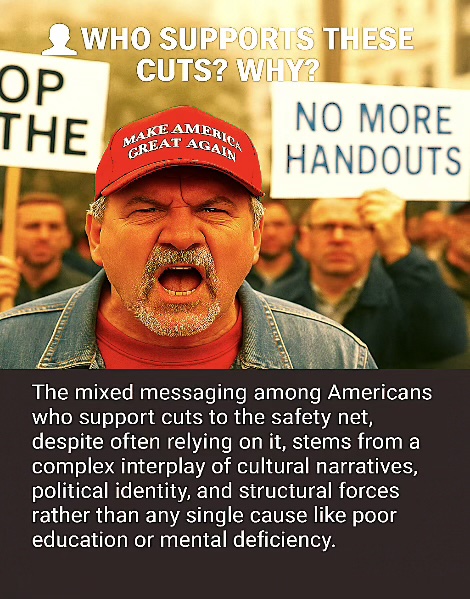
The mixed messaging among Americans who support cuts to the safety net, despite often relying on it, is not rooted in ignorance or incapacity, rather it is a byproduct of a relentless drumbeat of cultural mythmaking, partisan loyalty and economic vulnerability.
At its core is economic individualism, a deeply rooted American ethos that valorizes self-reliance and frames success as a personal achievement rather than a collective outcome. This belief system can lead individuals to view their own use of benefits as temporary or ‘earned,’ while casting others’ reliance as lazy or undeserving. It’s not necessarily hypocrisy; it’s a psychological distancing mechanism.
Layered onto that is status anxiety, particularly among white, working-class Americans who feel their cultural and economic dominance slipping. This anxiety often manifests as cultural resentment, where safety net programs are perceived as disproportionately benefiting racial minorities or immigrants, “others” who are seen as threats to a shrinking piece of the pie.
Religious and regional ideologies also play a role. In many evangelical communities, there’s a strong emphasis on charity through the church rather than government, and a belief that moral behavior, not structural support, should determine outcomes. Meanwhile, rural voters in the South and Midwest, who often live in areas with weaker safety nets, may distrust federal programs due to long-standing narratives about government overreach and inefficiency.
Education factors in, not in the sense of intelligence but rather, it’s about exposure to diverse perspectives and critical engagement with structural inequality. Those without college degrees are statistically more likely to absorb populist or nationalist messaging that frames government aid as a zero-sum game.
Finally, partisan identity has become a powerful filter. Many middle-income Republicans earning under $70,000 support cuts because their political identity is tied to fiscal conservatism and anti-welfare rhetoric, even when it contradicts their material interests. As Darrell M. West, a Senior Fellow at the Brookings Institution stated in his April 2025 commentary titled, Do Americans Really Want a Policy Revolution? “…ideology often trumps self-interest when it comes to social policy.” It is not a matter of deficiency; it’s a matter of narrative. And those narratives are powerful enough to override lived experience.
Support for Republican tax cuts, particularly those extending or expanding the 2017 Tax Cuts and Jobs Act—tend to cluster around specific demographic and psychographic profiles.
???? Demographic Profile of Supporters
| Category | Key Characteristics |
| Gender | Slightly more men than women support Republican tax cuts. In a 2024 Pew survey, 56% of men favored extending the 2017 tax cuts vs. 44% of women. |
| Age | Support is strongest among older adults, especially those 55 and older, who are more likely to prioritize low taxes and fiscal conservatism. |
| Geography | High support in rural areas, especially in the South and Midwest. States like Texas, Oklahoma, and Indiana show strong alignment with GOP tax policy. |
| Income | While the tax cuts disproportionately benefit the wealthy, middle-income earners ($50K–$100K) also support them. Many believe they’ll avoid tax hikes or benefit from deductions. |
| Employment | Support is common among small business owners, self-employed individuals, and blue-collar workers who value economic autonomy and lower business taxes. |
| Education | Those without a college degree are more likely to support the cuts, often aligning with broader Republican messaging on taxes and government overreach. |
???? Psychographic Drivers
Support for the Trump administration’s recent legislation, including sweeping tax cuts and major reductions to safety net programs, reflects complex psychographic factors that often override self-interest.
Economic individualism remains a core driver, with 65 percent of Trump supporters subscribing to a “you earn what you deserve” ethos, despite the fact that the top 1 percent received $51,140 annually in tax relief under previous GOP legislation, while the bottom 20 percent saw just $60.
Among white, working-class men, status anxiety fuels perceptions of cultural loss, with 68 percent believing the American way of life needs protecting and nearly half reporting they “feel like strangers in their own country.” Deep distrust of government is another catalyst: just 22 percent of Americans trust federal institutions to act in their interest, a figure that drops to 11 percent among Republicans, making cuts to public programs appear as a justified attempt to “starve the beast.”
Cultural resentment remains potent; over 50 percent of white working-class voters believe discrimination against whites is now as severe as that against minorities, intensifying opposition to aid programs perceived as favoring “others,” even when these same voters rely on benefits like SNAP or Medicaid.
Lastly, partisan loyalty reinforces support for tax reforms, with 85 percent of white evangelicals identifying with the GOP, often viewing tax policy as an ideological statement rather than a material calculation. These attitudes reveal a voter landscape driven less by economic rationality than by identity, perception, and cultural allegiance, with clear implications for market forecasting and regulatory stability.
???? Stealing from the Poor to Enrich the Rich
President Trump’s “One Big Beautiful Bill” has triggered a dramatic redistribution of resources, enriching the top 10 percent while stripping support from the bottom 90 percent. The legislation makes permanent the 2017 tax cuts, delivering $12,000 annually to the wealthiest, while the bottom 10 percent lose $1,600. Households earning under $13,350 will see incomes drop by 2.9 percent, while those over $120,000 gain 2.2 percent.
Despite claims of “wasteful spending,” 60 percent of SNAP recipients live in working households; 71.3 million rely on Medicaid; and 40 percent of retirees depend solely on Social Security. Cuts include $230 billion from SNAP, $1 trillion from Medicaid, and $50.4 billion from rural hospital funding, risking coverage for 11.8 million people and closure of 300+ hospitals.
Meanwhile, lobbying firms and corporations surged. Ballard Partners earned $14 million in Q1 2025, representing 130+ clients including JPMorgan and Chevron. The top 1 percent, already receiving $64,000 to $90,000 in annual tax breaks, stand to gain even more.
This legislation doesn’t just reveal a policy choice; it draws a line in the sand. The U.S. is not drifting but decisively steering toward the dismantling of public welfare. The evidence is unambiguous. Gutting safety nets isn’t just morally indefensible, it’s economically short-sighted and politically reckless.
© Dr.Elinor.Garely, InMyPersonalOpinion.Life.2025]. All rights reserved. No part of this content may be reproduced, distributed, or used without permission. For inquiries, contact EG@InMyPersonalOpinion.Life