
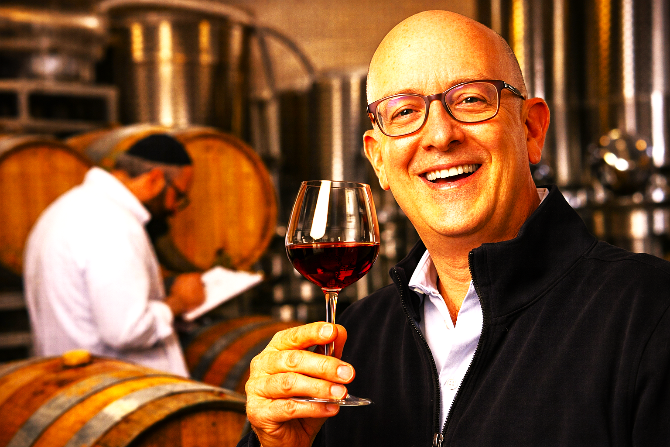
Dr. Elinor Garely
Kosher Is a Process, Not a Flavor Profile
From a technical standpoint, Lourie is clear that kosher status does not dictate flavor. “From a technical standpoint, making kosher wine does not require changing the fundamentals of good winemaking,” he explains. “It requires that the process be carried out within a defined religious framework under supervision.” The biggest operational shift is human, not chemical: “Once the grapes or juice reach the relevant stage, handling must be done by Sabbath-observant personnel. That changes staffing and workflow design more than it changes the wine itself.”
Does this limit creativity? “In my experience, once the systems are in place, it becomes operationally manageable,” he says. “A serious winery can build procedures that protect both halachic integrity and winemaking precision.” For the trade, he insists on a simple message: “Kosher is not a separate enological category. It is a production framework, and quality depends on the same things it always depends on: fruit, timing, hygiene, extraction judgment, élevage, and blending discipline.”
On mevushal, he notes Shiloh’s public positioning. “On mevushal wine, Shiloh is publicly associated with a flash-pasteurization approach,” Lourie says, “and the winery has earned recognition precisely because its mevushal and non-mevushal wines have both performed strongly in competition.”
How to Frame Shiloh on a Serious Wine List
How should a serious sommelier frame these wines? “If a sommelier lists Shiloh alongside Bordeaux or Napa, the most honest framing is not to force a one-to-one comparison,” Lourie suggests, “but to say that these are mountain-grown Israeli wines with Mediterranean light, limestone structure, and New World confidence in fruit expression.”
“At the table, the wines are extremely strong with Levantine and broader Mediterranean cuisines,” he says, “because the herbal, savory, olive-oil, spice, and grilled elements in those cuisines meet the wines naturally.” But he pushes back on the idea that they pair only with regional cuisine. “That is not the limit,” he adds. “Our Cabernet-based wines and upper-tier cuvées can also perform beautifully with classic French dishes and with modern tasting menus that lean into umami, provided the sommelier understands the wine’s texture and serving context.”
The Bull That Means Something: Shor and Its Lineage
The bull on Shiloh’s labels is not a marketing flourish. “The bull, or shor, is the symbol of the Tribe of Joseph and is central to the iconography of Shiloh Winery,” Lourie explains. “Publicly, the winery has explained that the ox or bull is tied directly to that tribal heritage.”
Stylistically, Shor has a clear brief. “I would say the Shor series represents clarity, generosity, and immediacy,” he says. “It is not meant to imitate the deepest reserve bottlings. It is meant to give a sommelier a wine that is articulate, fruit-forward, typic, and highly useful on the floor.” His suggested positioning is straightforward: “Shor should be positioned tableside as the more accessible, expressive, earlier-drinking tier, while Secret Reserve is the more layered, cellar-worthy, terroir-driven conversation.” As he notes, “Public descriptions of the portfolio support exactly that distinction, with Shor framed as varietal and fruit-forward, and Secret Reserve as elegant, complex, and built from the top sites.
Climate Pressure and the New Threshold of Precision
“Climate warming is not abstract for us,” Lourie says. “In the Judean Hills, one of the first signs is often earlier harvest timing, but over time it can also challenge acid retention, phenolic pacing, and stylistic consistency.”
“That does not mean the region is suddenly unsuitable,” he cautions. “In fact, high-elevation Judean Hills vineyards still have meaningful adaptive advantages.” The future, he believes, will be written in choices: “The future will depend on intelligent site choice, clonal selection, canopy strategy, and possibly a continued move toward varieties or rootstocks that retain balance under more compressed ripening conditions. In other words, climate change does not erase the promise of the Judean Hills; it raises the threshold of precision required to express it.”
Not a Curiosity: A Winery Asking to Be Judged Seriously. A Serious Seat at the Table
“What I would want the sommelier community to understand is that Shiloh is not asking for indulgence as a curiosity from an ancient land,” Lourie concludes. “We are asking to be judged seriously, because the raw materials are serious: altitude, limestone, light, diurnal contrast, disciplined viticulture, and a growing body of wines that have shown quality both domestically and internationally.”
“Shiloh was founded in 2005,” he notes, “and over a relatively short period it has built a portfolio that ranges from Shor through Secret Reserve to Mosaic, with the technical confidence to produce both mevushal and non-mevushal wines at a high level.” For him, the larger story is about a region coming into its own. “Israeli wine is no longer a sidebar conversation,” he says. “For those willing to taste without prejudice, the Judean Hills are one of the most compelling mountain Mediterranean wine zones in the world.”
© 2026 Dr. Elinor Garely / InMyPersonalOpinion.Life Protected by U.S. & international copyright + DMCA. No reproduction, reposting, redistribution, adaptation, or AI training allowed. Brief quotes only with full credit + link. Permissions: EG@InMyPersonalOpinion.Life
000