
At Shiloh, Amichai Lourie Turns the Judean Hills Into a Vineyard of Ambition
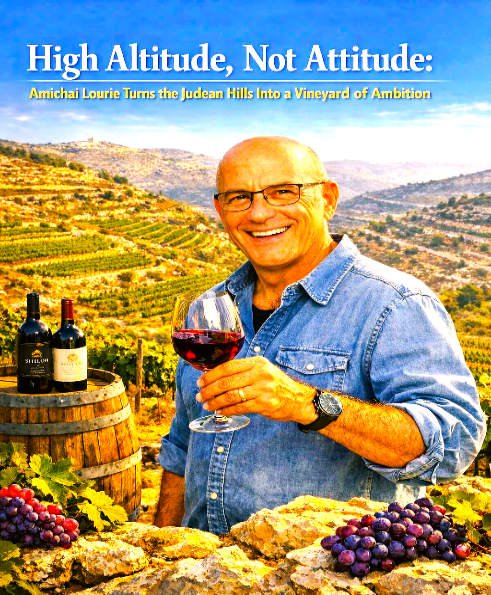
Where Israel’s First Step Is Everyone Else’s Finish Line
Dr. Elinor Garely
Amichai Lourie is clear: Shiloh is not asking for indulgence as a curiosity from an ancient land; it is asking to be judged alongside the serious wines of the world.
This story was developed from a one-to-one, in-depth interview with Amichai Lourie, Winemaker and CEO of Shiloh Winery, during his recent visit to New York City, where he shared his insights on the Judean Hills, Shiloh’s philosophy, and the future of Israeli wine exclusively with InMyPersonalOpinion.Life.
Orientation: Judean Hills, Not a Curiosity
“I would describe the Judean Hills as a high-altitude Mediterranean mountain region with real structural tension in the wines,” says Amichai Lourie, Winemaker at Shiloh Winery. He notes that Shiloh’s vineyards sit “generally in the 650-to-900-meter range, planted on shallow terra rossa over limestone, with a climate shaped by strong sun, low humidity, Mediterranean influence, and cool nights.” These, he stresses, “are not romantic descriptors; they are the core technical conditions that define the profile of the wines.”
“That elevation materially affects the maturation cycle,” he explains. “It gives us more hang time than many people assume when they hear ‘Israel.’ We still have intense daylight and full ripening potential, but the cooler nights help slow respiration, preserve freshness, and extend phenolic development.” The practical result: “It allows us to pursue fruit ripeness without automatically sacrificing structure.”
The soil is equally non-negotiable. “We work with shallow terra rossa clay over hard limestone bedrock, and the stoniness of the sites is not incidental,” Lourie emphasizes. “It affects vigor, drainage, rooting behavior, and water strategy. The clay fraction can retain enough moisture to support the vine, while the limestone component contributes to a more restrained, linear architecture in the finished wines. It is not easy ground, but difficulty is often part of what gives a vineyard its voice.”
What separates the Judean Hills from Israel’s coastal plain? “Exactly that combination of altitude, lower humidity, and stronger diurnal movement,” he says. “The coastal plain is warmer and more humid. In the Judean Hills, especially at elevation, the nights pull temperatures down enough to protect acidity and aromatic definition.” He cites annual rainfall “often in the 500–600 mm range,” but winter-weighted: “Summer farming is still fundamentally an exercise in precision water management.”
Stylistic Alignment: Toward a Levantine Identity
Asked how Shiloh fits into global benchmarks, Lourie resists easy comparisons. “If I had to answer honestly, I would say Shiloh does not fit neatly into a single imported comparison model,” he says. “There are moments where a sommelier might see a Mediterranean echo, and other moments where the wines show the concentration and mountain-fruit profile that people associate with certain New World elevated sites.”
“But I believe a distinct Levantine identity is emerging, and it should not be reduced to imitation,” he continues. “Our sunlight, our limestone, our dryness, our religious and agricultural context, and our regional history create a different equation.” When the wines are right, he says, “they combine ripeness with lift, density with brightness, and Mediterranean savory notes with mountain-grown structure. That combination is increasingly the signature of serious Israeli wine.”
Varietal Logic: Cabernet, Syrah, Petit Verdot and Beyond
For Shiloh, certain grapes make obvious sense. “Cabernet Sauvignon and Syrah remain central for very practical reasons: they respond well to our climate, they can handle solar intensity, and they give us reliable quality in a terroir that rewards concentration without necessarily producing heaviness,” Lourie explains. “The Judean Hills have shown repeatedly that Bordeaux grapes and Syrah can perform at a very high level, and the success of our Secret Reserve Cabernet Sauvignon reflects that fit.” He adds, “Also with the Petit Verdot and the Petit Verdot Secret Reserve, both extraordinary wines with aging abilities, this is where we have proven time and time again that we are able to make outstanding wine with that variety that most vineyards are not able to, making Shiloh stand out in the wine world.”
He is not, however, confined to international staples. “I do not think the future of Israeli wine is limited to the international canon,” he says. “The wider region is showing renewed interest in Mediterranean varieties such as Carignan, and I think that is healthy.” Within Shiloh’s Shor range, he has experimented broadly: “Our own Shor range has also included less expected material, such as Barbera, because I am interested in varieties that can express freshness and character under our conditions rather than simply repeat a formula.”
On ripening dynamics, he singles out two varieties. “In terms of reliable ripening, Cabernet Sauvignon and Petit Verdot give us tremendous authority when the site and crop load are right,” he notes, “but Petit Verdot is often especially compelling under our solar conditions because it can reach not only sugar ripeness but also aromatic and phenolic harmony without losing its energy.” The deciding factors are not analytic numbers alone: “The key, however, is never brix alone. In our environment, skin maturity, tannin texture, and the pace of seed lignification are what determine whether a block is truly ready.”
Managing Heat and Preserving Acidity
“Preserving acidity in Israel is always an active decision,” Lourie says. “Elevation is absolutely one of our major tools, but it is not enough by itself. You also need disciplined canopy management, crop balance, and harvest timing that is based on taste and texture, not simply chemistry.”
“Our aim is not to delay picking indefinitely in search of maximum weight,” he stresses. “It is to harvest at the point where fruit intensity, natural acidity, tannin ripeness, and site expression still sit in balance.” In very bright, hot vintages, shade becomes crucial. “Shade management becomes critical,” he notes. “Too much exposure can push fruit into over ripeness and flatten the wine; too much canopy can delay phenolic maturity or create unevenness. So, the answer is not one tool, but the interaction of altitude, canopy architecture, and timing.”
Irrigation as a Terroir Tool
“In Israel, irrigation is not a philosophical question; it is part of reality,” Lourie says plainly. “The more serious question is how to use it so that it supports, rather than erases, terroir.” His position is unequivocal: “In my view, precision drip irrigation can absolutely enhance site expression because it keeps the vine functioning within an intentional stress window. In our climate, unmanaged water deficit can shut the vine down or distort ripening.”
“I do not see responsible irrigation as anti-terroir,” he continues. “I see it as the tool that allows the site to speak more clearly in a semi-arid environment.” The real risk lies elsewhere: “What would mute site expression is over-irrigation, because then the vine stops struggling in the right way. Precision is everything. You want enough water to maintain physiological balance, but not enough to wash out distinction or homogenize the vintage.”
His team, he says, is deeply embedded in the vineyards. “My team lives in the vineyard during the season in each vineyard,” Lourie explains, “and additional technology is used such as drones and satellites and special rod used for irrigation. We also test the leaves to see the level of irrigation and still with all that technology the decision is still made by humans in the vineyards. I trust my instinct while these tools do assist.”
Shmita: Halacha Meets Vineyard Logistics
For many sommeliers, Shmita is an abstraction; for Shiloh, it is operational reality. “For readers unfamiliar with Jewish agricultural law, the Shmita year is the sabbatical year in which the land in Israel is subject to significant religious restrictions,” Lourie explains. “In simple terms, sowing, planting, pruning, and harvesting are not business-as-usual decisions in that cycle. Operationally, it requires long-range planning, halachic supervision, and a different relationship to the vineyard calendar.”
“At Shiloh, this is not theoretical,” he emphasizes. “Publicly, the winery has emphasized that Shmita, as well as other agricultural mitzvot such as tithes, are part of how it lives its identity. That means the sabbatical year has real logistical and commercial implications, from vineyard practice to inventory strategy to what is available in a given release cycle.”
Vintage Variation: Heat, Pace, and Balance
“Vintage variation in the Judean Hills is real, but it expresses itself differently than in a maritime region such as Bordeaux,” Lourie notes. “In Bordeaux, rainfall pressure, disease pressure, and flowering conditions can dominate the narrative. Here, the major variables are more often heat spikes, timing of heat events, water status, and the exact length of the ripening window, alongside occasional cold events.”
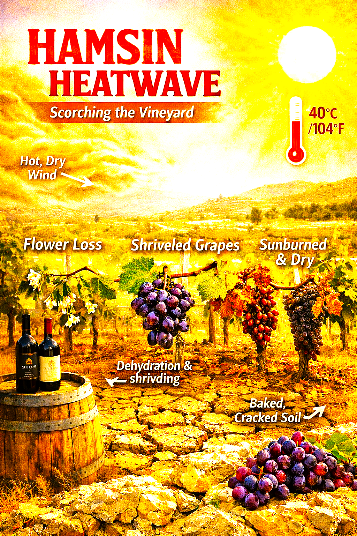
“A late spring frost can matter in some higher or exposed sites,” he says, “but the more dramatic influence on flagship wines is often the hamsin-style heat event at the wrong moment. If severe heat arrives during a sensitive ripening phase, acids can fall quickly and skins can race ahead of seeds, or vice versa.” When he talks about vintage differences, he is usually talking about tempo rather than temperature alone: “We are often talking about pace, compression, and balance under heat, not simply whether the year was ‘warm’ or ‘cool.’” “That said,” he adds, “our unique terroir makes all these challenges inexistent. That is how we are able to be very consistent year after year.”
Oak Philosophy: Architecture, Not Cosmetics
“Our philosophy with oak is to support structure and complexity, not to bury the vineyard,” Lourie says. Shiloh has, for example, described wines such as Shor Barbera as “being aged in a combination of French and American oak,” but for him, the wood is structural, not decorative. “Across the portfolio we have always treated oak as part of the architecture of the wine rather than a cosmetic layer.”
In the upper tiers, he is very much in tune with global shifts. “In the premium tiers, especially Secret Reserve and above, the world trend toward greater transparency is absolutely relevant,” he says. “The question is not whether oak matters, but whether it amplifies or obscures.” His instinct? “Top wines today benefit from more restraint than in earlier eras of global winemaking.” Stylistically, he sums it up succinctly: “Elegance through control, not volume through oak.”
Shiloh Where Kosher is a Flavor Profile
Lourie’s insistence on altitude, precision farming, and a distinctly Levantine identity is only half the story; for Shiloh, the technical vineyard discipline and the spiritual framework of Shmita, kashrut, and agricultural mitzvot are inseparable parts of the same ambition.
In Part 2, “Kosher, Mevushal, and Myth: Amichai Lourie Sets the Record Straight” he turns directly to the kosher dimension of his work, unpacking how halacha, Shmita, and rigorous kashrut standards shape not only Shiloh’s operations, but the very definition of what a serious kosher wine can be.
© 2026 Dr. Elinor Garely / InMyPersonalOpinion.Life. Protected by U.S. & international copyright + DMCA. No reproduction, reposting, redistribution, adaptation, or AI training allowed. Brief quotes only with full credit + link. Permissions: EG@InMyPersonalOpinion.Life
000