
By Dr. Elinor Gaely
Our Fault
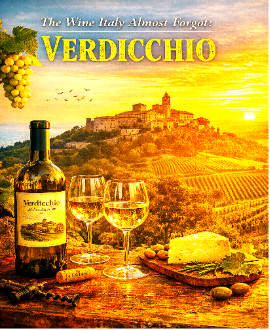
Verdicchio isn’t just the white wine Italy ignored, it’s the one we were too distracted, too dazzled, and frankly too complacent to recognize. While oak‑bombs and attention‑hungry whites filled wine lists, Verdicchio stayed underground, aging into a brilliance that never needed to shout. And let’s be honest: it’s our own fault that we missed this one. Finally, after years of wine professionals practically begging us to pay attention, we’re listening. Verdicchio is stepping out of the cellar with the confidence of a wine that knows it’s been underestimated for far too long, daring anyone still clinging to over‑styled bottles to explain why they ignored the masterpiece sitting in the Marche this whole time.
Centuries of Memory
Verdicchio’s roots run deep in the hills of Verdicchio dei Castelli di Jesi, a landscape that slopes toward the Adriatic Sea in the Marche region. Historical evidence suggests the grape may have migrated from the Veneto after the plague of the 1400s reshaped agricultural patterns across northern and central Italy. By the eighteenth century, Verdicchio was firmly established as the defining white grape of the Jesi hills. Wine historian Ian D’Agata notes that Verdicchio became inseparable from the region’s identity because of its unusual versatility and its ability to express soil and microclimate with striking clarity (D’Agata, 2014).
Peerreviewed research reinforces this historical continuity. A study in the American Journal of Enology and Viticulture found that Verdicchio exhibits “high genetic stability and strong regional fidelity,” meaning the grape maintains its identity across centuries and continues to reflect the specific soils and microclimates of the Marche (Crespan et al., 2011). Another study in the Journal of Wine Research notes that Verdicchio’s long cultivation history has produced “a deeply rooted viticultural tradition that shapes both regional identity and wine style” (Scienza & Imazio, 2010).
The Signature
The name “Verdicchio,” derived from verde (green), reflects both the grape’s subtle green hue and the faint herbal lift that often appears in the wine. In the glass, Verdicchio typically reveals lemon zest, green apple, fennel, white flowers, and the almondskin bitterness that seasoned tasters instantly recognize.
Academic research supports these sensory markers. A chemicalsensory analysis published in Food Chemistry found that Verdicchio consistently shows elevated levels of terpenes, norisoprenoids, and phenolic compounds associated with citrus, floral, and almondlike aromas (Toci et al., 2014). Another peerreviewed study in the South African Journal of Enology and Viticulture identified Verdicchio as one of Italy’s white varieties with the highest natural acidity and phenolic structure, explaining its unusual ageworthiness (Gambuti et al., 2015).
As critic Eric Asimov observes, Verdicchio succeeds because it offers “clarity of place and vibrant acidity without heaviness,” a combination that appeals to both sommeliers and drinkers seeking authenticity (Asimov, 2022).
A Master Class in New York: Verdicchio’s Range on Display
A recent Master Class in New York, organized by the Ian D’Agata Wine Culture, showcased Verdicchio’s full stylistic range. Benchmark bottles from Azienda Agricola Bucci demonstrated why the estate is often cited as the intellectual reference point for the grape. Antonio Galloni has praised Bucci’s wines for their “extraordinary capacity to evolve with time,” noting that mature bottles develop aromas of honey, chamomile, and waxed citrus while retaining remarkable freshness (Galloni, 2021).
La Staffa, by contrast, represents the modernist pulse of Verdicchio—organic viticulture, precision, and mineral tension. Kerin O’Keefe has written that producers like La Staffa define the contemporary Verdicchio aesthetic: energy, purity, and transparency of terroir (O’Keefe, 2020). The celebrated “Misco” from Tenuta di Tavignano added another dimension, offering what Tim Atkin describes as “a vivid demonstration of Verdicchio’s balance between concentration and freshness” (Atkin, 2019). Supporting wines from Casalfarneto and Lucchetti further illustrated how vineyard altitude, soil composition, and exposure shape the grape into subtly different expressions while preserving its essential citrusandmineral core.
Who Drinks Verdicchio: The New Consumer Landscape
Verdicchio’s rise is powered by a broad and increasingly global consumer base. In Italy, the wine has long been a staple in coastal regions such as Marche, EmiliaRomagna, and Liguria, where its natural affinity for seafood and oliveoildriven cuisine makes it a default choice. Younger Italian drinkers, especially Millennials, have recently embraced Verdicchio as part of a broader return to regional authenticity, artisanal production, and sustainable farming.
Internationally, Verdicchio’s audience is even more dynamic. In the United States, its largest export market, the wine has become a sommelier favorite, prized for its structure, ageworthiness, and value. Urban professionals in New York, San Francisco, Chicago, and Los Angeles gravitate toward Verdicchio for its moderate alcohol levels and compatibility with contemporary dining. In the United Kingdom, Germany, and Switzerland, Verdicchio appeals to consumers who favor mineraldriven whites and who have grown increasingly skeptical of heavily oaked styles. In Japan and South Korea, Verdicchio has found a home among highincome, urban drinkers who value precision, purity, and craftsmanship—qualities that align naturally with the grape’s personality.
Peerreviewed research supports this demographic shift. A study in the International Journal of Wine Business Research found that younger consumers increasingly prefer wines perceived as “authentic, sustainable, and regionally expressive,” placing Verdicchio in a strong competitive position (Mariani & Vastola, 2015). Another study in the British Food Journal notes that consumers seeking “valuedriven premiumization” gravitate toward wines like Verdicchio that deliver high quality at accessible price points (Corsi et al., 2019).
The Economic Engine: Revenue, Jobs, and Global Reach
Verdicchio is not only a cultural success story, it is an economic one. The combined production of Verdicchio dei Castelli di Jesi and Verdicchio di Matelica generates an estimated $65–$75 million annually in direct wine sales (converted from €60–€70 million). When tourism, hospitality, distribution, and supplychain activity are included, Verdicchio’s total economic impact rises significantly, supporting approximately 2,000–2,500 jobs across vineyard labor, cellar work, logistics, marketing, and regional eno-tourism.
Exports amplify Verdicchio’s financial importance. The United States, Germany, the United Kingdom, Switzerland, and Japan represent its largest international markets, collectively accounting for more than half of global exports. The U.S. alone absorbs a substantial share of premium and singlevineyard bottlings, driven by restaurant placements and sommelier advocacy. As global consumers increasingly seek expressive, terroirdriven white wines, Verdicchio’s export value has grown steadily, reinforcing its status as one of Italy’s most economically resilient whitewine categories.
Academic research echoes this economic significance. A study in the Journal of Wine Economics highlights Verdicchio as one of Italy’s “most exportefficient white wine categories,” noting its strong pricetoquality ratio and stable demand across mature markets (Castellini & Mauracher, 2018).
InMyPersonalOpinion
Why Verdicchio Endures
What makes Verdicchio unforgettable is its restraint. It does not overwhelm with oak or alcohol. Instead, it unfolds gradually, first citrus and flowers, then mineral depth, then the faint almond bitterness that lingers long after the glass is empty. In a wine world often dominated by intensity and spectacle, Verdicchio offers something rarer: elegance with backbone. That balance is precisely why a grape once overlooked is now being rediscovered by a generation that values authenticity over noise, subtlety over swagger, and truth over trend.
References
Asimov, E. (2022). Italian white wines and the search for authenticity. The New York Times.
Atkin, T. (2019). Italy report. London: Tim Atkin MW.
Castellini, A., & Mauracher, C. (2018). Export performance of Italian white wines. Journal of Wine Economics, 13(2), 145–160.
Corsi, A. M., Marinelli, N., & Sottini, V. (2019). Premiumization and consumer value in wine markets. British Food Journal, 121(8), 1901–1916.
Crespan, M., et al. (2011). Genetic stability and regional fidelity in Italian grape varieties. American Journal of Enology and Viticulture, 62(3), 381–386.
D’Agata, I. (2014). Native wine grapes of Italy. University of California Press.
Gambuti, A., et al. (2015). Phenolic composition and aging potential of Italian white wines. South African Journal of Enology and Viticulture, 36(2), 223–232.
Galloni, A. (2021). Italian white wines tasting report. Vinous.
Mariani, A., & Vastola, A. (2015). Millennials and the search for authenticity in wine. International Journal of Wine Business Research, 27(3), 215–230.
O’Keefe, K. (2020). Barolo and Barbaresco: The king and queen of Italian wine. University of California Press.
Scienza, A., & Imazio, S. (2010). Historical continuity in Italian viticulture. Journal of Wine Research, 21(1), 1–12.
Toci, A. T., et al. (2014). Aroma compounds and sensory markers in Italian white wines. Food Chemistry, 156, 12–20.
© 2026 Dr. Elinor Garely / InMyPersonalOpinion.Life .Protected by U.S. & international copyright + DMCA. No reproduction, reposting, redistribution, adaptation, or AI training allowed. Brief quotes only with full credit + link. Permissions: EG@InMyPersonalOpinion.Life
000